

The Conclave - Writing
Revelations is offering a unique opportunity for open discussion between Clive and his fans. Here is your space - a place to discuss topics relating to Clive's works where your thoughts will be posted ahead of our next interview with Clive. Having seen the entries posted here, we'll be encouraging Clive to join the discussion, respond to your observations and and to add his own thoughts..!We hope to foster intelligent and informed debate, so 'play nicely', send us your thoughts (and maybe the specific piece of text) by e-mail (with 'The Conclave' in the header) and we'll put your unedited words in front of Clive...
What pieces of Clive's writing do you find most interesting - what would be in your 'Best Of' collection if there were ever to be an "Essential Clive Barker - The Fan's Volume"..?
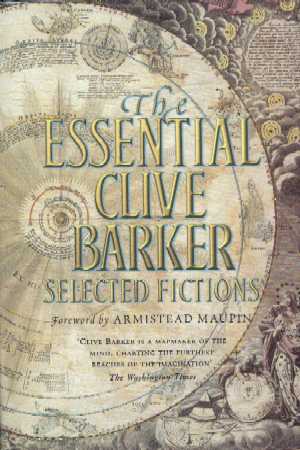
"[Creating The Essential Clive Barker] was very much about making a book which would in a way introduce new readers to the range of what I'm up to, the horror fiction, obviously, the fantasy fiction, the stuff for kids, and maybe indicating for readers who are already familiar with my stuff, the work that I really like. So it was a way of sort of saying 'Look, this is the stuff I really enjoy. This is, as far as I'm concerned, the cream of the crop where my writing is concerned.' And obviously there's gonna be disagreement there. There's gonna be people who are gonna say that they prefer one piece over another. And even I would say that there are absentees from the book. There are things that I would have liked to have seen in there, which we didn't have, room for. But nevertheless it's a broadstroke introduction to Clive Barker and it seems to be functioning well that way.
"It's the sort of the mid-career retrospective, if this was a painting analogy. It's something that says 'This is the stuff which I like. This is the stuff I'd like to be judged on so far.' And more important than that, 'Here's an introduction to the books for people who are perhaps not familiar with various aspects of my work. Here's teasers and tasters."
Clive Barker (Part Two)
By Spence D, IGN For Men, 20 December 1999David: "I’m not sure if it’s something Barker speaks of regarding his work, but I was just wondering if there was anything he’s said about the ‘acceptability’ of lesbian rather than gay sex in his novels and in society as a whole. I noticed it mentioned, mostly in passing, in the Revelations interviews but he’s never really explored this to my satisfaction in those interviews or anywhere else that I’ve seen. I’m aware that for the past several decades the US and most other countries have been going through a period of ‘lesbian chic’ which explains this phenomenon to some extent, but I still don’t entirely understand it. For myself, I’m a heterosexual male without any interest or inclination toward homosexuality, but I find Barker’s work sensual and powerful regardless of the sexual combinations of people, places, and things. I think it’s unfortunate that people close their minds to homosexual relationships (or any relationship for that matter) calling them either adolescent at best (lesbian relationships mostly) or disgusting at worst and thereby cutting their cultural exposure substantially.
"I’ve found most of the relationships in Barker’s work to be beautiful in their own way. For example: Marty, Whitehead, Carys and Mamoulian in The Damnation Game, in their strange four-way configurations; the same four-way configuration in Coldheart Canyon with Todd, Katya, Tammy, and Maxine. It seems there is a repetition of those 4-way relational configurations which I never really thought about until just now, typing it up. Even The Hellbound Heart had 4 at its center, with Larry, Julia, Kirsty, and Frank. This rule of 4 is odd and for me, unexpected. Especially considering Imajica starts with a description of 3’s being the most important relationships on and off the stage. At any rate, I’ve digressed substantially. In reading Barker’s works, I’ve found Sacrament to be the most memorable book of his primarily because it let me see relationships from a viewpoint that is rarely acceptable in the US. I don’t think I’d want to take a ride on the Tower of Power, but I certainly have a better grasp of the beauty available in all relationships, not just those that are considered ‘average’ or ‘normal’."
11 July 2006David Lynton: "What can I say but thank you Clive for doing what you do, with passion, originality and love. I just re-read Sacrament, and having just had a baby daughter arrive, your character Will’s musings on nostalgia and memory on his childhood struck a powerful chord with me now my life has changed so magically. When I first discovered The Books of Blood (through a Fangoria interview) I was intrigued and recognized something in your words that continues up until this day. Your writing transformed me in some way, and introduced a magic into my life that I will love and respect forever. I await your next book and the next and the next, with anticipation. Thank you for giving the fantastic such a fabulous breath of life. All the best forever."
18 July 2006ZXG:
My Collection
"When considering the body of work by any artist in any field for a ‘best of’ collection is a daunting task relying mainly on opinion, sales, and pop-culture. When considering an artist whose body of work covers more than one field the task becomes seemingly impossible. However insurmountable it may appear, there is a way to accomplish the task by sorting the works by art form and at this moment in time, this artist falls into three.
"Clive Barker spins yarns, ink images, and constructs cinema from a unique perspective that proselytizes and addicts or vulcanizes and repulses, all while crossing the defined lines of genre. Any complete volume would encompass a variety of media which might be rather cumbersome. It would include copious amounts of prose, several DVD’s, and high-quality reproductions of paintings, drawings, photographs. Fortunately, a multiple DVD-ROM set relieves the burden of producing such a massive collection in its traditional media. The full-length versions commonly referred to as director’s cuts, unabridged tomes, and vibrant images, available with the press of a key.
"The works selected from each genre testifying of the development, from the critical first break through to arrival as an established artist, is not the ultimate fan Bible. No, this collection contains works that deeply touched, caused reflection, and shocked while fueling their dependence. Gone are the expected commercial successes and the obligatory footnotes of a humble beginning that all ‘best of’ collections contain. Excluded are the political interpretations, psychological speculations, and contemporary symbolism that purport to explain what makes the work phenomenal. As true fan’s collection allows the observer to see the works in the unbiased, un-dissected, unedited state which initially captured the curiosity of the manuscript marauder cruising the stacks. The only addition to the collection, completing its construction, might be the most coveted piece of all: an epilogue or proem by the artist. As a fan, every work that Mr. Barker produces should be included as an encyclopedia. As a printer, the Barker Encyclopedia would be a dream job to print. As a publisher, there are financial considerations amongst others in producing a ‘Fan’ directed collection. Understanding all of the above positions, here are humble suggestions for a ‘Fan’s Volume’.
The List
In this order: • Sacrament • The Thief of Always • The Hellbound Heart—audio book (read by Clive Barker) • The Imajica • The Yattering and Jack • Galilee • Rare Flesh (David Armstrong, text by Barker) • The History of the Devil • Weaveworld • Explore the worlds of Barkerverse from here"
21 July 2006Camden Natysin: "I've often found that some of the best moments in Clive's fiction are some of the most simplistic, yet they're beauty is staggering. My prime example of this is a scene from the wonderful Sacrament, where Will talks to Patrick as he lays dying, and then finally gets to it. It's just that simple moment where Patrick says: "Then...always." and dies. It's one of the most beautiful moments I've ever encountered in any book, and I love how Clive can get so much out of so little, like a poet.
"It often seems that whenever I start a Clive Barker book, I'm at first not liking it because it wasn't as impressive as the one I read before, but by the end I absolutely love it, and am saddened by the fact that I've finished reading it. The last of these was 'Weaveworld'. I was about 180 pages into it before it finally clicked with me, but when it did, I was utterly enamored. I felt emotionally involved with the characters in a way I hadn't with any of his others, and every word captivated me, and I often would re-read sentences to get as much out of them as I could.
"I think that Weaveworld, out of all of Clive's novels that I've read, probably has the best and most satisfying conclusion. It was rightfully beautiful, inspiring and upbeat, and it really fit a story like that one. Out of the others I've read, Cabal was the only other one which I think ended perfectly. The Damnation Game really should've ended a bit before it did. The whole bit with Marty figuring the European was still alive, and Carys being his vessel, just added unnecessary length to a novel that wanted to be done with. It may not have been much, but it made for an unsatisfying conclusion. It's still a wonderful, scary story, but I'm not fond of the ending. I'm probably wrong here, but I think perhaps Clive just didn't quite know where to take it.
"One of my few complaints about 'Sacrament' is that it seems Barker only called breasts "titties". I wouldn't mind so much, but it's the only name he has for them in the book, and he mentions them enough that it irks me everytime I see it. I just wish he'd slipped the word "breasts" in there at least 1/3 of the time. It just clashes with the beautiful nature of the book, and makes it seem a bit trashy. I don't think any of the sexual elements do that, just the word titties. I mean, it's how rednecks and pubescent boys refer to a woman's chest, and I don't think a great writer like Clive should've used it so much in one of his best books. I still love the book, but I thought that didn't fit well with the material.
"I'm very fond of the way Clive tackles sex and sexuality in his short stories, novels, and paintings. There are some people who use it simply as pornography, or to be shocking, but Clive really utilizes it to get us into the characters' heads. We feel their passions, we feel that they're real, we know their desires, and we know how they like to fuck. We are just as intimate with his characters as we might be with lovers. He can make sex romantic, but not in a cheesy way (though there was a kind of cheesy scene between Jerichau and Suzanna in Weaveworld), and he can also make it real. He also represented this well in the film 'Lord of Illusions. Knowing the characters so well can make a big difference in how effective plot turns are, and I think that is why his books are so successful with me. And the sexuality brings a slight realism to things, which really brings back a belief in the fantastical to the reader.
"When you're done with one of Clive's books, you feel just like Cal Mooney did after the Fugue was destroyed in 'Weaveworld'. You feel like you've been to Wonderland, but now you've lost it. Because of this I feel especially sad to have finished Weaveworld, and hope I can find the same beauty and magic in 'Imajica'."
21 July 2006ZXG:"What pieces of Clive's writing do you find most interesting?
"An elegant question which seduces the dedicated devotee to engage in political interpretation, psychological speculation, and contemporary symbolism in an attempt to communicate that which makes the artist’s work phenomenal, intriguing, and meaningful while soliciting a rare candor of the soul. Frankly expressing what the beholder’s eye sees to the maker is extraordinarily intimate and a potentially destructive catalyst. Therefore, it is with the best intentions and hopes that the maker change not his ways because of these words.
"Present in all the worlds of the Barker universe is an eerie sensation of realism, sense that there is something other permeating this reality just beyond the veil protecting our sanity. Populated with amazing creatures, exotic locations, and a little magic, all of these worlds stand shoulder to shoulder in the world that exists outside their covers. Unlike other authors whom transport the reader to another reality independent of Earth, Mr. Barker manipulates the veil of one’s existing reality on Earth permitting egress into other realities already present in the shadows.
In the Imajica, an assassin pursues a main character, encounters a person from the past, and takes the opportunity to engage in adult relations. In the contemporary setting, the assassin is not human which is not inconceivable as other authors have delegated sharks, dogs, robots, and space aliens to fill this role. In other fiction, the assassin cancels the contract, and after a few difficulties, rides off into the sunset happily ever after. Not significantly stretching the imagination as tabloid newspaper headlines and popular talk shows testify to daily reporting sorted romances, jealousy, and greed for entertainment.
Yet, in the Barker universe, this assassin possesses an exceptional ability unlike his contemporaries that teases the hem of the veil. Pie’oh’pah, the assassin, a shape-shifter who can be anything one desires with a sex organ that eludes explanation. Pie’oh’pah becomes the object of the person from his past desires—the woman he has been hired to kill—to indulge in his selfish need:“Only seemed, he knew. This was his sight-starved eyes’ invention. Yet it came again, a sinuous light, sleeking her, then going out.” “This time the iridescence when it came was almost bright, and fixed in his head the image of her…” “His eyes had been feeding on darkness and projections for too long, and now, presented with solid reality, they were befuddled. Concealed by shadow the woman was a mire of shifting forms—face blurred, body smeared, pulses of iridescence, slow now, passing from toes to head.” “Whatever power had ranged his senses, its bluff was called when he’d make contact with her.” “That hallucinatory chaos had been distressing, but the solid thing it had concealed appalled him more. Whatever sexual imagining seemed shaped in the darkness… all of them had been an illusion. The creature he’d coupled with, almost shot his load into, didn’t even share her sex.” “…the shock he felt now was fueled more by the power of the deceit worked upon him than by the sex of the deceiver.”
“Just as he unbuttoned and discarded the clothes that concealed the mystif’s essential sex, so he had to tear from his eyes the comfort of the illusions that lay between his sight and its object. What would he feel then? It was easy to be aroused by a creature so totally reconfigured by desire that it was indistinguishable from the thing desired.”
“He put his hand against the mystif’s sex. You could fuck or be fucked with this, right?
Yes.
And you could give birth?
I haven’t. But it’s been known.
And fertilize?
Yes.”
---Imajica"Consider no one can be all things to everyone and many spend significant time searching for and then settling with the closest equivalent. To this, add the increasing popularity of fetish/’abnormal’/fantasy sexual practices, its increasing openness and acceptance, and the chameleons that provide these services a shape shifting assassin becomes plausible. Individuals whom transform, feeding these appetites, conceivably might hail from another reality freely intermingling with this reality. It is the simple employment of possibility in conjunction with imagination that removes the fiction and fantasy of the character and compels lifting the veil if only for a peek.
" Another captivating ingredient in the Barker universe is the erotic current. This current flows ranging from innocent hand holding to massive orgies and includes all appetites. It is not unusual to encounter gratuitous sex between the cover, usually as filler in shoddily constructed plots comprised of predictable actions and thankfully, this is not the case.
"In the Barker universe, sex is delicious and—most important—sensual while inviting a glance at the exquisiteness concealed in the dark. It reaches deep into the mind where carnal thirsts clamor for the nectar of darker fruits. The imagery, crafted out of words, directs imagination to summon similar desires and latent emotions to complete them with your thoughts, as there are no constraints, limits, or morays except which you choose to impose. Here, in the Barker universe, eroticism exists on a level that relies more upon the mind than the body. This is a place where a fleeting smile, the note of laughter, a trace of perfume is the bliss.
"In Sacrament, Will’s encounters testify and transform him as he transforms in the story. Julia wields its promise as skillfully as her knife. In Coldheart Canyon, the mosaic oozes lenocinant depictions of extraordinary delectations entreating sober meditation on the pleasures of such pursuits:[See: CHAPTERS TWO AND THREE OF COLDHEART PART ONE]
"It is just too much to excerpt."Ultimately, the most absorbing characteristic is the story. The many tales in the Barker universe are not adhering to strict procedures for plot, character development, or genre formulations (not that I detect), no, each offspring has a style all its own. A testament to the power of Mr. Barker as a storyteller is a coveted jewel that twists faces, knots bowels, and causes lost slumber in those partaking of the nectar. This jewel is the audio version of The Hellbound Heart as read by the author.
23 July 2006
"Any story read to you removes the burden of comprehension and recognition of the printed word. This allows the complete surrender of the mind to an intimacy with the imagination while seducing spirit into the dominion of dreams and ‘other’ realities. When the author reads the work, subtle nuances, cadence, and characteristics woven into the story that are often neglected come to life, things the current crop of readers fails to communicate or over perform. These voices in most cases are not appropriate for the story, hard on the ear, and chosen only for their star power (akin to Rosie O’Donnell read Poe’s Raven instead of James Earl Jones). Clive’s swinish mellifluence is a beautiful sound. Tenor, midrange to low, with rich throaty reverberant harmonics applied on command. The consonants are clear with a hint of child’s wonder. The vowels—up a half-octave and soulful in surprise, down a full and primal in mischief— modulate the scales, wrapping cadence and phrasing in oneiric ribbons of silvery speech. A renable melody distilled and refined from something more, something deitas, something bestial. Something walking the fine line between ‘other’ and human in a zigzag path offering hints of its true nature should one but choose to listen. A recording once begun is difficult to stop.
"Overall, there is no specific formula, readout, or quantifiable method to explain why I like Mr. Barker’s worlds. Perhaps it is the wisps of him woven into each work that resonates with a smidgen of me. On the ‘other’ hand, perhaps Mr. Barker perceives the world with uncommon insight which some acknowledge, many identify with, and few understand. A sensitivity that entices one to enter the darker realm of psyche looking at truths in fable one cannot hide and/or is hesitant to admit exists within the self.
"Then again, what do I know? I just like his stuff."Rebecca: "Dear Mr. Barker:
"I have no recollection of exactly how, “The Thief of Always” came into my possession, but I was so impressed with the moral of the story, I read it to my children. We all fell in love with it and recommended it to my son’s teacher, who in time misplaced our only copy. Some time later, after calling a near-by Second-hand bookstore, I located another copy (no Internet for us at that time)... In the short time it took us to drive to the end of the street, the book had somehow disappeared, apparently sold between the time it was pulled from shelf and the time we arrived. We were disappointed, but not really surprised.
"A few years later, once again in a Second-hand bookstore 2,000 miles from home, we found a hardtack edition, illustrated, and it now resides permanently with my daughter and was read to her future husband, via Internet, in Ireland.P.S.
24 May 2007
"I believe Peloquin is the most erotic and sensuous creature that I have ever experienced in my fiction journeys. You can sleep well at night knowing that he is well fantasized about in my dreams."Vlad Drac (aka Dave Smiley): "Mr. Barker let me start by thanking you for the endless hours of pure joy and horror of reading and rereading your amazing books. You are the only horror writer that I can read after being introduced to your genius with The Books Of Blood and continuing on through The Damnation Game, Weaveworld and everything else that you've written since. There is no other writer that comes close to your vision and art in the horror field (or any other that you've touched on) with the possible exception of Michael Moorcock in the fantasy genre and the others that he's touched on. I apologize for my incessant praise and gratitude (I'm sure you here/read similar statements quite often) for your books but they've taught me that dark thoughts or ideas are not only ok but help a person discover a deeper understanding of themselves. Now that I have bestowed the deserved praise and acclamation for all your works I have only one question; when will we see The Third Book Of The Art? The Great And Secret Show and Everville are such phenomenal books that even after or especially after 14 years I have a rabid need to read the finale (or even just the third book in a continuing series) of The Art. Once again thank you for sharing your talent and vision.
R.I.P. Robert Jordan
Pieces"
21 October 2007Parikshit Ghosal: "Mr Barker Suffice to say that I am a rabid fan of your work for the past decade.
"This is just a small note sent to you appreciating your awesome talent in all media you touch and how you enliven my life whenever I read any of your books,
"In your past interviews you have said that you are working on Abarat3 right now. I just wanted to share the following thought with you-Can you please finish The Scarlet Gospels after you are done with Abarat3 and then go onto the Abarat series, Art3 and Galilee2 etc…? I have been waiting for this book for so long. In fact not only me-my friends also voice the same opinion. I fully understand that you choose to do what you feel and that is what makes you such a unique artist but if you can accede to this request from me and many other fans of yours it will make our day. In fact The Scarlet Gospels has reached an obsessive point with me-I have dreamt of the book many times. In my dreams I always see myself trying to fathom what the book will be like. This is not to say that I am not waiting for your other books but The Scarlet Gospels has really become an obsession for me.I cannot concentrate on anything in life until i read that book.
"Thank you for reshaping the horror/fantasy genre.You are a true genius."
12 December 2007Danny: "Hello, Clive. Thanks for streaking my mind with veins of the oddest emotions and notions. Hellraiser came out when I was just getting into modern horror, as a young teen. I like to think this gave me a running jump across the genre. The term 'dare to dream' springs to mind suddenly. In all its connotations. Your books have further enhanced my view of awe and horror. (I don't often see the word 'awe' used with you. I don't know why.) I've tried to pinpoint the uncanny emotions that have been laid in my mind, by you. I don't think they were ever intended to be felt by us. Not as nature would see it. To enjoy being overwhelmed by darkness, that explodes like black fireworks, is surely counterproductive. And yet...
"Your brighter side, which hides in the dark (and vice versa) seems to be an opening to a kind of heaven. Which may well be a pattern laid down in our brains. I prefer to think the emotion stems from elsewhere...awakened by you. Flavoured by your books.
"I've got a taste for it. I read WEAVEWORLD over and over, captivated by the Tantalus glimpses of that stored world. The idea that the villains would be sleeping on the very edge of the carpet is so YOU. I think being YOU would require a love of life that easily picks up such subtle notions that pass most people by. I feel, with an almost psychic view, that so much of the emotions that are now stored in my mind woke during a period of your life, when you were breaking out into education and those years of theatre that proceed the films and most of your writings. Those years of growth and finding. In my mind they seem like a paradise I only know through a series of translations and rusty keyholes.
"You must have been a subtle cyclone.
"I'm sure you wouldn't segment your past and constant state of artistic happiness in order to see those early years as the best of times.
"Thanks again, for driving me a little bit crazy."
24 September 2008Laura: "In the Abarat series, why choose Minnesota? Why not, say, Maine or New York? I'm not putting down Minnesota, I live here and am currently growing up here. But what I think I'm trying to ask is that is there some sort of connection Clive Barker has to MN?
"The only thing I can think of is that for someone Candy's age (and mine), MN is rather boring. There's the occasional convention (CONvergence mainly), a big lake up north, a big mall.... And that the summers get up to 120 degrees while the winter get's -35 below. Basically there isn't much to do until you hit 21 years and get to go to the bar.
"So what exactly drives Clive to this state?"
29 January 2010C: "You know those those weighted questions emanating like noxious fumes from a clogged toilet, that begin with a tirade of very specific subjective observations and kind of box in a reply...
"In the wake of the the profanation of the church from the inside out, the decrying of the divine as "stupid" by Dick Dawkins (and the incredibly stoically unironic semi-demi-church of the dogmatic fire breathing fundamentalist atheist that followed), the means of instant celebrity via social networking sites that elevate one to folk-deity without needing to bother with petty-details like craft or actually providing a product separate from the self and, FINALLY!, the reality that anything not nailed down is being digitized and distributed to free thus reducing your furrow-browed, tortured, circle-walking hard work to a kind of cultural bratty expectation to be entertained for free (...and then criticize the quality of the entertainment!)is there... Is there,
"and here are the questions...
"Is there any room left in the world for the starry-eyed mystic tradesman of the Blake, Milton, The woman who wrote the bible etc. variety such as yourself?
"Do you feel that a diminishing economic incentive effects your muse?
"Will there be, despite a high unlikelihood of being profitable, more personal works to appear like Sacrament and the fantastic Gods and Monsters?
"I watched the movie Lord Of Illusions for the first time last night and...
"After creating a kind of messianic existentialist in Nix and his gospel of the big black nothing, then reinforcing this motif by having each of D'Amour's encounters with magic turn out to be mere illusions, or at the admittance of Swann, to be a mixture of demagoguery and "bending the rules" ~ Why does Nix end his trip down the dirtchute in a lake of fire and not into empty space/darkness to complete the riff?"
1 September 2010
Your thoughts here...
The Conclave | The World According To... Index | Home page
This page has been created for information and entertainment purposes only. All quotes remain the copyright of the original owners.
