Other Essays and Contributions
"With the prologue, 'They're Mad, They Are,' I began work on a vessel that was not yet ready for sea. And on that holed ship, together we embarked over open waters towards an unknown destination.
"What I then witnessed both touched and humbled me. You, the mighty crew of the HMS Odyssey, simultaneously crafted her and plotted her voyage with artistry and grace. No small feat.
"The path we traveled was treacherous, to be sure. But we passed through the eye of the storm, and found ourselves in a new world. It was brutal, brilliant, and inspiring."
Odyssey II - Final Thoughts
By Clive Barker, deviantart.com, 29 June 2013
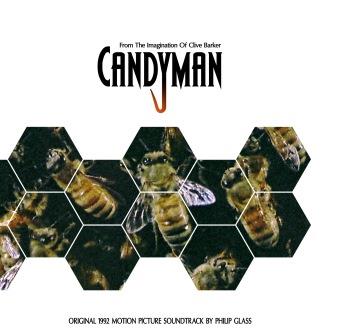
"Philip elevates horror and suspense to an epic plateau. Moving between the gentle toy piano
touches of a child's grim fairy tale and the sinister pipe organ of the most fearsome of fire
and brimstone sermons, Philip Glass has found a way to evoke the web of the collective fears
woven across the span of a human lifetime and lay it like a shroud across an hour and a half
of our lives. To this very day, this music still sends chills down my spine.
"The release of music on vinyl is an important ritual. I invite you
to pay tribute to that ritual: light the candles, power up your sound system,
place the needle onto the record, and don't be surprised if something
unexplainable happens upon reaching the end of the fifth playing..."
Candyman
Liner notes by Clive to the vinyl release of the Candyman soundtrack, One Way Static, 2014
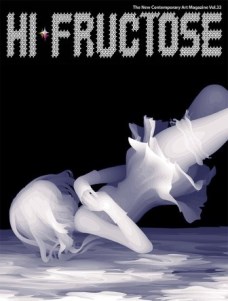
"It is a lonely path, exploring the darkness. Which makes coming across a fellow traveller on those shadowy roads all the more fascinating and unforgettable. It is rare, and beautiful.
"Hans Rudi Giger held out his hand, and a bright globe rose from it, illuminating a cavern of vast, complicated claustrophobia and sexuality. His artworks mapped majestic territories that made those dark areas waiting in the deepest chasms just that slightest bit less terrifying, because here was a man who visited the abyss and lived to tell the tale. And we are all made better as a people for the fruits of his journey."
A Remembrance Of H.R. Giger
By Clive Barker, Hi-Fructose, Vol. 33, October 2014
"Tiree... Guernsey... Kauai... Three islands. Three different worlds. It's almost as though each one of them could have been plucked from a different time.
"Or a different Hour...
"In that thought is the beginning of a whole new journey, to a place of visions and imagination, full of the fantastical and the bizarre, yet all rooted in my memories of places I have been and people I have known.
"The islands of Abarat."
Islands, Real Or Imagined
By Clive Barker, Inkpop.com, 30 September 2011
"What could be more exciting than standing on the threshold of a new world?
"The door is open, just a crack, and through it we catch a glimpse of what lies beyond. A panorama of untold wonders. A heaven set with unnamed stars. A crowd of faces - some radiant with goodness, some corrupted by ancient evil - ready to swarm into our world...
 "I write these words standing upon such a threshold. And the sights I can see are about to spring to life in four new comic books from the Marvel / Razorline imprint. They are the beginning of what I am certain will be a unique exploration into uncharted regions: those 10 realities that I have called the Decamundi, and which Mr. Carl Potts wittily dubbed the Barkerverse.
"Hyperkind - which will be the first of the quartet to appear - is a revisionist super-hero title, featuring a group of teenagers chosen by fate to inherit the powers of a far older tradition, powers which they are ill-equipped to comprehend or wield.
"Hokum and Hex is a visit to a world of magic and absurdity, a mingling of thrills, chills, and wild lunacies that will, I trust, revive the fortunes of the tale dedicated to both nerve-wracking action and spine-chilling mystery.
"Saint Sinner - which is perhaps the darkest of the four books - introduces us to states of flesh and spirit that I truly doubt have appeared on any page hitherto: states so powerfully portrayed they will haunt you for weeks.
"And Ectokid is a narrative which leaps, I hope nimbly, between our world, the realm of the living, and the Ectosphere, a place haunted by all manner of supernatural terrors.
"None of these titles is, I think, quite like anything you will have seen from either Marvel or Barker before. Though I have been associated for several years now with films on the cutting edge of horror, my life in publishing has moved further from the blood-soaked ground of the Hellraiser mythos with each book, into evermore fantastical territory. When the chance came to expand my imaginative horizons and open, as it were, 10 new doors to 10 new kinds of reality, setting down what my mind's eye saw, the invitation was irresistible."
At The Threshold: Some Thoughts On The Razorline Imprint
By Clive Barker, Comic Buyer's Guide, No 1024, 2 July 1993
"Enter Jakabok, a vicious, demented and blood-thirsty demon. He was an occupant of hell for many years, and he knows how
to cause every kind of mischief; grief, anguish and agony are his food and drink. But Mister B., as Jakabok likes to be called, is
no longer an occupant of the underworld. He's in this book.
"Let me be clear: Mister B. is not in this book as Scarlett O'Hara is in Gone with the Wind. The terrifying Mister B. will be
possessing this book, watching you from its words. He can feel the pressure of your fingers on the pages, he can hear your
breath and your mutterings, he can also hear your heart quicken. That's what he loves most: the quickening heart, the
clammy hands. Any proof that the terrifying tales which he tells are working their dark magic.
"You see, Mister B. has ambitions, and he'll use every trick he knows to get what he wants from you. He'll entertain you
with his stories of the war between heaven and hell that is going on around us all the time; he'll threaten you with horrors only
those who've seen the depths of the underworld could possibly know. He'll even throw in some gallows humor when he's in the
mood.
"But what does he really want? And what is he prepared to do to you to achieve his ends? The book has plenty of answers. But to
get to them, you'll need to read, and with every page you turn Jakabok comes closer to you. Closer, ever closer.
Tasting the sweat in your fingertips as it sinks into the page where he waits."
Mister B. Gone
By Clive Barker, HarperCollins promotional notes, written as a 'Dear Reader' letter, 2007
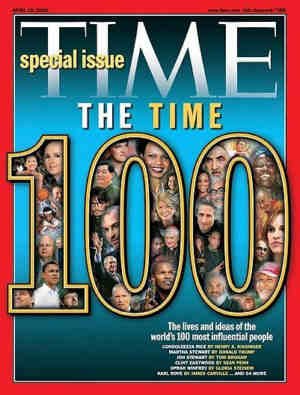
"By the end of Inkheart, her most elegant and accomplished work to date, we have experienced wonderments - but grief too. In that book, the first of a trilogy, Funke presents us with a simple but irresistible idea. She creates someone who can read characters off the page and into life. Think of it: you have all of literature in front of you and a tongue that can animate written souls. Who would you choose? "Miraculous events don't happen without consequences in Funke's world. Magic has too much weight to be freely given. But adult readers will leave the book with the happy certainty that imagination outweighs the contempt for the fantastic that we are taught credible adulthood demands - and is there, ready to heal and redeem, when we come back to find it again."
Cornelia Funke The Next J.K. Rowling?
By Clive Barker, Time Magazine (US edition), 18 April 2005
"Mick has often sought out the opinions of his friends on works-in-progress and it was in that spirit that he invited myself and
David Cronenberg to a very private screening of an early cut of Sleepwalkers. Just before he began to run the movie, however,
several high powered 'suits' from the studio walked in, and took seats at the back of the screening room. The movie got underway.
It played well, the scene where the young hero makes a kind of supernatural love to his own mother. Most love-making scenes are
uncomfortable as hell to shoot, and it's often a time that actors' insecurities present themselves. But the young man in the scene
was obviously very aroused by his co-star, and the proof of that was standing up in the middle of the screen for all to see. Appreciative
smiles from me. Horrified gasps from 'the suits.' Mick stands up, the scene playing out in all its erectile glory on his face, while he
hurriedly explains that "there will be an effect covering this." A big effect, obviously.
"We laughed later, at the thought of the palpitations 'the suits' must have been having at that moment. Of course, when the scene
made the picture a supernatural glow did indeed cover the offending anatomy. But I will treasure forever the image of Mick turning to
his little audience in some confusion while his hero's pride and joy stood proud on his face.
"Ah! The movies. You gotta love 'em.
"Mick, forgive me telling this little tale. And here's to another few decades of friendship, collaboration and giving the suits something to
sweat about."
Mick Garris: A Very Un-Hollywood Type
By Clive Barker, World Horror Convention Book, 7-10 April 2005
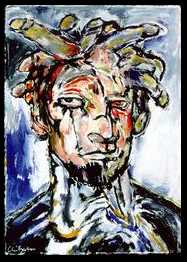
"Flesh is our indisputable commonality. Whatever our race, our religion, our politics we are faced every morning with the fact of our bodies. Their frailties, their demands, their desires. And yet the erotic appetites that spring from - and are expressed through - those bodies, are so often a source of bitter dissention and division. Acts that offer a glimpse of transcendence to one group are condemned by another. We are pressured from every side - by peers, by church, by state - to accept the consensual definition of taboo; though so often what excites our imaginations most is the violation of taboo."
One Flesh Exhibition
Essay by Clive Barker, 11 February 1997
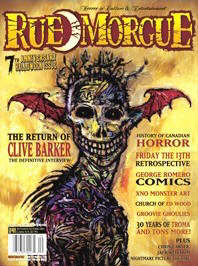
"It's not often that the opportunity comes along to simply celebrate. To say: here are some things that made a difference in my life
when I first encountered them and, in fact, are still making a difference, touchstones of power and feeling which I return to over and
over again, especially when my creative batteries are running low. I'd love to make a list of such touchstones that was 100
items long. But I don't have too much room, so I'm limiting myself to one: a painting.
"In my late teens I went with a group of friends to taste a little of old-fashioned bohemian living in Paris. We saw all
the usual sights, with a heavier emphasis on cemeteries, perhaps, than the ordinary itinerary would contain. One of the
places we visited, of course, was the Louvre. After a few hours I'd had a surfeit of paintings, and was ready to leave. Then
I turned a corner and stepped into the presence of a work that has haunted my imagination ever since. It's called Raft of
the Medusa, created in 1819 by French Romanticist painter and lithographer Theodore Gericault."
Classic Cut Presents: Raft Of The Medusa
Essay by Clive, Rue Morgue, No 41, September/October 2004
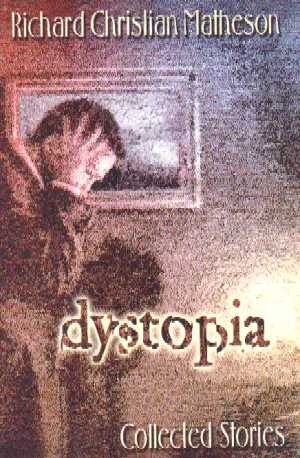
"What RC does is a lot harder than it looks. I know. I've tried. Rendering a story in just a few pages, complete with enough character work to make the reader care, is a tough business, and over the years RC has done it countless times."
Dystopia
Contribution by Clive to the deluxe (numbered and lettered) versions of Richard Christian Matheson's anthology, Gauntlet Press, 2000

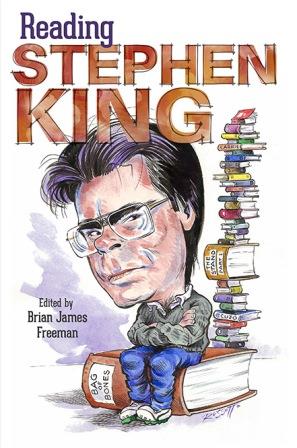


"When my English publishers put out my first stories, The Books of Blood, they were greeted with a very English
silence. Polite and devastating. I don't know what I was expecting, but it certainly wasn't this smothering shrug.
"And then, a voice. Not just any voice. The voice of Stephen King, who had made people all around the world fall in
love with having the shit scared out of them. He said, God bless him, that I was the future of horror. Me! An
unknown author of some books of short stories that nobody was buying....
"Stephen had no reason to say what he said, except pure generosity of spirit. The same generosity he has shown over
the years to many authors. A few words from Stephen, and lives are changed forever...
"Now I do my best to be a voice for others. To pass the parcel along. As a writer, Stephen has taught me countless
lessons in storytelling. But it is the lesson of how to give that echoes most powerfully through my life. And will,
I hope, echo on through the lives of others as I support the next generation of writers with my own sincere
enthusiasm."
Stephen King Gala Tribute
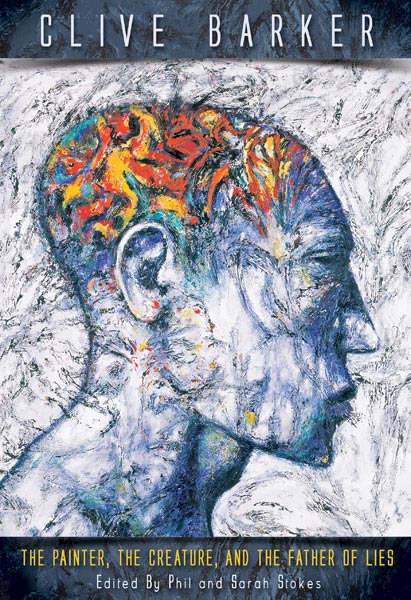
Speech by Clive at The Canadian Booksellers Association event, John Bassett Theatre, Toronto, Friday 8 June 2007. Subsequently published , (i) Revelations website, 2008, (ii) The Painter, The Creature and The Father of Lies, Earthling Publications 2011, (iii) Reading Stephen King, Cemetery Dance 2017
"I have always had the belief that readers of fantastic fiction (whether it was invented world fiction, science fiction, children's
fiction) would be less bigoted than the average reader. Why? Because their imaginations are so much broader, so much more
inclusive, than the reader of what I'll loosely call realistic fiction....
"Perhaps, naïvely I think of readers of fantastic fiction as being a more liberal bunch than the rest, probably tending towards the
left in their politics, and, generally speaking, more open-minded than the rest. After all, their reading habits require them to open
their heads and hearts to all kinds of strangenesses, don't they?...
 "But people are troubled, believe me. And the voice they give to their trouble is not well-argued or generously framed: it is
more often than not a vicious outpouring of barely articulate rage and disgust...
"But people are troubled, believe me. And the voice they give to their trouble is not well-argued or generously framed: it is
more often than not a vicious outpouring of barely articulate rage and disgust...
"Recently, this unpleasant venting of bigotry in the form of literary criticism has spread into some even more confusing areas.
After all, I might not llike the fact that a reader hates the sexual proclivities of one of my characters, but I can understand it.
However, when readers claim to find 'gay innuendo' threaded throughout the first book of Abarat, I begin to wonder if we're not
getting into dangerous territory. Abarat is not a gay book, in the way that Sacrament may be argued to be. And the readers who
are now demanding that it be taken off the children's shelves and put in the gay and lesbian section are to my mind out of their
depth. But as the author all I can really do is sit and watch the argument heat up. (That, and take the opportunity to write
occasional pieces like this.)"
May You Live In Interesting Times
By Clive Barker - guest column 'Masters Of Horror', Cinescape, December 2004, Issue no 76

"Our hero, Repairman Jack - whose tangled emotional life (and enthusiasm for James Whale movies) occupies a good deal of the book's 365 pages - is drawn into a plot which involves an ancient family curse, the desecration of a temple (dedicated to Kali) in 1857, and some stolen jewels. He also encounters the rakoshi - three-clawed humanoid reptiles (sic) whose appetite for human flesh provides most of the all too infrequent scenes of horror which the book offers."
The Tomb
A book review by Clive of F Paul Wilson's novel, The Tomb, in Time Out magazine, 19 - 25 September 1985
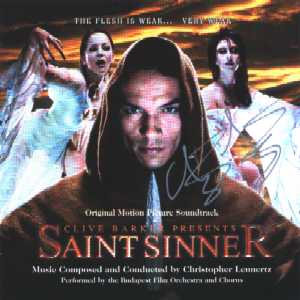
"It was clear from the outset that [Chris Lennertz] had a strong grasp
of the scale of the challenge before him, and of its possibilities.
Saint Sinner was to be made, we all knew, for a modest sum of money,
but it had a complex story with some metaphysical undercurrents. If
all the narrative's elements were to be brought in focus then the
score would have to be an intricate piece of writing, layered and
ambitious...
"The result is a score that is powerful and moving, with more than a
touch of liturgical resonance. It is a transformative score. Saint
Sinner feels bigger, deeper and richer accompanied by Chris' music.
It has become, in short, the movie I dreamt it would be when I first
set pen to paper... the Sinning Saint perfected."
Saint Sinner
Liner notes by Clive to the soundtrack of Saint Sinner, La-La Land Records, 26 September, 2002

"I've travelled a long way with Harry D'Amour. He first appeared in a story I wrote almost a decade ago now, 'The Last Illusion'. Since then, I've recounted his life and troubled times in two novels and some short fiction. I've not made the road very easy for him. His destiny, it seems, is to be in constant struggle with what might be loosely called 'the forces of darkness', though he claims he'd be quite content investigating insurance fraud. His reluctance is, I trust, part of his charm. He's not a Van Helsing, defiantly facing off against some implacable evil with faith and holy water. His antecedents are the troubled, weary and often lovelorn heroes of film noir - private detectives with an eye for a beautiful widow and an aversion to razors. It therefore seems perfectly appropriate that Harry finds his way onto the cinema screen, where his world can intersect with that of the grand guignol horror movies I've had the pleasure to create hitherto. This self-willed collision of genres - horror movie and detective film - caused the studio some headaches when I first screened 'Lord of Illusions'. They wanted a simpler picture, with less emphasis on the noirish mood. I reluctantly made some excisions, on the understanding that the director's cut would be available on tape and laser disc. So here it is. The complete, unexpurgated 'Lord of Illusions'. I think the picture is much stronger in this version than in its theatrical incarnation: the characters richer, the plot clearer, the atmosphere darker. Thanks to the vision of my colleagues at United Artists, this cut was not cobbled together after the fact. Simon Boswell scored this version. We mixed it, dubbed it and timed it. In short, we did everything but put it on the big screen. Ah well... This is, quite simply, the definitive 'Lord of Illusions' - the version by which I wish the work to be judged. Enjoy the journey. And my thanks to you, and Harry, for the company."
Lord Of Illusions
Liner notes by Clive on unrated laser disc, 1996
"The deal I signed with New World to be allowed to direct the first
[Hellraiser] film (a Faustian pact, with hindsight) gave over all
rights in the characters and their mythology to the company; they've
since moved through many hands, becoming an asset to be traded. But
I've done what I can to keep an avuncular eye on the gang (fending off
asinine storylines that would have reduced them to jokemeisters from
Hell) but feeling ever more remote from the creations that first sprung
to life ten years ago.
 "All of which makes the business of introducing this new edition of
the film highly pleasurable for me. In preparing it, I was inevitably
obliged to reacquaint myself with the material, which was both painful
and poignant. The lives of everyone connected with the first Hellraiser
have moved so far since those days. So have the technologies which are
used in the making of a horror film. By comparison with recent forays
into the genre Hellraiser is a simple domestic tale; the effects are
scarcely state-of-the-art effects... and the narrative straightforward.
I'd like to think the strength of the film resides in these simplicities;
but in truth it's hard, even at this distance, for me to know what
works and what doesn't. All I see are the frailties of the film, which
are innumerable. (Lord, how did we get away with some of those opticals?)"
"All of which makes the business of introducing this new edition of
the film highly pleasurable for me. In preparing it, I was inevitably
obliged to reacquaint myself with the material, which was both painful
and poignant. The lives of everyone connected with the first Hellraiser
have moved so far since those days. So have the technologies which are
used in the making of a horror film. By comparison with recent forays
into the genre Hellraiser is a simple domestic tale; the effects are
scarcely state-of-the-art effects... and the narrative straightforward.
I'd like to think the strength of the film resides in these simplicities;
but in truth it's hard, even at this distance, for me to know what
works and what doesn't. All I see are the frailties of the film, which
are innumerable. (Lord, how did we get away with some of those opticals?)"
Hellraiser
Liner notes by Clive on deluxe collector's edition laser disc, 1996

"The Reality Principle says to me that a bunch of guys going to see a movie in which a very well-built, immaculately-lit guy kicks ass around the world are going to come out feeling more arrogant about their sexuality, more likely to behave in high-handed and anti-social ways than people who come out of movies (and I'm speaking not about rape fantasy movies, I'm not talking about 'Dressed To Kill', I'm talking about horror movies) in which the moral status tends to be that 'Thems that do bad get it back' and whose reality is not in question anyway because it's not going to be about something they're going to see on the street."
On Censorship
Essay by Clive, Clive Barker's Shadows In Eden, 1991.
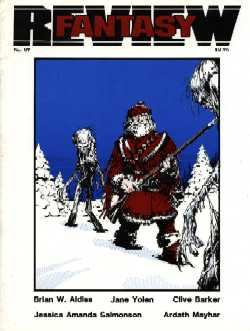
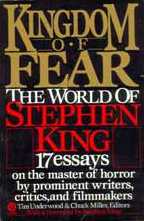
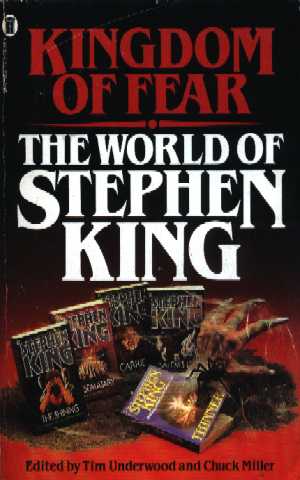
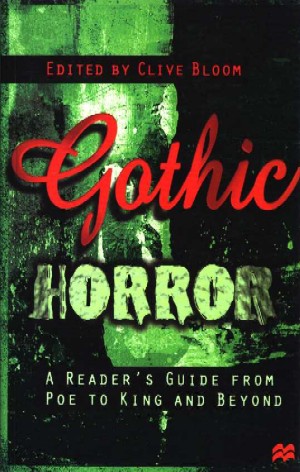
"King offers us another kind of vision; he shows us adults what the children in his fiction so often take for granted: that on the journey which he has so eloquently charted, where no terror shows its face but on a street that we have ourselves trodden, it is not, finally, the stale formulae and the trite metaphysics we're taught from birth that will get us to the end of the ride alive; it is our intimacy with our dark and dreaming selves."
Stephen King - Surviving The Ride
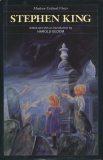
Essay by Clive Barker, 1986, (i) Fantasy Review No.87, January 1986 (ii) Kingdom Of Fear (edited by Tim Underwood & Chuck Miller), 1986 (iii) Clive Barker's Shadows in Eden (iv) extracted as 'On Horror And Subversion' in Gothic Horror (edited by Clive Bloom), 1998 (v) Modern Critical Views: Stephen King (edited by Harold Bloom) (vi) quoted in Hollywood's Stephen King by Tony Magistrale, 2003

"This is the room where I write my books and screenplays. It's a room for dreaming with my eyes open; a room for looking at the sky and seeing other worlds. I've never had a working space I love as much as this room."
Havens: Celebrities Favorite Rooms
Liner notes accompanying photo of his writing study in Havens by Michael McCreary, September 1995
"As the creator of Hellraiser and other ghoulish tales, I can't seem to write anything without getting blood all over the pages. Not my blood, but the blood of one unfortunate character or another. So while I spend a great deal of time helping my hungry creatures find some innocent bystanders upon which to feast, I've never addressed the consequences of sloppy table manners among the demonic set... "...You need to discover two things instantly. First, is it your blood? If so, and there seems to be quite a lot of it, don't worry about the laundry. Worry about an ambulance. Second, how long has the blood been allowed to pool and coagulate? This is important, since you have only a couple of minutes between the bloodletting and the stain-removing. If the blood dries, you're dead. So move quickly, and remember to blot the blood. Don't rub it. Rubbing it just rubs it in."
How To Get Bloodstains Out Of A Shirt
Essay by Clive, Men's Health, October 1996.
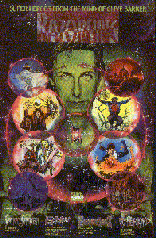
"From now on, sometime stand-up comedian, failed lover and insomniac,
Trip Munroe will be a defender of Earth. He will travel the Decamundi
looking for magical allies in the struggle; he'll meet his great
grandfather's spirit, and learn how comedy expresses the healing spirit
of the Cosmos; he'll do stand-up routines for deities, and ride his
unicycle through the fires of the Neobys.
"The old order of pseudo-archaic spells and high-falutin' symbolism is
over. Welcome to the magic of the nineties - comical and brutal,
surreal and cynical, dark and... ridiculous."
Razorline
First Cut - Razorline, Vol. 1, No 1, introductory essays by Clive on each of Hokum & Hex, Saint Sinner, Hyperkind and Ectokid, September 1993
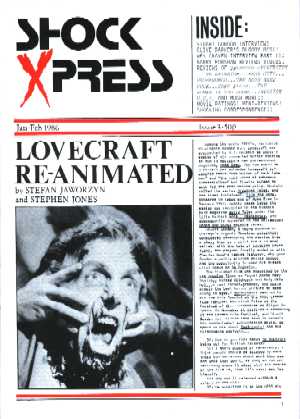
[Re: Orphee in a list of 10 favourite horror films] "Probably my single favourite movie. I'm fond of Cocteau because he was a playwright, illustrator, poet and moviemaker - all areas in which I work. He was a man with a tremendous grasp of subtleties and ambiguities - he can find the poetry in virtually anything, which is a huge skill. Orphee is profound yet very accessible, packed with startling imagery which retains immense power - the mirror, the motorcyclists, Death standing at the foot of Orphee's bed while he sleeps. It's a mark of genius that someone can take fairly common images and invest them with such power that they subsequently come to be known as his own. Orphee is also a very sexual film - the magnetism working between the characters is that of need rather than pleasure, which is the difference between sexuality and sensuality - no-one is in this for cheap thrills, they're in it for transcendence."
Barker's Bloody Best
Essay by Clive, Shock Xpress, No 3, January/February 1986
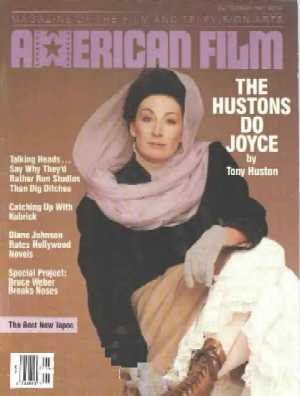
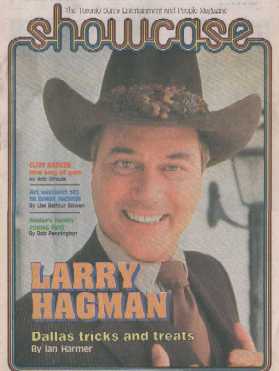
"Try to imagine the best place to enjoy being scared. I stress enjoy. I'm not talking about the pre-dawn sweats in which the terror of mortality gnaws at the gut; I'm talking about the fear for the thrill of it, the chill of it. Fear as pleasure. Where would that be best experienced? "In the dark, certainly. In company, most likely, where we'd have the comfort of knowing others were with us, sharing our responses. And in front of us in this warm darkness - close enough so that we can feel its proximity, yet somehow sealed off from tresspassing into our world - the source of our fear: the beast. "In other words, fear is best in a cinema, with the monsters as close as our noses, yet safe as only celluloid can be."
Big Chills
Essay by Clive, (i) American Film Magazine, September 1987 (ii) edited version as King Of Horror Picks Favourite Scary Flicks, Toronto Sunday Sun : Showcase, 30 October, 1988 (iii) Clive Barker's Shadows in Eden.
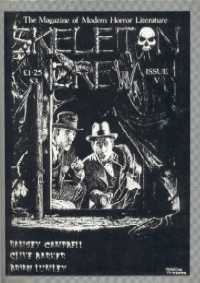
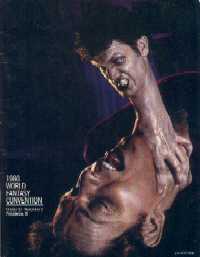
"It may be that the darker the portions of the psyche one can commit to paper, the easier it is to smile at the world."
Ramsey Campbell : An Appreciation
Essay by Clive Barker, (i) 1986 World Fantasy Convention Programme (ii) Skeleton Crew, No 5 (iii) Clive Barker's Shadows in Eden

"Having spoken of monsters in such celebratory terms, it's bitter to admit that the stories we construct to parade these creations are constructed so that, by the final chapter, they - the tribe - are unmade. We plot everywhere their overthrow, ruin and exile. Prayers are recited to keep them from our thresholds. We cover our children's eyes against the sight of them, or are, ourselves, kept from a glimpse of their excesses by censors."
A Thing Untrue
By Clive Barker, (i) The Face, No 25, October 1990 (ii) Pandemonium, 1991
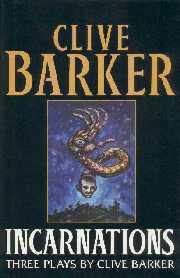
"The Devil is an actor: a man of masks, never the same tempter twice. It's appropriate then that a play exploring his life and times should be an actor's piece, using word-pictures in place of elaborate sets, in the stream of which a large number of characters are carried, some of them healthy swimmers, many swept away by the protean evil that is the play's true constant...If this story's worth telling it's because it's about being human. The Devil's tale is the tale of our own confusion, ego and inability to live without hope for Heaven. His wings removed, Satan is dropped into the world wounded, and though he conceals his frailty well enough, putting on a fine show of dispassion, he's never far from throwing back his head and raging like an abused child. If the play persuades its audience to look at what this mirage of external evil is - in short, an excuse; a brushing off - then it has done something of what I intended."
Incarnations
By Clive Barker (see Collected Plays) production notes by Clive.
"To be perfectly honest, I need your help...
There have been signs for a long while that Lionsgate, the company releasing the movie, was going to screw around with it. Release dates
were changed and changed again. And my phone calls to the people at Lionsgate, asking for answers, were not returned. I was finally told
that Lionsgate only planned to open the movie in a tiny number of theaters - somewhere between 100 and 300 - run it for
a week, then put it on DVD.
"In other words, they were going to dump our movie...
"So... I'm fighting back.
"And I'm asking you now to fight with me.
"If you want to see The Midnight Meat Train on the big screen the way it should be seen, please contact Joe Drake at Lionsgate and
tell him your feelings..."
Open Letter To The Fangoria Weekend Of Horrors, 20 - 22 June 2008
By Clive Barker, 20 June 2008 (note: full text online at www.fangoria.com)
More contributions


