Interviews 1987 (Part One)
...While Clive and his cast were still busy giving interviews on Hellraiser, behind the scenes at Cannes Hellbound was being pitched to New World. By July, Pete Atkins was working on the first draft of the screenplay just as Clive was gaining an injunction against Green Man producing any further pictures of his stories. Through November and December Atkins worked on the last drafts of Hellbound, incorporating cast changes as he went, before the shooting script was finalised as the year ended. Poseidon's intended summer release in the US of the Books of Blood Volume 6 (as The Life of Death) was put on hold, to be combined the following year with Cabal instead. Meanwhile, astonished gorehounds found Clive's new departure into fantasy (albeit with the now trademark Barker slant) a little tough to stomach. Fans of good storytelling, however, were happy to follow this new route, and a whole new audience was enchanted by Weaveworld - Collins & Poseidon rubbed their hands with glee ...
Horrors! It's Clive Barker
By [ ], Booktalk, 1987
"I'm trying to write serious books which happen concidentally to be horror books. I am concerned that my work be
well written and intelligent. I am writing to the best of my ability. At no point am I condescending to my readers...
"People don't believe in garlic and crucifixes anymore. My fiction is about comprehension. It's not simply about getting
away with as few bites as possible - it's about understanding why the monster is trying to bite you in the first place."
Raising Hell
Interview by [ ] for Stephen King's World of Horror documentary video, 1987
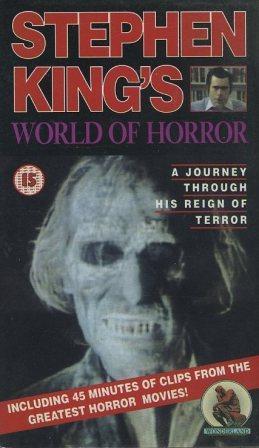
Stephen King's World of Horror, 1987
"What happens in my fiction is that characters do things for reasons -
usually reasons of appetite of some kind or other. Though they may
look strange, though their bodies may be inhuman, abhuman, subhuman,
their motivation is something we can most of us relate to in some way
or other.
"There's this nice family unit, there's a status quo, there's a family
dog and there's whatever the hell else there is - and suddenly
something comes in from the big, dark, outside and threatens the family
unit, steals the child, eats the dog, burns down the house, occupies
the reality that is dominant up to that point. I am rather on the
side of those forces."
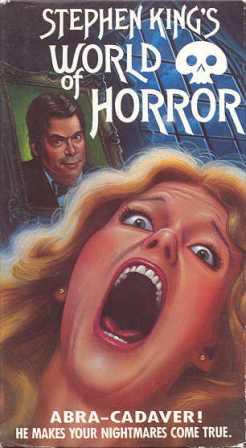
Stephen King's World of Horror, 1987
Trailers
Interview by [ ] for Stephen King's World of Horror documentary video, 1987
"Trailers are great. I mean I love 50's trailers: 'Attack of the 50 Foot Woman' - have you ever seen the trailer of that? It's great! They're great stuff; they're an intensification, very often, of what's in the picture and, it has to be said, very often all the best bits of the picture get put in the trailer."

Blitz, No 49, January 1987
Clive Barker
By Paul Mathur, Blitz, No 49, January 1987
"I never turn away. It's like in the slogan for this film - 'There Are No Limits' - the only limits are in the imagination of the author. There are things that I wouldn't write about, like I wouldn't set a horror story in Auschwitz and I wouldn't base a story on the real suffering of something that really happened. It's a question of, not taste, more dignity...
"Writing books is a lonely business, so doing a film that I've written and directed means I can not only communicate my message, I can also work with loads of great people. There was talk of me directing Aliens 3, but I didn't want to do it. They're excellent films but I want what I do to come from me."
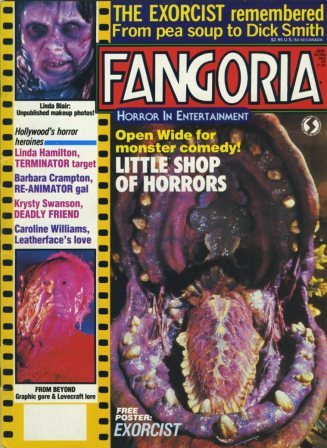
Fangoria No 60, January 1987
Clive Barker Raises Hell
By Philip Nutman, Fangoria No 60, January 1987
"The story [of Hellraiser] is based on a novella, The Hellbound Heart... the movie is based on that story, but is quite a distance from
it; there have been many changes. It is an original screenplay I wrote with the intention of making it my directorial debut...
"We wanted someone [for FX] who has a new eye and was as hungry to produce something as original as we are. We have faith that
this picture will break new ground, and we wanted a talent in the special makeup effects department who would be willing to take
considerable risks. And what we have in Bob [Keen] is someone with the most marvellous technical know-how married with a
tremendous imagination. For us, that's a very potent combination. I see eye-to-eye with that aspect because that's how I view my
fiction."
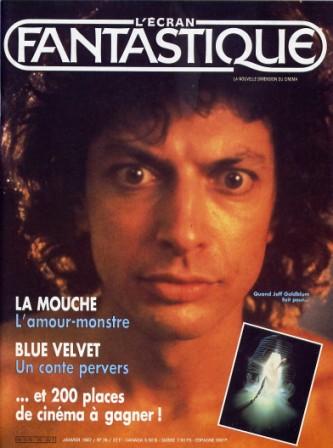
L'Ecran Fantastique No 76, January 1987
Clive Barker, Createur de Monsters II
By Indra Bhose, L'Ecran Fantastique No 76, January 1987 (note - translated from the French)
"I made a point of keeping control on the way in which the stories which I wrote were shown on the screen. Screenwriters do not have much say on the structure of the films which they inspire, but I wanted to ensure for myself that the images which I introduced into the screenplay would find their way onto the screen..."

Photoplay, Vol 38 No 2, February 1987
Hellraiser
Photoplay, Vol 38 No 2, February 1987
"I wanted to make something intelligent and fresh [in Hellraiser], something with a little more style than the rest."
L'Enfant Horrible
By Robin Eggar, Sunday Express colour supplement, 1 February 1987
"Personal relationships have their place but everything is put aside for work. To me, the idea of a wife and children is a millstone, getting between me and the things I want to do. My most intimate relationship is with my imagination. It always has been. My imagination is the one thing that I really like about myself. It is the longest one night stand I've ever had. And it has never let me down. Yet."
Hellraiser
By Tom Pulleine, Films and Filming, No 389, February 1987
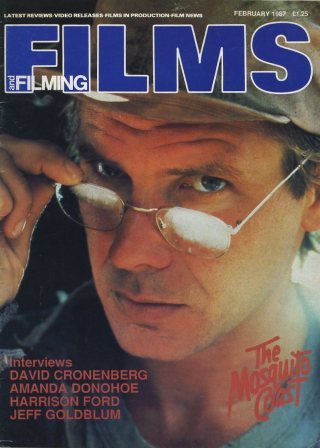
Films and Filming, No 389, February 1987
"I believe style has a lot to do with economy - and I don't mean just
in the money sense. I've tried to avoid being rococo for it's own sake.
After all, the story is the important thing... but that's not to say
that we're trying to make some sort of spurious art movie; this is
no-holds-barred stuff.
"I couldn't be a neo-realist, however hard I tried. It's
very important to me to make the motivations accessible,
not to have people just succumbing to uncontrollable
urges. However fantastic the story may be, the horror
is still rooted in human desires. I'm just not
interested in the kind of horror film where virgin girls
are pursued by men in ski masks. There are no virgins
in my movie. And no ski masks either, come
to that."
Transcript Of Talk At UCLA, 25 February 1987
Clive Barker's Shadows in Eden
"Once I've got those ideas, if there are monsters in

Clive Barker's Shadows in Eden
them, I do drawings because I like to be able to
describe a monster nipple by nipple."
A Little Bit Of Hamlet
Barker at UCLA 25 February 1987,
by Dennis Etchison,
Clive Barker's Shadows in Eden
"I think the censorship lobby has legitimate fears. I could certainly think of pictures that I would not want six-year olds to see... My problem is not that there aren't legitimate concerns but that because the argument is so fractionalized, the real issues are not addressed. The real issues are what values are put across in these pictures. If you start to talk about values I think something very interesting happens; there is quite clearly an argument that can be put against pornography - that it de-humanizes women - which I think is a legitimate argument. But what about 'Rambo' de-humanizing life?"
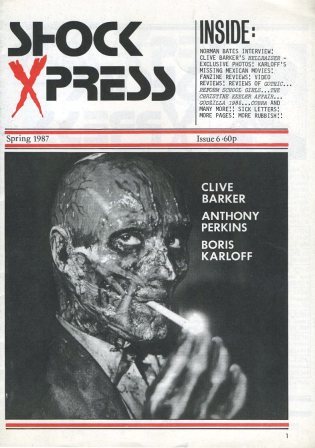
Shock Xpress, No 6, Spring 1987
Raising Hell
Hellraiser set visit by Stefan Jaworzyn, Shock Xpress, No 6, Spring 1987
"The rule I made at the beginning [of 'Hellraiser'] was that once the picture had started I wouldn't fiddle around with it. We wouldn't ever be at the stage where I was writing scenes one night to be filmed the next morning. It's unfair to everyone involved - actors, special effects crews, technicians. Once we got the pink pages in, there would only be changes in nuance. We worked very hard on the script to get it just right so we could say, 'Now we'll go, we'll make this picture.' "
Club Portrait
By Chris Lloyd, Club International, Vol 16 No 3, March 1987
"The difficulty isn't the discovery of what scares people, but investing fear with some sharp undertone, some resonance. 
Club International, Vol 16 No 3, March 1987
Getting murdered scares people but there are very few murder scenes in movies that are worth looking at twice. I'm always trying to invest death with more meaning than simply extinction.
"Marion Crane's death in Psycho has this extra element. The fact is that she's a criminal and stepping into the shower is the first moment of release for her. She's washing off the dirt of two days. She's taken all her clothes off and she puts her neck up and for the first time we genuinely see pleasure on her face. She smiles. And you can imagine her thinking about what her lover's embrace is going to be like when she eventually reaches him. Then - Wham! The moment is dramatised. She's not just another body in the shower. It's much more elegant and interesting than that."

Cinefantastique, Vol 17, No 2, March 1987
Rawhead Rex
By Alan Jones, Cinefantastique, Vol 17, No 2, March 1987
"I just want the film to be an all-out monster movie with lots of blood and cheap thrills. I wrote the best script I could, and I'm hoping for the best."
Fantasy Review, No 100, April 1987
Other Worlds : Conversation With Clive Barker
By Matthew J Costello, Fantasy Review, No 100, April 1987
"I'll start another novel [after Weaveworld] just after the turn of the year, and another movie is planned after this one [Hellraiser]. Not a horror picture, a fantasy picture. I have a very low boredom threshold anyway, so moving from medium to medium is fine. But mainly I think it informs the work in one medium to have worked in another one. I can bring insights to bear on film because I have worked in the theatre, or because I have worked in illustration, and maybe the film work will reflect back into my theatre work or my illustrations. I certainly hope so."
Horribly Successful
By Paul Kerton, Telegraph Sunday Magazine, No 545, 5 April 1987
"Monsters are only embodiments of our own appetites growing large or out of control. They are capable of doing things we can't do: they can fly, they can survive death by fire or water, and sometimes they are embodiments of our desire to do quite extraordinary things. In fact, there's an incredible variety of sexually voracious, flying, immortal beasts - and I would say that making love all night, being able to fly and living forever are actually the three most constant human fantasies.
"The relationship there is between people and monsters is more ambiguous than we care to admit...
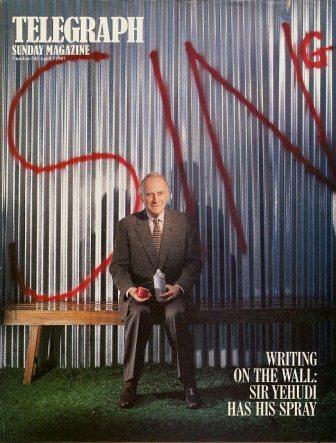
Telegraph Sunday Magazine, No 545, 5 April 1987
"Nowadays, trying to pretend a werewolf story is just about a guy who grows fur on his face is very naive, and that sort of attitude has kept horror from serious appraisal. There is a wonderful exchange in Abbott and Costello Meet the Werewolf where Lon Chaney Jr says, 'I am cursed. I have a terrible disease. When the moon is full and the nights are raw, I turn into a wolf and I go out seeking women.' Abbott says, 'I know a lot of guys like that.'
"We are not pretending any more that The Werewolf is about a man who turns into a wolf. It's about desire. It's about being out in the woods where you can do things you can't do in the city. That's the essence of it. And the best horror contains both the werewolf and the analyst's couch."
Larry King Show
Larry King Show, 6 May 1987
"Having worked for a long time in theatre, where there is an immediate
gratification thing in there - you know whether a piece of
theatre is working or not because the audience is leafing through their
programme or eating popcorn, or watching the stage. I'm very aware of
boredom thresholds; I try to make sure that the book - I am aware of
the audience all the way through writing the book - I'm trying to make
something which will consistently excite...
"If my editor says to me, 'Look, it slows down here,' I will take
account of that and won't say, 'Well, it's my book, it's my vision, I'm
just going to go ahead and do it anyway.' It's important to me that
I'm writing for people and not writing just for myself... I
self-edit a lot, and then I've got both my agent and of course my
editor at my publishers. I think my various editors would agree that I
listen; I disagree sometimes, but I would try and argue the thing
through, and it's very useful - you work nine months on a book, you
lose perspective, and it takes a clear, clean eye to read this thing
and say, well, 'you know it slows down here' or 'it needs a bit more
detail there'. So, yes, I certainly listen to my editors."
Touch of Evil Film Festival brochure, Washington, October 1987
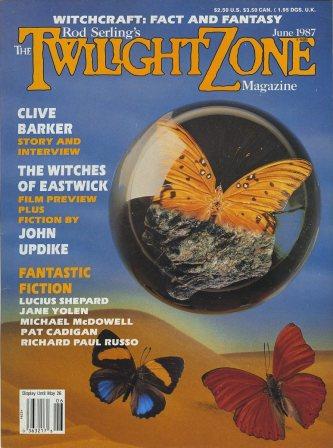
Twilight Zone Magazine, Vol 7, No 2, June 1987
Talking Terror With Clive Barker
By Douglas E. Winter during Hellraiser SFX,
(i) Rod Serling's The Twilight Zone Magazine, Vol 7, No 2, June 1987
(ii) small excerpt included in the Touch of Evil Film Festival
brochure, Washington, October 1987
(iii)Clive Barker's Shadows in Eden
"The thing is, I don't just push the gore - I push everything. When my stuff is bloody, it's very bloody, but when my stuff is sexy, it's very sexy. When it's funny, it's very ludicrous. I don't like half measures... So I don't think I'm a gorehound. I am an excess-hound: I like to push stories and events and characters to the limits. I would be very distressed if my readership were reading simply to see people torn apart or whatever. That would be a bit like going to 'King Lear' just to see Gloucester's eyes put out, or to Webster to see simply the deaths. I'm not in the genre to gross people out. And I don't write narratives just to give me good chances to gross people out. My narratives, as I create them, lead to moments of frisson that seem to be rather dark and distressing. Some of the moments of distress are going to be gross-outs, but some of them are going to be revelations, moments in which our vision of the world is turned upside down."

Rave Reviews, No 7, June/July 1987
Interview With Clive Barker
By Julia Fitzgerald, Rave Reviews, No 7, June/July 1987
"I live an undramatic life outside of my creative productions... It's a question of the period of my life at the moment - film work, books being written, travel. There's a breathless quality to it all and I feel I must make the most of it, consolidate what luck has brought me and give life to a career until it's secure enough to leave for three months and know that people will still remember my name... I feel as if I'm walking a tightrope and still haven't quite got my balance. It's all so new still."

People Weekly, 15th June 1987
Meet The New (Stephen) King Of Horror, Briton Clive Barker
By Andrea Chambers & Jonathan Cooper,
People Weekly, 15 June 1987
"I think I write tasteful fiction. I do seek to horrify, but I also seek to disturb, amuse, arouse and intellectually challenge."
Hammering Out Hellraiser
Set visit, by Philip Nutman,
(i) Fangoria, No 65, July 1987
(ii) Fangoria : Masters of the Dark
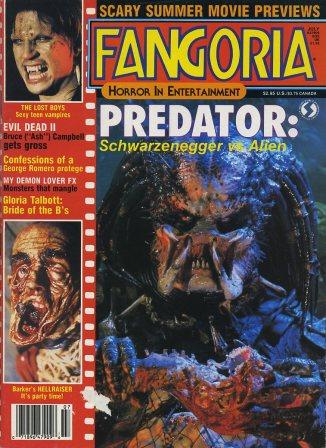
Fangoria, No 65, July 1987
"In The Inhuman Condition, the puzzle stands for many
things, such as evolution; you solve the knots, and
beasts - which are three separate parts of the
evolutionary puzzle - appear. In Hellraiser, the
puzzle stands for something quite different - it's a way
to open a door to Hell, but it also stands for the
puzzle of desire... Puzzles, labyrinths, anything that
involves intellectual inquiry, even on a very small
level, which then explodes into another world entirely:
that's an interesting place to be. And the Lament
Configuration is a good visual device. Far better than
invoking the Devil with cod Latin and sacrificing
farmyard fowl, and more fun than dead virgins!"
Some Harsh Words For The Critics From Ballard And Barker
By Rodney Burbeck,
(i) Publishing News, 24 July 1987
(ii) Clive Barker's Shadows in Eden
"I don't read reviews now because they just annoy me so much. I don't read the Sundays, it's tomorrow's chip paper anyway and one should not concern oneself with the trivial opinions of trivial minds; but they do shape the sales of movies, theatre tickets, books."
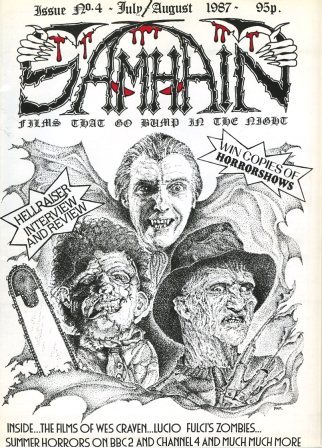
Samhain, No 4, July 1987
Clive Barker
By Nigel Floyd, Samhain, No 4, July 1987
"The challenge for me is to bury the poetry sufficiently deep in the piece of fiction that: (a) it can't be detached from the fiction; and (b) that it's not going to get in the way of the reader or viewer who is just there for the ride...And, obviously, in an ideal world, I am trying to write a fiction or make a movie that collides these two intentions, that gives the reader the thrill of the ride and the sense that there's a destination."
![Knave, Vol 19, No 8, [August] 1987](knave198b.jpg)
Knave, Vol 19, No 8, [August] 1987
Clive Barker: Anarchic Prince Of Horror
By Stephen Jones, (i) Knave, Vol 19, No 8, [August] 1987
(ii) Clive Barker's Shadows in Eden
"The thing I wanted to be when I was small was Peter Pan - I wanted to be able to fly; I wanted access to a Never-Never Land."
The Hell Bound Heart
By G. Dair, Cut, Vol 2 No 8, August 1987

Cut, Vol 2 No 8, August 1987
"One of my great articles of faith is that I won't look away, I won't avert my eyes and whatever I feel, however sexy, however
maniacal, I will actually put on the page. So having that reputation the challenge was to see if I could put it on screen."
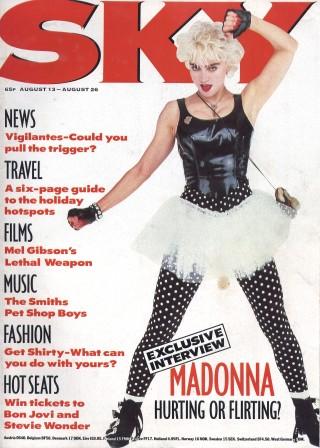
Sky, No 9, 13 - 26 August 1987
Is The Future Of Horror A Man Called Clive?
By Anne Billson, Sky, No 9, 13 - 26 August 1987
"I don't like send-ups. I like my horror dark. It seems to me that there's a certain reluctance on the part of writers and film makers to treat horror seriously, to suggest that it can actually say something interesting. One of the things I love about it is the ability it gives you to draw in surrealist imagery, to produce genuinely weird images."
Film
By Kyle Moffat, Edinburgh Festival Times, 26 - 31 August 1987
"I feel that Hellraiser looks rather better than many low-budget horror films. I think it has a kind of visual panache and elegance which is maybe lacking in its horror film brethren. However I didn't want to just make a showy piece of work and so I spent a lot of time making sure the film was telling the story rather than indulging in flashy special effects. I prefer people to say the film looks OK but tells a great story rather than vice-versa, as too many horror films, no matter how good they look, lose the audience's attention because they forget to tell the story!"
The Horror, The Horror, The Horror
Panel discussion with Ramsey Campbell at Worldcon, Conspiracy '87, Brighton, 29 August 1987
"There's a lot of devouring goes on in fairy tales, and I remember having an illustration - I remember the illustration much more clearly than I remember anything of the text - of Hansel and Gretel. You remember how Hansel gets fattened up by the witch? There was a picture of Hansel (with whom I presumably identified) in a cage; the witch was blind as I remember, and he gives a bone to her to prove that he's not getting any fatter... The idea of the witch fattening up this child for eventual devouring is a very early sexual memory.
"In Weaveworld I tried to make some of that explicit, what I would term the fairy tale... the women in the fairy tale, the bad women... is to try to call the bluff of the sexual
subtext in the fairy tales, if you like: not 'call the bluff,' but to actually state it, make it kind of explicit. The devouring image is strong in those things, and the devouring image is so strong in horror fiction. Your characters psychically eat each other - occasionally more than psychically eat each other but certainly psychically eat each other - and have influence on the psyche of each other. My characters physically tend to eat each other! 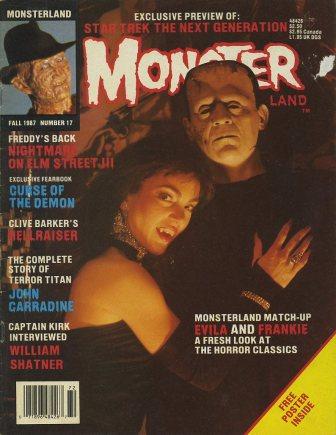
Monsterland, No 17, Fall 1987
Over a period of pages!
"There's a lot of devouring goes on in horror fiction and I can certainly trace my first pivotal devouring experience back to Hansel and Gretel. It moved me."
Clive Barker : Raising Hell In London
By Stephen Jones, Monsterland, No 17, Fall 1987
"I want to direct pictures because I enjoy the movies, but I don't honestly think that there's been a great deal of intelligence applied to the making of horror pictures. The best horror movies touch genuine nerves, things that disturb us. It's a universal form. Horror travels well."
Hell St. Blues
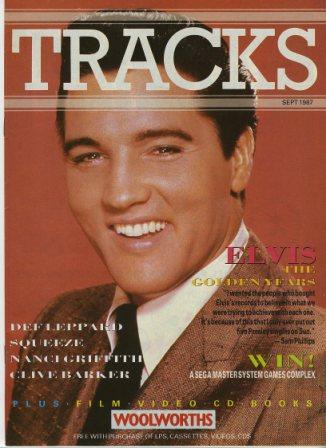
Tracks, September 1987
By Giovanni Dadomo,
Tracks, September 1987
"At the start, the budget was very modest and the thinking was that I had quite a name as a writer, so they could always print that big on a video box and at least break even with a video release."
Clive Barker
By Robert Conroy, Seconds, No 4, 1987
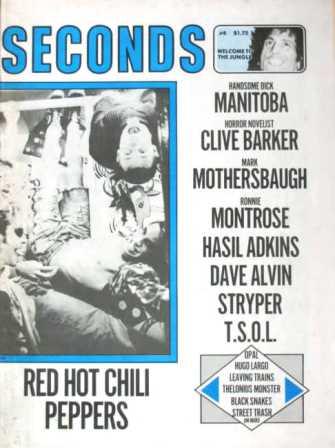
"At one point Coil were going to do the soundtrack for the film. But that turned out not to work, it wasn't right for them, it wasn't right for New World. But John [Balance] and Peter [Christopherson] and I, I guess there had been a sort of sense that we could be plain about how far we wanted the imagery to go in this picture. There was a great exchange of sort of secret imagery, photographs that we'd got in our private collections that we weren't going to show to anybody, you know?
Seconds, No 4, September 1987
"It turned out that Peter had gotten access to pictures of rituals in Sri Lanka which I also had. Pictures of people who had hooks through their flesh, and we're not talking about three hooks here, we're talking about dozens of hooks from which they hang goods of various sizes and weights. They're hooked through the flesh the way you would accidentally hook a fish hook, it drew blood but not a huge amount. The whole idea is that you reach a transcendence, an ecstasy via these means. It's a very familiar thing. A Man Called Horse has the same kind of thing in it. You press the body to its limits and then beyond, and at some point mind and body dislocate, because the mind finally says, 'I'm not taking this shit anymore, I'm getting out of here.'
"There is an argument that the same thing is going on in S&M clubs from here to Hamburg and back. That whole area of pain as pleasure and pleasure best realised through pain is one that I think fascinates more people than will admit to it. I think probably an awful lot of nice, middle class couples across America are tying each other to the bed twice-nightly, though they probably would never admit to anyone else that they do that. It's very potent imagery. It's got to be potent, otherwise why would it be forbidden?"
Slime Time
By Nigel Floyd, (i) Time Out, No 889, 2-9 September 1987 (ii) Clive Barker's Shadows In Eden (as "Clive Barker: Hellraiser")
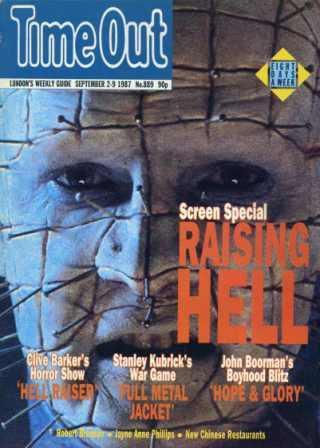
"I think in some ways I'm writing a New Gothic. My
characters tend to be a return to those marginals and
outsiders and whackos and madmen and oversexed
Time Out, No 889, 2-9 September 1987
visionaries that wander through Gothic novels doing
unspeakable things to each other. In fact I think that
the anti-Gothic, what I would call bourgeois horror, is
the kind of horror which is firmly rooted in the nuclear
family, though it tends to show it under threat...
"The characters in my fiction are very often
dreamers, lost people, people who aren't quite at ease
with the bourgeois, the domestic. What interests me is
the idea of characters who confront the extraordinary,
rather than simply finding some creatures or some
forces that they must eradicate or exorcise in order to
return to the norm they had on page one.I think of my
stories as having happy endings, perversely enough,
because they very often have scenes of revelation of one
kind or another: characters understanding themselves and
realising why they need fresh meaning in their lives.
Even if that meaning is called Rawhead Rex, who is nine
feet tall and likely to tear off their head. Even so,
there is meaning, and there are new ways of looking at
themselves in relation to their own subconscious."
Such A Nice Lad
By Diane Massey, Look Alive, Liverpool, September 1987
"You can see a film about a psycho on the loose and you might go back to your house and imagine there's a maniac in the kitchen and it's a real fear. My films are purely fantasy and what happens to my characters can never happen to anyone in real life. I like to entertain people, I don't really scare them."
Beyond Hell
By Steve Pratt, The Northern Echo, 4 September 1987
"We didn't say, 'We are going to make a test picture.' From word one we said, 'We may be the new boys but we want to
do something different.' We didn't want to be seen to be treading cautiously over familiar ground...
"This is an adult movie about adults... I think it's perfectly correct that this kind of material doesn't find its way into the hands
of four or five-year-olds, or even fourteen-year-olds. But I believe if you are eighteen you should be able to see what you like in the
cinema.
"I would not advocate the kind of movie that's mindless mayhem. I was very insistent that whatever we put into the picture
in the way of gore and slime was justified by the narrative."
Raising Hell For A New Horror
By Anne Billson, The Independent, 4 September 1987
"It seems to me that there's a reluctance to treat horror seriously or to suggest that it can say
something interesting. I don't like send-ups. I like my horror dark, and mean-spirited with a lurking subtext...
"I don't like stalk'n'slash pictures, I think that they're boring and sexist. You have an incredibly obvious divide
between what the men and women do. The women tend to get into showers and wet T-shirts, leave the door unlocked
and scream. I wanted to have women who were not standard victims."
Hit And Myth
By Imo Wilson, Midweek, 8 September 1987
"The book is romantic in the sense that it puts the magic in Cal and Suzanna's lives above the passion they have for each other. I was trying to make the reader think about the relationship between Cal and Suzanna function from another shared experience other than sex.
"What particularly attracted me was this whole idea of the imagination held in common between two people. Imagined ideas are one of the few ways I believe that we can actually express affection in a way that genuinely makes sense...
"I write a kind of fiction which allows me to create a very solid world and inject it with metaphorical elements of various kinds, with carpets and magic people. I like to imagine things beyond the stars and what happens here and see what happens when those two forces overlap or interact. I am often surprised with what are the consequences I draw; in other words I'm a bit like Lawrence in that I don't know what I think until I write it down...
"What I am trying to show is the collision of reality and fantasy. I am trying to make the fantastical accessible enough so the reader will say, 'Yes, I understand that is part of my being. It isn't that I have a real world and I have a fantasy world and it blows away when I wash my face in the morning, fantasy is actually part of my textural being.'"

Record Mirror, 12 September 1987
As A Splatter Of Fact
By Elaine Paterson, Record Mirror, 12 September 1987
"I have trouble with terms like evil. Frank isn't evil, he goes out seeking experience - pleasure and pain intertwined - of a kind that's bound to lead to bad times.
So I wouldn't see this initial drive as evil. But when he gets strong enough to turn his back on Julia he does so, and I think even a casual reading of the film
suggests that had things gone well for the couple, it wouldn't have lasted. They would have been at a marriage counsellor eventually!
"I said to Oliver Smith, 'The trouble is we've got to believe this man. Play it sexy.' I didn't want Frank to be the bogeyman."
Demons With Dark Glasses
By Kim Newman, NME, 12 September 1987
"I feel like the guy in front of the ghost traiin ride inviting people in, and having invited them in, it seems to me to be my job to provide them with the thrills. We want to make every bend more vertiginous than the last, so we have to 
NME, 12 September 1987
mount the terror and mount the vision, the revelations, until we've got something that leaves the audience trembling.
"The movie is a perverse love story, and if any element is going to deter people, it'll be the perversity. Hellraiser is a very dark piece of work. The ad line is, 'There are no limits!' We are taking audiences where they've never been. Audiences have been to Hell before, but we've got a different kind of Hell. The line between pleasure and pain, between violence and desire, is so fine, and I find that an interesting ambiguity. I wanted to make a picture which has some of the originality which I hoped to bring to my written fiction, so there's a sense that you're dealing with a mind that will push that little bit further, but not necessarily into gore.
"We're into areas of imagination, areas of bizarretie, areas of a slightly visionary quality."
Perfect Skin
By Tony Mitchell, Sounds, 12 September 1987
Sounds, 12 September 1987
"Many of my books are about sex, rather than sex happening as light relief between horrors, but it has to be said that,
as far as the censor is concerned, sex with horror is a real problem, because of the whole sex-and-violence thing.
"It seems to be OK to have sex in movies that are have-sex-and-die movies. As soon as there's a flash of naked flesh in a
Friday The 13th movie, you know the naked flesh has about 30 seconds to remain warm. There's a certain puritanical
morality - the young people screw and they die.
"Of course, Hellraiser's rather more mature people also screw and die! But they are much more authors of their own destiny
than the nubile victims of the have-sex-and-die pics.
"It was very interesting when Frank has got into his brother's skin and he and Julia have the love scene. New World said, 'Do
we really need this?' I said, 'You're kidding me. I'm not going to have these people going through all this suffering and not
get to fuck at least once!'"
Phantom Of The Box Office
By [ ], News on Sunday, 13 September 1987
"You don't have to keep going further. There's aways a fresh audience. These sort of films definitely appeal to a certain generation. You get fed up with them after a certain age... except for sick bastards like me."
Clive Barker Is Determined To Give Everyone A Scare
By John Hartl, The Seattle Times, 14 September 1987
"I have a brother who is very different from me, and so do several of my friends. I wanted to deal with sibling rivalry, and the fact that two people from the same family can have such completely dissimilar lifestyles. Then I got into the sexuality and obsession that are so much a part of my books. It's something I feel I've brought to horror that hasn't been there for a long time: the perverse erotic frisson."
Beauty Of Horror Adds Up For British Writer
By Chris Farley, (i) Chicago Tribune, 15 September 1987 (ii) (as The Monster Maker) The Dallas Morning News, 29 September 1987
"The assumption is that horror fiction is just bad fiction, or cheap fiction or exploitative fiction, which of course some of it is. But
most genres are judged by the best in their fields. Horror, unfortunately, is often judged by the worst... It's a very subversive, but
relevant genre. You're talking about things you can't address any place else, things you're told you shouldn't talk about - death,
insanity... You can deal with all sorts of forbidden subjects and that's a great thrill...
"Hellraiser is not like a hunt-and-slash picture full of teenagers cut to pieces. It's quite an adult piece of
work, I think, with people suffering adult problems. We do have our teenage hero in the person of Kirsty,
but she doesn't hold any wet T-shirt contests... In stalk-and-slash pictures you see bad performances
because the actors have been told to play victims, not to act. An actress is put in a scene to be killed by
a machete. But what's the motivation? 'Forget that,' the director will say. 'You're just here to be killed by a
machete...' This is a movie with real relationships in it and human emotions."


