Interviews 1989 (Part One)
...1989 saw the publication of The Great And Secret Show - which let on what really happens in smalltown west coast America - and while everyone was busy reading, the saga that was to be Nightbreed was just beginning with the worldwide arrival of Cabal. Clive waxed lyrical about beauty in monstrousness - he finally had the opportunity to let his cinematic vision describe one of his greatest preoccupations, even from childhood. Interviews were given describing hoardes of monstrous creations roaming Pinewood - could they all fit in just one movie? - oh yes, and what's more, they are the good guys. This was going to be everything that Underworld wasn't, the ultimate treatise on the ethos of the outsider, but with the autumn release-date missed and over two more weeks of reshoots, by the end of the year it became apparent that all was not well in the depths of Midian or with 20th Century Fox...
Hellbound With Barker
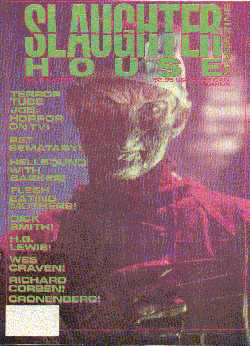 By Jim Whiting and Brad Whiting,
Slaughterhouse, Vol 1 No 2, 1989
By Jim Whiting and Brad Whiting,
Slaughterhouse, Vol 1 No 2, 1989
"I guess the whole thing is that we are now a de-deified society. We are a society without God and yet a little animal part of us still wants that God, needs those gods, and I'm trying to hold onto that kind of imagery and vocabulary."
Bound For Hell A Second Time
By Nick Cairns, The Magazine, 1989 *
"I got taken seriously at the studios around town and I'm going to remake 'The Mummy' for Universal in a couple of years' time which will be a real lark, and I'm doing something for Warners and I'm doing something for Fox. Now I think if I had made a sleazy 'Zombie Hooker' picture I wouldn't even have got through the door of those places. The only thing more difficult than getting into Hollywood is getting out."
Another Clive Barker Interview About Movies That Are... "Intense, Unapologetic, Sexual, And Psychotic"
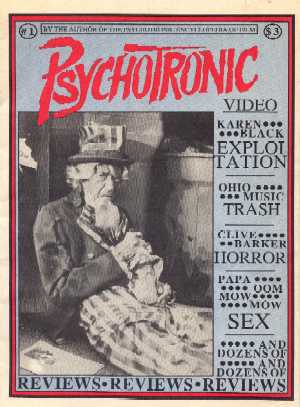 By Michael Weldon,
Psychotronic, No 1, 1989
By Michael Weldon,
Psychotronic, No 1, 1989
[As a child] "We used to stare at each horror poster that went up,
trying to figure - what the fuck goes on in this movie?!
"Sometimes what was in the imagination was better."
The Other Side Of Midnight
By Anthony H. Wilson, The Other Side Of Midnight, 1989
"There are certainly figures to prove, to indicate, that there is some correlation between sexual violence on the
screen and sexual violence as enacted in real life. Rape scenes are triggers. There are certain other visual triggers:
 blood on naked flesh - or blood particularly on naked female flesh - is considered a trigger.
"I am aware, as you are, that
an awful lot of the low budget end of horror movies exploit female nudity and female vulnerabilty particularly as a
frisson with no relation to plot or psychology or characterisation or anything like that. I mean this is the most fundamental
and brutish form of entertainment. You know, I said it before: you take the twelve most beautiful people you can
find in California, you take their clothes off and then you kill them...
"Yeah, I do [disapprove], I do - and here's my reason: the first thing is I still think that horror fiction is all too often the
last refuge of the chauvinist. I think there's an awful lot of fundamental misogyny going on in horror movies and in
horror books: women as victims still, who do stupid things in order to get saved or murdered. I kill men and
women with equal vehemence - I have a sort of open-handed attitude to murder!
"All that I'm trying to avoid is these sort of movies simply in a sort of sense, being their own worst enemies, because
I want the genre to be respected, I want the genre to be comprehended, if you like, by the critics and the
censorship boards and so on as something that has some sort of artistic validity... that the metaphors that are
being explored in good fantasy are rich and rewarding. And they are rich and rewarding because we're talking
about God, The Devil, pain, obsession, sexuality, undying love, eternity... you know, this is not light subject matter.
It may be treated in a metaphorical way but then, if you take the view that anything that has a fantastical element is
somehow or other escapist, you undervalue The Tempest and Midsummer Night's Dream amongst other things."
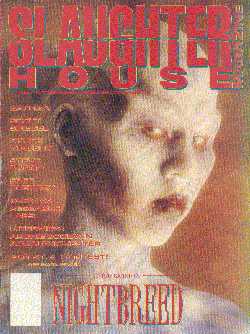
Nightbreed : On The Set With Clive Barker
By J. B. Macabre, Slaughterhouse, Vol 1 No 4, 1989
"I would like to feel that I'm not just celebrating my own imagination, but celebrating what I do, a tradition of imagining. That's why I'm so hot on literary tradition and all of that. I think that the tradition of the fantastic is horribly misrepresented, simply because the mainstream has repeatedly snatched great chunks of the fantastical tradition for itself. What it leaves is often the genre's weakest brethren. I want to be able to reinstate the fantastic. I think that the only way I can validate myself is to see myself belonging to a very straightforward and simple tradition of the storyteller, who is plugged into Jungian stuff. It's not really a question of echoing, but really advancing the stories. There is a revisionist folklore. That is plausible. It's not a contradiction. You can come at these forms and flip them around."
Stalking The Night Fantastic
 By Dave Hughes,
GM, No 12, 1989
By Dave Hughes,
GM, No 12, 1989
"I still think horror fiction is all too often the latter refuge of the chauvanist. There is still a lot of fundamental misogyny going on in horror movies and in horror books. Women treated as dumb, vulnerable creatures who do stupid things in order to get saved or murdered. I kill men and women with equal vehemence! All that I'm trying to avoid is horror movies being their own worst enemies. I want the genre to be respected. I want it to be comprehended by the critics and the censor board as something that has something that has some kind of artistic validity."
Clive Barker : What Makes Him Tick
By Tim Caldwell, Film Threat, No 19, 1989
"I prefer to do it [make movies] on a populous level. You know, Bunuel was always the art filmmaker. I couldn't give a fuck for being the art filmmaker. I want to be there on a Friday night. The first 'Hellraiser ' picture opened at 1,000 screens, now that's subversion on a grand scale, and that's the level of my ambition. I don't want to be some arthouse supremo who is seen and reviewed by people who are already persuaded. I want to persuade people who don't think they can be persuaded."
What Films Frighten...
By [ ], Imaginator, No 5, 1989
"'The Exorcist', I think, is the scariest picture ever made. 'Suspiria' also is scary. [Not 'The Haunting'] - too fucking subtle !"
Hellbound: Hellraiser II
By Alan Jones, (i) Cinefantastique, Vol 19, No 1/2, January 1989 (ii) Clive Barker's Shadows in Eden (as "See You In Hell, Darling")
"There were clearly many questions left unanswered by the film ['Hellraiser'] which we couldn't do the first time around as we didn't have the budget. The sequel was conceived with this in mind, which is why we pick up the story literally minutes after the climax. To catch the momentum and consciously carry on the mythological development was a challenge I found irresistibly exciting."
All The Gory Details
By Kent Black, M, January 1989
"Filmmakers such as David Cronenberg and writers such as myself have made an aesthetic of seeing the thing clearly - be it sexuality, madness or violent death. Earlier writers left the body on the floor and wrote 'dot, dot, dot.' I want my readers to stand there and really see that body. Every night on the six o'clock news, we are subjected to live action blood and guts. It desensitises. I am as influenced by Robert Mapplethorpe as I am by Edgar Allan Poe. The former presents a photograph for you that is clear and focussed and says, 'Here it is, take it or leave it.' Hopefully, that spirit is behind my work as well."
Clive Barker - Hell-Raiser
By Andrew Ritson, (i) Computer Gamesweek, 25 - 31 January 1989 (ii) edited slightly as 'Talking Shock (1) - Written In Blood' in Deadline, No 23, October 1990
"Death is but the beginning. Sure, there will be more adventures and more fun to be had. But your Heaven will be different to mine. Yes, there is better to come. All my heroes believe that."
Clive Barker Talks A Load Of Cabal
By [ ], Network Video, No 6, 15 February to 1 March 1989
"[I want to] re-establish a great tradition of literature- no-one bothers to put trends and values together anymore."
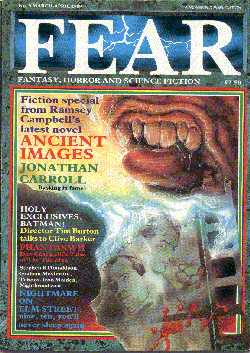
Die Laughing !
By Mark Salisbury,
(i) Fear, No 5, March-April 1989
(ii) Clive Barker's Shadows in Eden
"I hate the Batman TV series. I hate it because it doesn't have the courage to be heroic and do all the things that Bob Kane intended him to do. If you want to make a camp series then you invent something called Squirrel Man and you tell the story of Squirrel Man and you have a joke at his expense. But the fact is Bob Kane wrote the story about a kid who watches his parents murdered, who suffers, who is obsessive, and what happens is the makers of the TV series trivialise all that."
Watch Out Mr Murdoch, It's Clive Barker
By Nick Cairns, Creeping Unknown, No 9, March/April 1989
"Even in movies which are terrible, there can sometimes be moments which touch you or get to you in a way that no moment in a much better movie will. There are no moments in any of the Romero pictures which get me as much as Lucio Fulci's Zombie Flesh Eaters, which is a much inferior picture to anything George makes. There are a few moments in Zombie Flesh Eaters which just get my hairs at the back of the neck... Completely wonderful and just... completely shameless."
Profile: Clive Barker
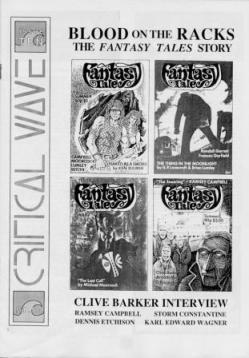
By Kev McVeigh, Critical Wave, No 10, April 1989
"I think there's quite a lot of humorous stuff in Weaveworld. I think the point is to some extent to disarm the reader. You're presenting the reader in horror with very scary stuff - in fantasy with strange, outlandish stuff - and you need almost to have a buttonholing quality. You need to be able to say to the reader, 'Hey, listen, you're gonna have a good time with me.' You need almost to be an entertainer in the broadest sense. So I use humour in the horror stuff to offset the grim material, just to simply make the grim material grimmer. There is nothing more chilling than a villain who manages to make jokes with blood all over his hands. There is nothing more chilling than an author's description of something that makes you laugh and shudder at the same time, and I like those ambiguities. In Weaveworld there are sequences which are entertaining and funny, I hope. I'm thinking of the child, Nimrod, who is in fact a grown man in baby form, happily being received into the ample bosom of one of Cal's neighbours, with Cal knowing full well that this is in fact a grown man, even as Nimrod toys with the breasts of the neighbour. These are incidental pleasures, but I think they help to make the book a more enjoyable experience."
Master Of The Macabre
By Carole R. Simmons, Campus Voice, 17 April 1989
 "Americans [are easier to shock than Britons.] Britain is the birthplace of this kind of literature - Frankenstein, Dr Jekyll and Mr Hyde, Dracula.
The extraordinary contribution America has given to the genre is Psycho. We did have Jack the Ripper, but we didn't develop him as a
merchandising tool the way you've developed Freddie Kreuger.
"Americans [are easier to shock than Britons.] Britain is the birthplace of this kind of literature - Frankenstein, Dr Jekyll and Mr Hyde, Dracula.
The extraordinary contribution America has given to the genre is Psycho. We did have Jack the Ripper, but we didn't develop him as a
merchandising tool the way you've developed Freddie Kreuger.
"It's tough to make a neat parallel between [words and movies]. The written word gets into your psyche and lingers there longer, but seeing a
movie is a collective experience; everybody jumps and hollers at the same time. I have more fun seeing horror movies, but more chills reading
horror books."
Clive Barker
By Andy Pigz, Strange Things Are Happening, Volume 1 No 5, April - May 1989
"In Weaveworld you have Shadwell who, by reducing everything to buying
and selling, shows a particular 20th Century villainy. We live in a
world in which we are sold desire and yet what we need the most lies
within ourselves, our capacity to love and our ability to share dreams
with others. The joy of being a child is the joy of an unfettered
imagination, and it also touches many areas in adulthood; our sexual
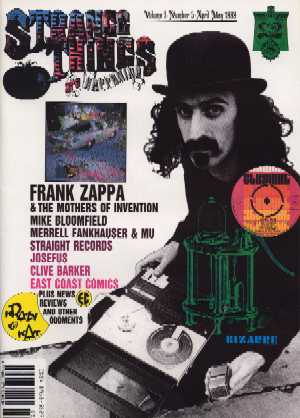 fantasies, our belief in what heaven is, the joy we take in the natural
world or the interest we take in UFO's and ghosts.
fantasies, our belief in what heaven is, the joy we take in the natural
world or the interest we take in UFO's and ghosts.
"Going back to Shadwell, he is there as the ultimate seducer, allowing
you to have whatever you most want. Yet the things people actually
want to take from him are never the things he expects them to want.
When it comes to it, it's the things we are moved by that we must seek
out and more often than not they are very simple experiences.
Unfortunately, we are in a society built on being dislocated from our
feelings and that's why people do dumb things like becoming Christian
Fundamentalists. I don't think they are particularly looking for
salvation through Christ, but have developed a real need to believe
that the world has a metaphysical dimension and that it isn't all down
to buying and selling."
Clive Barker And Director Tony Randel On Hellbound: Hellraiser II
By Dann Gire, Cinefantastique, Vol 19 No 4, May 1989
"I was in a couple of meetings where Tony and Peter [Atkins] were fine-tuning some of those shots with Julia. The two of them would have these fervid gleams in their eyes when they would talk with passion about how sexy Julia would look without her skin. For a while they debated creating a magazine for the scene called 'Slayboy' that would have the Slaymate of the Month inside. She would be lying by the fire with her skin sort of draped over the chair."
De Minuit A Midian
By [ ], Manticora, No 2, May 1989 (Note: translated from French)
"I don't want Nightbreed to be one of these movies where the story is interrupted by a sequence of special effects. The storyline has its own strength. I don't want the audience to be distracted by trickery. There are traditions of films. Those who rely on special effects grow old quickly. An American Werewolf In London is interesting, in part because its special effects are now somewhat outdated. On the other hand, La Belle et La Bete remains timeless, fabulous."
Meeting Of The Blood Brothers
By James Rampton, The Independent, 4 May 1989
"You see him [David Cronenberg] in interviews, and he's urbane, he's witty and he's dry - and then he makes Scanners where everybody's head explodes. So he struck me as an absolute gift for Decker, because Decker has this very good social front as a highly paid analyst - nicely cut suits, nice office - and at the same time he's a mass murderer and nobody knows. There's an echo in there...
Hollywood, Sex And Armageddon
By [ ], Publishing News, 12 May 1989 *
"Succinctly put, it's about Hollywood, sex and Armageddon. I wanted to do for America with 'The Art' what I hope I accomplished by setting 'Weaveworld' in England."
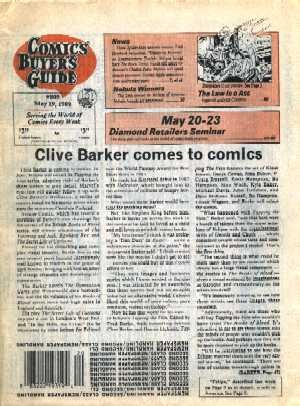
Clive Barker Comes To Comics
By [ ], Comic Buyer's Guide, No 809, 19 May 1989
"I don't think English culture in the late '50s was anything like as cinema-orientated as America. My parents went to the movies very irregularly in their courting
days; it was a treat. Very early on in my cinema-going experience I came to view cinema as a treat, as something very special, the way you would have viewed
going to the live theater. That does change your attitude.
"For a long time I viewed cinema as a mysterious, once-a-year experience which probably was associated with a birthday. And I never got to choose what to
see. That wasn't true of comics. You made your own choice, your own decisions and it gave me an autonomy in what I put into my imagination. [Comics] are
still remarkably accessible in terms of the prices and that's what makes them so potent."
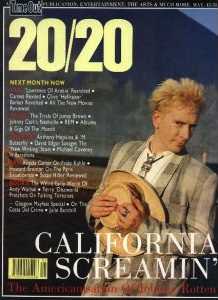
Frights Of Fancy
By Nigel Floyd,
(i) 20/20, No 2, May 1989
(ii) rewritten and slightly expanded in Clive Barker's Shadows in Eden
"The climaxes here [in Nightbreed] are emotional rather than sick imagery climaxes; they're climaxes of heroism and romance. Admittedly, the romance is sometimes very perverse; I mean, what's going on between Boone and Lori is extremely perverse - they fall more and more deeply in love the deader they get."
Nightbreed Set Visit
Saturday Night At The Movies, 27 May 1989
"Nightbreed's a very dark fantasy movie. It's not a horror movie in the way that Hellraiser was. When it gets violent, it certainly gets violent but it's not strictly speaking a horror movie.
"I'm really interested in making high quality, imaginative entertainment which is unlike anybody else's high quality, imaginative entertainment - that's what's important. I think that people will come out of this movie and say, 'Well, Clive Barker certainly had his stamp on that...'"
Nightbreed
By Philip Nutman, Fangoria, No 83, June 1989
"There's an important distinction between Hellraiser and
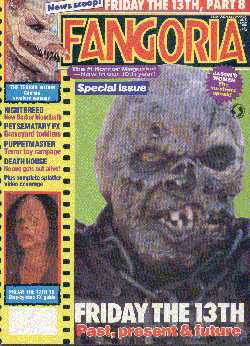 Nightbreed. Hellraiser was an intelligent low-budget
horror movie, but we didn't really have much visual
sweep. We had a house in Cricklewood and limited sets.
For Nightbreed, we have three soundstages at Pinewood
Studios, Canadian locations, 60 monsters and David
Cronenberg in a major role. It's a big canvas.
I'm excited. We have the possibility to make a horror
picture with the visual richness of a Hieronymous Bosch
painting.
Nightbreed. Hellraiser was an intelligent low-budget
horror movie, but we didn't really have much visual
sweep. We had a house in Cricklewood and limited sets.
For Nightbreed, we have three soundstages at Pinewood
Studios, Canadian locations, 60 monsters and David
Cronenberg in a major role. It's a big canvas.
I'm excited. We have the possibility to make a horror
picture with the visual richness of a Hieronymous Bosch
painting.
"We have some extraordinary creatures, many of whom are
extremely violent and require several elaborate effects
gags. We're contractually obliged to deliver an
R-rated picture, so it won't be as gory as the
Hellraiser movies, but there's lots of visceral
material. I think it'll be more exciting since the
kind of imagination that created the Cenobites has
been given free reign. Although we had limited money
on the Hellraiser films, we created images that touched
people; here those images are times 10, some of the
weirdest monsters ever seen."
* Quote taken from extracts presented in Clive Barker's Shadows In Eden, edited by Stephen Jones - full text wanted.
Click here for Interviews 1989 (Part Two)...


