Interviews 1996 (Part Two)
Clive Barker
By Terry Lipelt, In Audio, Vol 4 No 7, July 1996
![Lost Souls, Issue 4, [July] 1996](inaudio96.jpg)
"The internal life that we have occupies us, and I'm not just talking about myself as a writer, it's true of everybody. We live in our heads. We live with memory, we live with projections of what it's going to be like tomorrow. You may be having this conversation with me and your brain is doing 12 other things at the same time. You may be thinking about what the whiskey and sour is going to be like tonight! Some of those things are projections, some of them are memories, some are sheer fantasies. Tonight you're going to have eight hours of sleep and some of that time your mind is going to be working, creating extraordinarily rich and surreal images...
"What I've done is make a profession of accounting for what my subconscious is doing. What I've done is make a system or a scheme to keep things intact. I keep a dream journal of images that I sketch. I put entire dream scenes into books. And certainly as children in our lives, we're helped by, and maybe even shaped by, extraordinary tales that are unreal - but that can help us understand who we are. Isn't that what the Wizard of Oz does? Isn't that what Peter Pan does? Isn't that what Alice does when she goes through the Looking Glass? She helps us understand the world. I think too many of us are ashamed to admit that it's a part of our lives...
"The interesting part about the three stories we've just talked about, is that if you think about Alice, Peter Pan and the Wizard, there is some darkness in those stories. I mean, the flying monkeys scared the bejesus out of me when I was a kid. I remember seeing Pinocchio as a kid and actually not being scared so much as excited by the transformation of boy into donkey. The shadow on the wall... I haven't seen that movie in a long time and it's still etched into my subconscious. In other words, I think that to tell a story about the world, and not tell about the darkness, is to be untruthful. "
A Conversation With Clive Barker
Harper Collins press kit for Sacrament release,
reprinted in Lost Souls, Issue 4, [July] 1996
"I was surprised at the extent to which I revisited my childhood in
writing this book. I was surprised that 'Lord Fox' - a character who
is both human and animal, as well as an expression of Will Rabjohn's
subconscious - became such an interesting character. I was also
surprised at how important it became to me to track Patrick's story and
evoke the feelings we have as we watch him. Patrick is Will's ex-lover
who has AIDS and is determined to die with dignity. In the year and a
half that I took to write this story, several close friends died of
AIDS. It's not a negligible thing nor something to ignore or gloss
![Lost Souls, Issue 4, [July] 1996](lostsouls4.jpg) over. A lot has been written about this deadly disease including
entire books that have tracked the fall and demise of people who have
been stricken with it. I wanted to fold that story into the texture
of Sacrament while retaining the celebratory element of physicality.
I didn't want the book to come out as 'anti-sex'"
over. A lot has been written about this deadly disease including
entire books that have tracked the fall and demise of people who have
been stricken with it. I wanted to fold that story into the texture
of Sacrament while retaining the celebratory element of physicality.
I didn't want the book to come out as 'anti-sex'"
Confessions
By [Stephen Dressler and Cheryl Bentzen], Lost Souls, Issue 4, [July] 1996 (note : full text online at the Lost Souls site - see links)
"Quentin called me up to ask me to do the introduction for 'From Dusk Till Dawn', which I was happy to do. A little before Christmas I went up to the editing room to see the movie in its rough cut, from which I then wrote the introduction. I'm a great admirer of what Quentin does and it's nice to know that Quentin likes what I do. Can you imagine the combination, my god! The most violent movie ever made - Quentin Tarantino and Clive Barker! "
No More Cuddly Aliens
By Jane Ganahl, San Francisco Examiner, 3 July 1996
[On Independence Day] "There is something very xenophobic about all of this. This culture has a primal impulse to point to another tribe and say, 'They are less than we are.' We constantly throw the source of wickedness onto others outside the tribe, even inside if you are too different. So while everyone's feeling very gung-ho about this movie, I question the morality of it... My argument is that you judge a culture as much by its popular culture as by its higher art forms. You can say it's just a popcorn movie, but it's going to be a fucking huge popcorn movie - not just here but around the world. It's how America is going to be representing itself. There is something pernicious about that."
Author Clive Barker Takes Your Questions
On Line Interview 9 July 1996 by Gordie Meyer,
[supposedly on-line at http://bbs.iguide.com/books/clive/ but we've
never managed to make the link work...]
[]
Hoods Cast, Crew Sweating Out Killer Deadline
By Marilyn Beck and Stacy Jenel Smith, Los Angeles Daily News, 10 July 1996
"My next movie project will be an original script called 'American Primitive', about American artists who create from their visions of angels and spirits."
Clive Barker Drops Horror
By Kim Covert, (i) Winnipeg Free Press, 11 July 1996, (ii) as 'Horror Author Tackles Species Extinction', Canadian Press, 12th July 1996
[re. Sacrament] "I don't want to write issue books, in the sense that
'now Clive Barker is going to stand on his soapbox and lecture you
and wag his finger at you,' because that's not fair, but I would
like to give, in the context of a story, some expression of the
things that I feel deeply...
''But this is the first time I've really worn my heart on my sleeve where that's
concerned and I think that's a response to a kind of
urgency I feel about the screw-ups we're making.''
Diary
By [ ], The Sunday Times, 14 July 1996
"[Tiree]'s a wonderful place for just meandering; not that you can get far, my family still have many friends on the island...
"This book [Sacrament] is as close to autobiography as I have yet come, so it was obvious that Tiree, which figures so strongly in
my memories of childhood as a place of magic and mystery, would play a strong role in it."
AOL Appearance
Transcript of on-line appearance 16 July 1996, (note : full text online at the Lost Souls site - see links)
"I began with short stories because they seemed easiest to write, but I very soon dreamt up stories that needed a larger canvas. Inevitably I turned my attention to novels which grew in scale as my ambition grew. One of the extraordinary things of being an artist, whatever the medium, is that really there is no definitive moment (at least in my experience) when you say to yourself: I know how to do this. To be perfectly honest, every movie I make, every book I write, every painting I paint, feels like an experiment."
Sacrament Of Extinction
By Chauncey Mabe,
(i) South Florida Sun-Sentinel, 18 July 1996, (ii) as 'Clive Barker Gives His Fans Dose Of Reality', Orlando Sentinel, 4 August 1996
"Our future depends on what kind of stewards we are of the Earth. And so far we're doing
a lousy job. Popular culture has damaged the natural world by teaching us to be afraid of
great white sharks or twisters, when in fact the main aggressor against man is man.
"Even though I write fantastic literature, I try to connect with the real world, to
connect with real crises by the use of allegory. Our culture still harbors deep, deep
veins of homophobia. But as a gay man, I can stand up and yell. Animals can't. We have to
be voices for the things that can't cry out. This book tries to do that.
"It's interesting to make the hero of such a story a genetic cul de sac. As a gay man, he
won't be leaving behind any children to tidy up his loose ends. He has to solve his
problems in his own lifetime. It seems to me that Will's homosexuality fits neatly here."
WPLN Interview
Transcript of 'Consider This' Radio Interview, WPLN, 19 July 1996 by
Scott Smith
"We see everywhere this kind of collision of human necessity, economic necessity, and the needs of the species with which we share the planet. And of course it's always the other guy that goes down. It's not us. We in America... and I live here; I can't vote yet, but I consider myself part of the culture... we consume a vast amount of the world's resources, and we consume much of that completely unnecessarily because we have great demands for choices. There's a greater demand for choice in this culture than any other culture in the world... in the history of the world. You only have to go into a supermarket to see. You know, we're not content with five kinds of cereals; we need a hundred and five. We consume, we consume, we consume, things that have no defence against us, animals, things of beauty, things which even if you want to think of it on a very selfish level can potentially be useful to us. The observation has been made very often that perhaps the cure for cancer is somewhere in the Amazon even now in the form of an insect that's sitting up a tree which is being felled. Species we don't even have time to name are going to extinction in the Amazon right now. So I do whatever I can do to voice my opinion. And actually to go on shows like this and talk to you and speak about it... that's one of the issues of the book that I feel very passionate about and I want to be able to do it. "
Dark Fantasy: A Peek Into The World Of Clive Barker
By Susan Larson, The New Orleans Times-Picayune, 23 July 1996
"I'm letting the thing which is going to obsess me next come to find me. I want
my books to fill me up and use me up. I think it was Balzac who said, 'I'm
empty of talent and power and energy,' and I thought, 'That's cool.' I like
the idea that God fills you up. I have my time on the planet to tell the
stories that have been given to me.
"I dug deeper than ever before in this book [Sacrament], particularly in those scenes
of people dying of AIDS, and I found that writing about love was so much
more difficult than writing about hate. I don't think my own search for
meaning was as much in focus before this book as it was when I was
finished.
"There was a period of about a month when I was lost to the world. I wrote
and meditated and tried to find a way to intensify the experience. How can
I make those words sing so strongly that the reader sees and feels what I
see and feel? What can I pluck out of their hearts?"
Clive Barker Takes A Bite Out Of South Florida... But Misses The Jugular
By Michael W. Sasser, The SunPost, South Florida, 25 July 1996
"At literature's best, it addresses substantial issues in the subtext. I remember seeing A Midsummer Night's Dream and being drawn to the image of Pan's sexuality. Some people see the play as a little fantasy and nothing else. But there's more. Pan's sexuality has aspects of androgyny and bestiality... it displays this as the norm... living a pure life... becoming more primal. In fantasy it's free form reality. When I saw the play, I understood the sexuality and it touched a nerve in me...
"I don't know if there will be any backlash because of this book [Sacrament], but I'll take it if there is. What the fuck. This is who I am, and anyone reading between the lines of my work could put the pieces together... even in the Hellraiser movies, there are elements. I don't think people who are fans of my work already care that I go home to my boyfriend instead of my girlfriend."
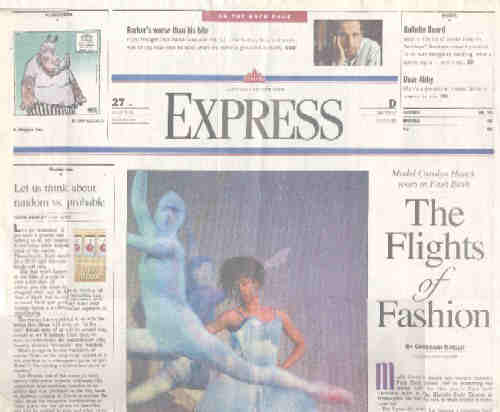
Barker's Worse Than His Bite
By Mary Ann Grossmann, Saint Paul Pioneer Press, 27 July 1996
"We're at a time when we are asking questions about where we took a mis-turn. How did we get to this place? We don't believe in
politics anymore, don't believe in our dreams, we've lost God and we're screwing up the planet.
"I didn't want to bring in a creator; that's a different book. I wanted to stop with the evidence that's before our eyes and not offer, as
I've done in previous books, an alternative theology. There's absence of absolute good and evil [in Sacrament]. I really wanted to put
at the heart of the book the things that are in the world with us. And I really think that, if animals could talk, they would say what Lord
Fox tells Will - that they wish humans would disappear from this planet."
Clive Barker
By Timothy Nasson, In Step Magazine, Volume 13, Issue 14, 25 July - 6 August 1996 (note : full text online at the Lost Souls site - see links)
"My work is behind the camera. The movie-going audience doesn't have to relate to me. And the same thing goes for the writers. I can write about gay characters and people won't see me as they might a male homosexual movie star who chooses to stay in the closet because of the negative effect coming out may have on his box office draw. It really would be inappropriate for me to proscribe what others should or should not do."
Horror Master Clive Barker Talks About Life, Creation And The Complex Gay Hero Of His Newest Book
By David Parnell, This Week In Texas, 2-8 August 1996
"I've lost a lot of friends [to AIDS]; I lost my cousin Mark, who lived in Yorkshire in the village which I've described and then renamed as Burnt Yarley in the book [Sacrament]. So Burnt Yarley is Mark's hometown, or home village, and I hope he's reading the book right now and thinking well of 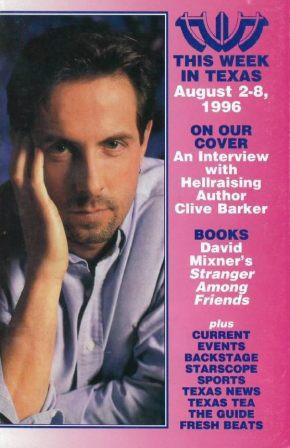 my description. So I lost my cousin, I lost a lot of my friends, and what's important to me is to make stories and stimulate people's imaginations but also connect with the here and now, connect with who we are right now, what the planet is like right now, what the hopes of the world are right now, what are the things that bring us close to despair.
"The plague is very terrible, and some of the most extraordinary mail that I have received on Imajica has come from men with AIDS reading the book and finding a character who was them or was close to them in the book and finding they had a place in this mythology that was an important and heroic place, as opposed to being characterised as victims, as people who were somehow or other just to be pitied - incredibly moving letters, and letters from the lovers of men who died saying, 'Your book was on my lover's bedside and this is what I was reading to him in his last days.' Just extraordinary stuff."
Hell-raiser On A Spiritual Quest
By Jane Ganahl, San Francisco Examiner, 11 August 1996 (note : full text online at the Lost Souls site - see links)
"Will's sexuality [in Sacrament] is not just an interesting detail, it's central to the theme of the book. But he's also a guy who has lived his life and is saying, 'I don't know what this adds up to'. He captures life on film, but retreats from it. It's one reason I wrote the book because I'm there myself. It was a self-criticism. It was a way to wake myself up, to tell myself, 'Don't just be a witness.' "
Saturday, CBC Radio
By George Affleck, appearance on Saturday, CBC Radio, Vancouver, 15 August 1996 (transcribed in an edited format as From The Minds Of Masters in Shiver, No 2, Winter 1997)
"I've been on the road now for six weeks, this is the last day of six weeks of touring, and can't tell you that  it's an enjoyable process, by and large, because you're in a lot of hotels, and you're in a lot of lounge rooms, and eating a lot of airplane food. But at the heart of the whole thing are two experiences. One is this experience of talking with somebody about the book and why you wrote it and so on. And the other is the most important experience, beyond the writing experience, that I can have which is to meet and talk with the people for whom I wrote the books...
"I think that movies carry a larger clout in the way that we look at people than the books do, and I think that's regrettable. I mean, the Hellraiser movies, the Candyman movies, Lord of Illusions, they're all out there doing their thing. Pinhead, from the Hellraiser movies, is this kind of monstrous icon in certain quarters, he's known around the world. I have very mingled feelings about that. I mean, I'm grateful for the fact that those movies have drawn people to the books, but the books are infinitely more important to me than the movies are. Books are more important than movies. Not just my books being more important than my movies; the experience of reading is far more important to me than the experience of seeing the movies. And so it's something of a monkey on my back, to be perfectly honest, and I'm a little weary of it. I'm a little weary of how important people see the movies as being. I'm finishing the tour today and then I'm gonna go back and write some books, and stay away from the bright lights for a while. I mean, it's not really my nature to be doing this. Even being public, I don't particularly like that. What I enjoy is being at home with my dogs and my lover and writing books."
Coming Out No Horror For Barker
By Wilder Penfield III, Toronto Sun, 17 August 1996
"So much of my working life is spent in a fictional world, that it's important for me to keep restocking my imagination with slices of reality."
Sacrament Full Of Gay Lifestyle
By Damian Inwood, Province, Showcase section, 19 August 1996
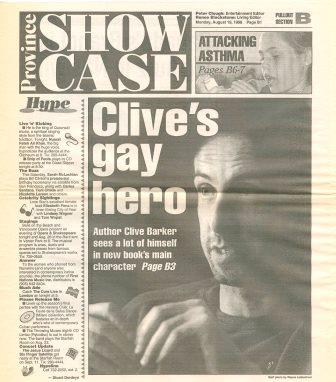
Province, Showcase section, 19 August 1996
"I've never been mauled by a polar bear but I've obviously had a lot of friends die of AIDS. I've relocated, as Will has, from England to America. I have a passionate interest in the environment, I love animals and I've made some little celebrity for myself studying death, as Will has...
"There's really no reason why a mainstream novel doesn't have a gay hero. Yes, he's queer; yes, he's living a very complex life, but the spiritual search he's on, the sense that he's reached a crossroads, those are universal issues. You know, gay readers have put up with straights for such a long time - a little quid pro quo, please. I mean, I wanted Romeo and Thibault so badly."
LoveLine
Transcript of appearance on TV show, LoveLine, 21 August 1996 (note : full text online at the Kazmierczak site and the Lost Souls site - see links)
"I made the first Hellraiser movie, this is the honest truth, ten years ago for $21,000. I wrote and directed it for $21,000. And I signed away the rights in perpetuity... You do these things and they seem dumb in hindsight. But the truth is, they were giving me a million dollars to make the movie. And who knew that there were going to be sequels and plastic models and... At the end of the day, I don't regret it. At the end of the day, somebody gave me some money and said go make a movie and I had a great time."
The Charm Of 'Mr. Pinhead'
By Brett Josef Grubisic, XTRA! West, 22 August 1996
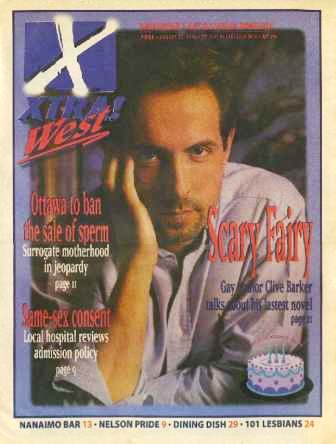
XTRA! West, 22 August 1996
"Our current psyches are such that we can't have the taboo and celebrate it without also punishing it. One of the things I've tried to do in my fiction is say, 'No, wait a sec. We like these things. These things are access to another place in us.' Are they morally ambiguous? Of course. But we are morally ambiguous, that is the nature of being human.
"I think the monstrous is connected to some part of ourselves. In other words, it is the opposite of what the conservative mind says: it says, 'Don't! That's taboo for a reason. Just keep away from it.' I say the reverse. If the idea of sleeping with a woman stirs you up, look at it. If the idea of sleeping with a guy disturbs you, look at that too. Go sleep with a guy! Our culture wants us to avoid these things. We're better wage slaves if we go along evenly. We'll buy more shoes or hamburgers if we're not stirred up. What the artist is constantly saying is, 'Hey, get stirred up. Connect. Let your heart beat faster.'"
Clive Barker Comes Out
By Linda Richards, January Magazine [September 1996] (note : full text online at the Lost Souls site - see links)
"All that stuff about Will when he first goes to Boston as a 19 year old. That's all me. That was me in Boston when I was 19 and 20... And, uh, when I was 20 I had a... hmmm... how am I going to say this? I had an older admirer that facilitated a lot of things. And so I went to Boston and I spent a lot of time in America when I was young."
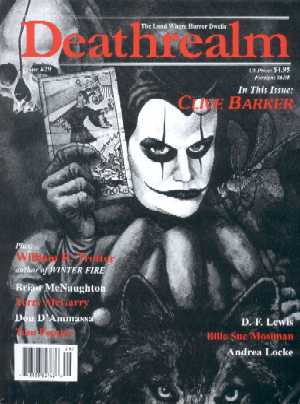
A Graveside Chat With Clive Barker
By Jim Moore, Deathrealm, No 29, Fall 1996 (note: interview took place in 1995)
"I feel as if I'm basically describing the same territory. Even though the forms are different, and obviously the techniques and demands are different, the business of describing what's going on between my ears, and passing it on to someone else, is still the same. I feel as though whatever I choose to handle in my description - be it with paint, pen or camera - the investigation is all of the same territory. I live in one country, and it's the country between my ears. I choose to make different reports out of that country in different mediums, but I know it would be possible to trace connections between the images I create, and the stuff that's in the books and in the movies, without any problem at all. It doesn't feel as if there are any great schisms or great fractures between the worlds which are being described."
Sensual Sensibility
By Michael Glitz, Out, No 36, September 1996
"Sacrament is a redemptive story, and even though it plunges very deeply into the things that give me anxiety as a human being living in an increasingly spoiled world, I do think there's plenty of light at the end of this tunnel... One of the things that horror does is deliberately address issues in a very extreme form; so it's kind of aversion therapy. You get to look at these things in an extreme form and, yes, in a safe situation. I think movies in that sense can be quite theraputic; they can strengthen your antibodies where this stuff is concerned."
Lord Of Illusion
By [ ], Home Cinema Choice, September 1996
"This extra stuff includes intense material, dialogue
material, subtext material - a lot of stuff that helps
people understand what the movie is all about. It's
 not twelve and a half minutes of blood and gore, it's
actually the thematic guts of the movie. What MGM/UA
did, and I'll think they're wrong till the end of my
days, was say that this isn't enough of a horror movie,
we want to make it more intense. It was a bad
commercial decision in my view. They wanted to take
out some of the detective elements. I said no. Part of
the point of the movie is that is a genre-breaking
movie. It moves from film noir to horror and back and
forth and that's what makes the movie work. But
MGM/UA was adamant. They said, 'We're gonna take this
stuff out, either you do it or we do it'. So I said I
would take it out, so long as they promised me that a
director's cut would come out on video and laser disc.
Worldwide."
not twelve and a half minutes of blood and gore, it's
actually the thematic guts of the movie. What MGM/UA
did, and I'll think they're wrong till the end of my
days, was say that this isn't enough of a horror movie,
we want to make it more intense. It was a bad
commercial decision in my view. They wanted to take
out some of the detective elements. I said no. Part of
the point of the movie is that is a genre-breaking
movie. It moves from film noir to horror and back and
forth and that's what makes the movie work. But
MGM/UA was adamant. They said, 'We're gonna take this
stuff out, either you do it or we do it'. So I said I
would take it out, so long as they promised me that a
director's cut would come out on video and laser disc.
Worldwide."
Clive Barker - Lord Of Illusions
By Nigel Floyd, SFX, No 16, September 1996
"The question is, 'Is what Swann performs on the stages
of the world an illusion or is it the real thing?'
That's a fine line to walk because one of the things
you're doing in the movie is you're actually making
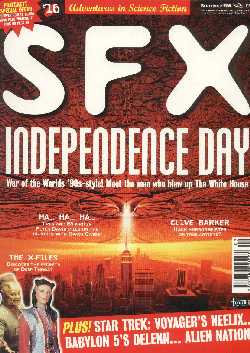 illusions, cinematic illusions, to represent magic that
in some cases may be illusions. So it's fun. I like
those different levels. I thought that film noir
pastiche had already been done brilliantly by Alan
Parker in Angel Heart - all those smoky interiors with
latticed light falling through. That's one of the
reasons why I moved the setting from New York to Los
Angeles, because in doing that I felt I was shrugging
off a lot of those darker, noir-ish moods. And at the
same time taking it into the sun, into the landscape
that Chandler had made his own in his Philip Marlowe
books. It also enabled me to put some images on to the
screen that you don't often see in horror movies, like
light and palm trees...."
illusions, cinematic illusions, to represent magic that
in some cases may be illusions. So it's fun. I like
those different levels. I thought that film noir
pastiche had already been done brilliantly by Alan
Parker in Angel Heart - all those smoky interiors with
latticed light falling through. That's one of the
reasons why I moved the setting from New York to Los
Angeles, because in doing that I felt I was shrugging
off a lot of those darker, noir-ish moods. And at the
same time taking it into the sun, into the landscape
that Chandler had made his own in his Philip Marlowe
books. It also enabled me to put some images on to the
screen that you don't often see in horror movies, like
light and palm trees...."
Illusions Of Grand Gore
By Michael Beeler, Video World, September 1996
"One of the things I tried to do with Illusions was to put some spectacle back into the genre. I don't mean special effects spectacle, though we have that as well, I mean in terms of the scale of it. This movie takes place in beautiful houses in Bel Air, the theatre, the desert, Los Angeles and New York. A whole range of things that make it feel noir, in a sense, where the detective moves from element to element, always searching for some fresh clue 
Video World, September 1996
that leads him on down the line.
"Horror movies by and large are a claustrophobic experience, aren't they? The first Hellraiser movie takes place in a house, Nightmare on Elm Street is a furnace room in a house, Alien is a closed system. It's one of the things you say about horror movies. They tend to have enclosed systems because claustrophobia feeds the fear. What we tried to do with illusions was play into something very different, give people an openness, with a much more open-ended narrative. I don't think that people will be able to guess the ending halfway through...
"This movie is a little like Chinatown meets The Exorcist, it has a Chinatown kind of feel to it: mystery, beautiful women, terrible secrets. And then it has demonic forces treated very seriously, the way The Exorcist did. It's more like a collision course. I take the scares in this movie very seriously, the tongue is nowhere near the cheek. The intention of this movie is to give people a profound sense of dread and send them out of the movie thinking, 'I tasted something, I felt something.'
"You know, I hate horror movies that make you laugh. I hate horror movies where the tongue's in the cheek. Why do that? If you're going to scare people, do it. At least try it. I mean, you can never know if you're going to succeed, but you hope you're going to succeed, so go the distance. That's what people are coming to a horror movie for, isn't it? You know, to have the bejesus scared out of them."
Confessions
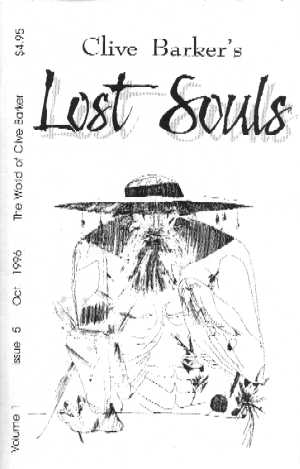
By [Stephen Dressler and Cheryl Bentzen], Lost Souls, Issue 5, October 1996 (note : full text online at the Lost Souls site - see links)
"[William Friedkin] and I had lunch about four months ago just on the basis that we wanted to be in business.....I love what he does, he loves what I do. I said what about Damnation Game and he said I love that book let's talk. I think he'll be tremendous if we could pull it off because 'The Exorcist' remains one of the best horror movies of all time and I think many of his movies were under-rated. I'm a huge fan of 'To Live and die in L.A.', which I think was absolutely a first rate picture. I would love to be in business with him."

The Pen Versus The Digital Sword
By Joel Enos, Computer Life, Vol 3 No 10, October 1996
"My books are all virtual worlds, books about virtual space. The worlds are either interdimensional or between your ears, but they allow the reader to take on an identity other than their own. [There's a] natural parallel to to the internet."
The Inquest Q & A
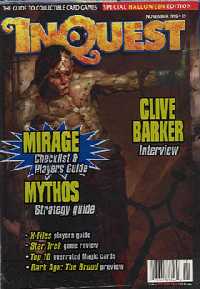
By Rick Swan, InQuest, No 19, November 1996
"[I grew up in] the 50's in post-war England. It was pretty gray, pretty drab. It drove me to the library a lot. We didn't have a television. We didn't see movies. I probably saw four movies in the first ten years of my life. I think in the long run that was pretty good for me, actually. It made me read books. And the public library was free."
The Brains Behind The Pain
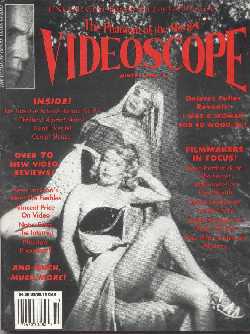 By The Phantom Of The Movies,
Videoscope, No 29, Winter 1996 {note : interview took place in August 1996}
By The Phantom Of The Movies,
Videoscope, No 29, Winter 1996 {note : interview took place in August 1996}
"I wanted to aspire to making a picture [Lord of Illusions] that was not going to insult anybody's intelligence; you don't have to check your brain in to see the movie. You don't have to say, 'Well, it's just a horror movie'. It's a movie. A sick and twisted movie, but a movie, with a story, a mystery, with a beginning, a middle and an end. Not just people getting set up to be killed... Psychologically we play with people's heads, we have hallucinatory stuff, we play with people's bodies, with the piercings and impalings; we also play with the stuff where the audience is just discomforted because they're in the company of characters whose world view is totally different from their own. They're not demons, they're not supernatural entities, they're not paranormal entities, they're human beings - they're just off. I find that very interesting. I find that more disturbing than Freddy or Pinhead."
Click here for Interviews 1997...


