Interviews 1998 (Part Two)
Confessions
By [Stephen Dressler and Cheryl Bentzen],
Lost Souls, Issue 11, September 1998 (Note : interview took place in August 1998)
"I think I get looked down on for not using [a computer], yeah sure. I
think people are surprised by it. There's an element of disbelief that
I would handwrite this big book. Do I not have mentally what it takes
to operate a computer?...I've done two or three online appearances and
I think they have been very successful. I've been able to answer only a
tiny fraction of the number of questions I get asked but nevertheless
 we were able to do some of them."
Jane Hawtin Live With Clive Barker
By Jane Hawtin,
Tribute, Volume 15, Issue 6, September 1998
"[Galilee] is not 'Titanic', that's not what I can do. I am a man whose vision of the world is not going to be Leonardo and Kate in a clinch while the ship goes down. Love in the world I inhabit has powerful, sexy characters who are engaged in behaviour that is rather strange and forbidden."
Clive Barker
By Michelle Russo,
(i) online at www.gothicchicago.com, September 1998
(ii) Lost Souls, Issue 12, January 1999
(iii) Outburn, Issue 8, May 1999
(iv) M.K. Ultra Magazine, Summer/Autumn 1999 {Note : interview took place in August 1998}
"I think you can ask most kids at a certain age, 'Is your secret friend
real?' or, 'Is the secret land that you go to in bed each night real?' I
think the kid would say yes. What happens when we get older is a
different thing. We are told that this kind of imaginative escape
 within ourselves is not really important in the world. We are told it
will not get us where we want to get and it will not get us all the
glossy wonderful things they show us in ads. Therefore it is not so
terribly important. So one of the things that happens in our culture
is we become diseased with a damage to the psyche and our imagination.
When we are told this stuff is no longer important, the other thing that
happens in American culture more than anywhere else in the world, is
that other foolishness comes along as a substitute for these
imaginative things. For instance, the case of many Americans who
believe they are regularly being whipped up into spacecrafts and being
rectally examined by aliens. Aliens are no less fanciful than
NeverLand, Imajica or Middle Earth. I've encountered people on the
internet who said they have met angels, or been abducted by aliens or
whatever. I find it to be a very dangerous possibility that we are
slowly sliding to a place where we cannot distinguish what is real and
what is not... I am a fantasist, a professional imaginer. Perhaps you
would expect me to encourage people to muddy the waters of reality, but
I will not. I find the idea of people who believe in angels and
abductions uncomfortable."
within ourselves is not really important in the world. We are told it
will not get us where we want to get and it will not get us all the
glossy wonderful things they show us in ads. Therefore it is not so
terribly important. So one of the things that happens in our culture
is we become diseased with a damage to the psyche and our imagination.
When we are told this stuff is no longer important, the other thing that
happens in American culture more than anywhere else in the world, is
that other foolishness comes along as a substitute for these
imaginative things. For instance, the case of many Americans who
believe they are regularly being whipped up into spacecrafts and being
rectally examined by aliens. Aliens are no less fanciful than
NeverLand, Imajica or Middle Earth. I've encountered people on the
internet who said they have met angels, or been abducted by aliens or
whatever. I find it to be a very dangerous possibility that we are
slowly sliding to a place where we cannot distinguish what is real and
what is not... I am a fantasist, a professional imaginer. Perhaps you
would expect me to encourage people to muddy the waters of reality, but
I will not. I find the idea of people who believe in angels and
abductions uncomfortable."
Clips: What's Your Favourite Video Scene?
By [ ],
Movieline, September 1998
"The marriage scene from The Scarlet Empress with Marlene Dietrich. Why? It's one of the most lushly beautiful scenes ever. It's also deeply perverse."
E! Online Horror
By Jim Hosney, a lecture from E-Online Filmschool, October 1998 (Note : transcript of Barker's contribution online at the New Yzodderex site as We Pinned Clive Barker Down and He Made Short Work of Your Questions, full lecture online in RealAudio at the Lost Souls site - see links)
"Anchorites were medieval women who led an extreme life of commitment to Christ and the Church. A male equivalent is a Cenobite. It's an inverted religion in a sense. The direct opposite of the female counterpart. The whole reason that Pinhead is a leader is he intones lines in the same religious detachment. Think of this in context - when the film came out, monsters were rather mindless, like Michael Myers, or jokesters, like Freddy Krueger. But Pinhead wasn't; he was almost elegant, an intelligent monster."
Clive Barker's 'Freakz'
Universal Studios press release about the Halloween Horror Nights attraction designed by Barker, October 1998
"Audiences have become accustomed to experiencing images of extreme
intensity and violence, so we've had to go in a more dramatic and
unique direction to create this environment at Universal Studios. I
intend to take away the audience's sense of control, take away their
zone of comfort. In 'Freakz', every corner is loaded with something
that will make their adrenaline rush, make their palms sweat, truly put
them in a state of fear.
"My work in [theatre] has left me with an appreciation of things that
can be done in a 'live' medium that simply cannot be done in movies.
In 'Freakz', there will be the dread of physical contact, the chance
that this thing is going to touch you. There will be the sense that
these creatures will be coming at you from all angles. Although the
audience will have the choice of where to look, they won't be able to
simply avert their eyes from the screen as they do in the movies. An
important element of their safety net will be removed. It promises to
be a far more physical experience than the cinema affords. "
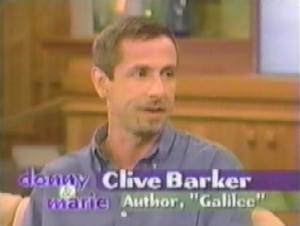
Clive Barker
By Donny and Marie Osmond, The Donny and Marie Show, 8 October 1998
"I think our imaginations are a continuum. I think the divisions, honestly Donny, are artificial. When you're dreaming, you don't divide up the dreams of childhood and the dreams that might scare you or the dreams of your professional life or, you know, all the nightmarish things that come to everybody at some point. We don't make those divisions: our imaginations flow. I think that what we do in our culture is we say, 'OK, here's a time we have to be serious, now here's a time we can be childish, here's a time we can be sexy and here's a time we can't be sexy.' I don't think that's the way our minds work. I think actually sometimes, perversely, we can actually have things arise in our heads which are wholly inappropriate. You know, you're sitting in church and a sexy thought comes into your head - what's that doing there? Well, it's there because your subconcious wants it to be there and you have no control over it... I don't think you should have control - I think we control our imaginations way too much and, you know what, other people control them for us: big corporations control them for us, they give us things to dream about instead of making space for us to dream for ourselves."
'Freakz' Alive, Clive!
By Rob Lowman, Los Angeles Daily News, L.A. Life, 14 October 1998
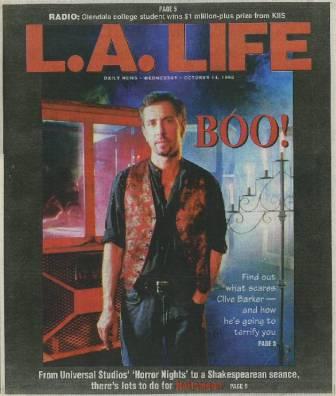 Re. Freakz: "[Universal] haven't made me water anything down, if we gave [the audience] watered-down scare they'd be angry... There's
something deeply perverse about this. If something like this happened to us in real life - a completely negative thing - we'd reject it
wholesale. But if it's a safe environment, like a movie or a ride or a book that we can put down, there's a very strong public appetite
for it.
Re. Freakz: "[Universal] haven't made me water anything down, if we gave [the audience] watered-down scare they'd be angry... There's
something deeply perverse about this. If something like this happened to us in real life - a completely negative thing - we'd reject it
wholesale. But if it's a safe environment, like a movie or a ride or a book that we can put down, there's a very strong public appetite
for it.
"What it is, is a confrontation with death in a very safe environment. If we walk away from the play environment having confronted
death ... then maybe we are stronger when we confront it in the real world. We all need to do this. We're all going to die.
"The years tick on and you get closer to the end, and that's part of the dynamic of being alive. Knowing we're on that journey."
Los Angeles Times, 15 October 1998
The Horror!
By Irene Garcia, Los Angeles Times, 15 October 1998
Re. Freakz: "You won't see any cobwebs anywhere near this attraction, there won't be any gravestones or fake spiders. It's
going to be about something fresh... It will be a specific psychodrama, I think it's much scarier if it has a sense of story.
"Something freakish is on a table giving birth, It will definitely draw people in."

Boo Bash
By Evan Henerson, Cheers!, Pasadena Star News, 23 October 1998
"The theory [of Freakz] is that at the end of four or five minutes, you'll be so thoroughly frazzled that all you can do is get a drink. It has sort of a crazy circus energy to it. It stands completely at the other end of the spectrum from the subtle 'don't open that door.' This is about flinging open that door and, oh God, letting the bad guys in."
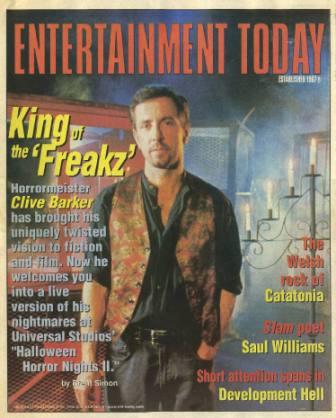
King Of The Freakz
By Brent Simon, Entertainment Today - Vol XXXI No 6, 23-29 October 1998
"I love to scare the bejesus out of people, I really do, but there's more to me. Our culture is so preoccupied with specialisation - I refuse that function completely; I will not allow myself to go back to where I'm just doing the same thing over and over. I owe it to my audience, I owe it to myself, but primarily I owe it to my imagination."
My Favourite Weekend
By Robin Rauzi, The Los Angeles Times, Calendar, 29 October 1998
"One of the things Hollywood does have is pretty cool cemeteries - and I'm not just playing to the gothic moment here. I loved them in England and Paris, and I was ready to be disappointed when I came here, but I was not. There's a lot of flamboyance where stars are concerned, whether it's Al Jolson down on one knee or Marilyn Monroe's tomb. I tend to go to the obvious ones, the famous ones... I'm a buff where early Hollywood is concerned and there's an interesting paradox here. Movies confer a type of immortality, so it's a strange thing: How can Marilyn Monroe possibly be buried here, at Westwood Village Memorial Park?"
Sympathy For The Monster
By Andrew Asch, The Orange County Register, 30 October 1998
"People want to go into the dark and be confronted by the strange. It's a universal appetite."
Ghoul Britannia
By Mike Bradley, The Times : Metro, 31 October - 6 November 1998
"I do miss England, especially in the autumn. I miss Englishness more than Liverpool. Some of the things you miss are so much to do with who you were, and I'm just not that person anymore. Here in the States I can be wholly and completely myself, be unchallenged in whatever I want to do, be it my painting, my writing or my movies. I can get things done."
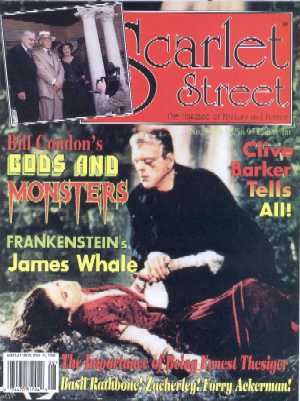
Monster Maker
By Kevin G Shinnick, Scarlet Street, No 30, November 1998
"Yes, I was a horror fan, but I've always been much more of an
"imagination" fan. That is to say, I like horror movies, but I like
fantasy movies and children's movies and science fiction movies. In
other words, I like movies that stimulate my imagination. If somebody
 had asked me what I liked most I probably wouldn't have said horror
movies; I'd have said fantasies. I saw Fantasia when it came back in
one of its many reissues in the sixties; I saw it seven times in one
week. I saw the double bill of One Million Years B.C. and She that came
around when I was 14, and I saw that six or seven times. There are
entire sections of She that I can recite when drunk. I do
Bernard Cribbins, I do a very good Peter Cushing as Holly - it was the
most expensive movie that Hammer had made up until that time, and I
think it's rather fine. It's got a wonderful score, and a lot of the
poetry of Haggard's work is intact... I think poetry has to come almost
accidentally. You can't seek it too hard. It's the quest beast - the more
you seek it, the more it's going to elude you. The trick is to say,
'Well, can I put myself in a position where, if it comes to me, I won't
reject it?' I think there's a strange, perhaps perverse poetry in some
of my movies. Some of the images in the first Hellraiser movie, in
Pinhead, in Candyman, in the swords dropping on Swann in Lord Of
Illusions - there's a kind of image which is not 'on the nose' there to
scare you, to make you jump, but has something else going on in it.
Certainly the image of Pinhead falls into that category. Of course,
to a huge extent this is in the eye of the beholder. What I find poetic,
you might not - though it's likely we're going to have more things in
common than Pat Buchanan and I. But there's certainly going
to be some images which touch off something in ourselves, some point of
reference which will go back to our own histories, something we've
read or seen when we were kids. You'll find something and I'll find
something else. I couldn't, if I was watching She now, defend it as
great cinema, but that's really not the point. If it moves you, it
moves you."
had asked me what I liked most I probably wouldn't have said horror
movies; I'd have said fantasies. I saw Fantasia when it came back in
one of its many reissues in the sixties; I saw it seven times in one
week. I saw the double bill of One Million Years B.C. and She that came
around when I was 14, and I saw that six or seven times. There are
entire sections of She that I can recite when drunk. I do
Bernard Cribbins, I do a very good Peter Cushing as Holly - it was the
most expensive movie that Hammer had made up until that time, and I
think it's rather fine. It's got a wonderful score, and a lot of the
poetry of Haggard's work is intact... I think poetry has to come almost
accidentally. You can't seek it too hard. It's the quest beast - the more
you seek it, the more it's going to elude you. The trick is to say,
'Well, can I put myself in a position where, if it comes to me, I won't
reject it?' I think there's a strange, perhaps perverse poetry in some
of my movies. Some of the images in the first Hellraiser movie, in
Pinhead, in Candyman, in the swords dropping on Swann in Lord Of
Illusions - there's a kind of image which is not 'on the nose' there to
scare you, to make you jump, but has something else going on in it.
Certainly the image of Pinhead falls into that category. Of course,
to a huge extent this is in the eye of the beholder. What I find poetic,
you might not - though it's likely we're going to have more things in
common than Pat Buchanan and I. But there's certainly going
to be some images which touch off something in ourselves, some point of
reference which will go back to our own histories, something we've
read or seen when we were kids. You'll find something and I'll find
something else. I couldn't, if I was watching She now, defend it as
great cinema, but that's really not the point. If it moves you, it
moves you."
Shock Of The New
By Brendan Wallace, The List, 5 - 19 November 1998
"Families are interesting. Let's face it, we've all got them and you can never predict what they'll do. People die, people live longer than you expect them to; kids are born, kids turn sour. It's the root of all our lives.
"And so this novel [Galilee] is much more overtly autobiographical than my earlier work. The narrator, Maddox, for example, is expressing the problems of writing. And the character of Galilee himself is based on my life partner David. There's always been that element in my work, but it's much stronger in this new book."
The Great And Secret Donny And Marie Show
By Nick Hasted, Independent On Sunday, 8 November 1998
"The river, and the sense that it delivers you out into a larger place, a place I did not get to see until a lot later, carries incredible romance. That sense of a world filled with strange names, that began at the end of the river. When I think about the world, I think about the sea. I think the sea, whether the dream sea of The Great and Secret Show, or the physical sea, as it appears in many of my books, is always the way of carrying me away. My flight into fantasy as a kid was a flight from the world. Now, those same mechanisms have become a way back."
The Great And Secret Clive
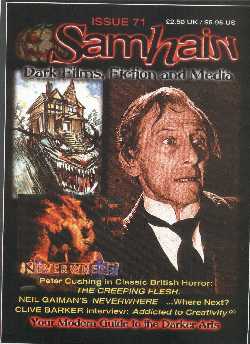
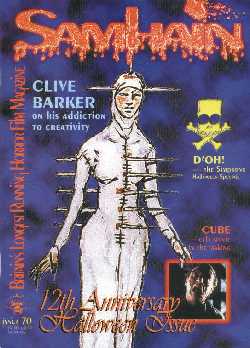
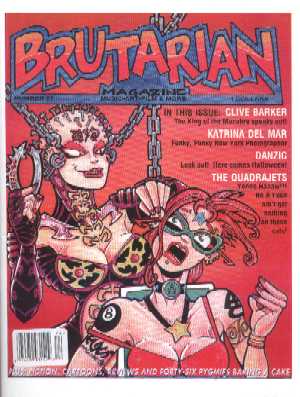
By Bill Babouris, (i) Brutarian, No 25, 1998 (ii) (First half only, as "Addicted To Creativity Part 1") Samhain, No 70, November 1998 (iii) (Second half only, as "Addicted To Creativity Part 2") Samhain, No 71, January 1999
"There's a part of me, a part of every one of us, which is always
thinking of the things we are not supposed to look at - the forbidden,
the taboo, the business of violent death, the business of insanity and
obsession, the business of sexuality. In our culture, the culture of
 the West, but I guess this applies to world culture in general, we tend
to make a division between the things we can speak of in the presence
of others and the things we can't, that we are afraid of speaking about,
perhaps because they go so deep into us, because they are so private.
And I think that my job as a storyteller is to go to those places about
which other people don't particularly want to talk, and talk out loud.
It fascinates me. You know, I don't have the ability to write
conventional reality, the way my imagination works. If something tells
me to look away, that's when I look most clearly. And so, the
business of horror, the business of the forbidden, has been since my
earliest beginnings my preoccupation. I don't believe there is
anything in the human experience which an author should not talk about.
I believe it's our responsibility to talk about these themes, and
the more people tell you not to talk to about these themes, the more
important it becomes...
the West, but I guess this applies to world culture in general, we tend
to make a division between the things we can speak of in the presence
of others and the things we can't, that we are afraid of speaking about,
perhaps because they go so deep into us, because they are so private.
And I think that my job as a storyteller is to go to those places about
which other people don't particularly want to talk, and talk out loud.
It fascinates me. You know, I don't have the ability to write
conventional reality, the way my imagination works. If something tells
me to look away, that's when I look most clearly. And so, the
business of horror, the business of the forbidden, has been since my
earliest beginnings my preoccupation. I don't believe there is
anything in the human experience which an author should not talk about.
I believe it's our responsibility to talk about these themes, and
the more people tell you not to talk to about these themes, the more
important it becomes...
"I have a fig tree outside my window, I planted it in my backyard four
years ago. This week, because the sun is suddenly back in Los Angeles,
this tree has gone from being a bunch of grey twigs to be covered with
bright green leaves. I can imagine nothing more miraculous than that.
These transformations that I've been putting into my books, things
growing, swelling, changing and the fact that this brilliant tree will
go back to being a bare tree in October, this whole cycle enchants the
hell out of me.
"The natural world provides us with so much that is miraculous and yet
we live lives in which we are being fed such tacky images of nature;
we are given our chicken in the form of something which is already
skinned and cut and wrapped in plastic; we are given our mice as always
having big, black ears, big, red noses and little waistcoats on,
courtesy of old Disney."
Handle With Scare
By Phill Jupitus, Channel 4 Big Breakfast, 6 November 1998
"I actually don't find much very scary; I actually prefer a different kind of ride now, I prefer to be given something fantastical and strange and I want to be taken out of myself, and that's what I want to give to other people. I want to give people a journey into my imagination."
How Romantic?
Comment to Phil and Sarah Stokes at book signing, Dillons, Oxford Street, London, 7 November 1998
"I'm dealing with much more 'soap opera-ey' elements in Galilee. Yes, there's romance in Imajica and the others but a few years ago I just did not have the balls to put 'A Romance' on the title page of any of the books. Now I thought, 'Well, hey, fuck it!' "
Transcript Of Interview On BBC Radio 5 Live
By Brian Hayes, 9 November 1998
"I think my feeling is, on a Clive Barker book, hopefully when you turn the next page you're not quite sure what you're going to get next and that's what I'm always aiming for... Whether I'm wielding a paintbrush, or I'm behind a camera, or I'm writing a book, my duty is, in this order, firstly to my imagination, and secondly to the audience who are going to see this movie, or look at this painting, or read the book and I want to be clear, I want to be elegant, I want to be a good artist and I want to be a better artist - that's what I want to be on a day to day basis - I want to be better at what I do."
Write On!
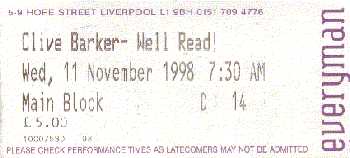
Write On! talk at Everyman Theatre, Liverpool, 11 November 1998
"The kind of effect that novels have is unpredictable - and should be so unpredictable. And part of the point is that you are now coming to these books with your own ideas and your own inventions and your own mind's eye and I don't want to control that. Part of my problem with movies is that they are too controlled. I like, as a reader, to be able to feel [asked], to be guided by the author but by no means controlled by him. Invited, as I said earlier, to a dance, a dance sometimes performed by two people - and on good nights several more."
The Good, The Bad, And The Light In The Dark
By Phil Stokes, at the Write On! talk at Everyman Theatre, Liverpool, 11 November 1998 (note: full text here)
"There is an energy, a - I have to say it - a Satanic energy, which is
deeply, deeply within us. As long as we try to pretend that it isn't
there, try to pretend that it doesn't invade us, I think we empower it
in the wrong way. I think this appetite for the monstrous and the
strange is perfectly fine and dandy as long as we admit it's there.
The moment we try and pretend that it isn't there, we're Ken Starr,
you know, demonising everything but himself. I'm ragging on Mister
Starr, who's history, but there's a certain kind of posture in this thing and that
posture is one of moral self-righteousness in which these dark and
strange deeds have no part of my life. Well, I don't want to be there,
 I want to say of course it's a part of me and a part of my imagination
and let in the good in the bright and the transformative - what Blake
calls 'Jesus, the Imagination'. I want it. I want to make it
interesting in my books. I want to make 'good' interesting. I don't
want people to go to these books, to the heroes and the heroines in
these books, and think, 'Ugh, now we have to sit through all this shit until
we get to the bad guys'. It's a technical problem, it's a
characterisation problem, it's something I'm trying to do. I want
to engage the 'good' in a way that they find the idea of being good, of
being good to other people (I mean very simple things here - to be
able to express love, to be able to reach out and bridge the gap
between other human beings, and maybe the mass of human beings), I
want to make that important to people. I want people to say, 'You
know what? This business of goodness is not dull. It's not like
eating vegetables. It's wonderful.' And in order to make that
wonderful, I think that we need to invert the rules a little."
I want to say of course it's a part of me and a part of my imagination
and let in the good in the bright and the transformative - what Blake
calls 'Jesus, the Imagination'. I want it. I want to make it
interesting in my books. I want to make 'good' interesting. I don't
want people to go to these books, to the heroes and the heroines in
these books, and think, 'Ugh, now we have to sit through all this shit until
we get to the bad guys'. It's a technical problem, it's a
characterisation problem, it's something I'm trying to do. I want
to engage the 'good' in a way that they find the idea of being good, of
being good to other people (I mean very simple things here - to be
able to express love, to be able to reach out and bridge the gap
between other human beings, and maybe the mass of human beings), I
want to make that important to people. I want people to say, 'You
know what? This business of goodness is not dull. It's not like
eating vegetables. It's wonderful.' And in order to make that
wonderful, I think that we need to invert the rules a little."
I Sound Like A Pervert? Whoopee!
By Phil Daoust, The Guardian Magazine, 12 November 1998
"I think people are a little two-faced about this stuff, I think the business of sex, the business of the flesh, whether it's our flesh or somebody else's, in just about any bloody combination we like, is absolutely fascinating. Watching people do that deed is fuckin' wonderful because it's pleasurable and it's sensual... This posture of literary detachment seems totally phony. I think it goes with a bunch of other postures we should look at, like, 'I don't enjoy writing about violence.' Of course you bloody do. It gets the blood going."
Gods And Monsters
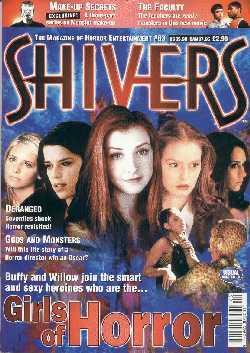
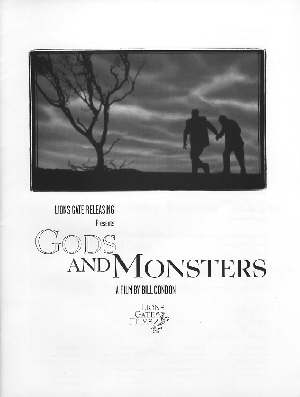
By [ ], (i) Press Book, 1998 (ii) edited as Gods and Monsters by James Abery, Shivers, No 63, March 1999
"We're both Northern lads, Mr. Whale and myself. He came from a very small town. I came from Liverpool. I became interested in Whale quite early on because he was an Englishman making horror movies in Hollywood and that seemed to be a good thing to be doing. I became, I wouldn't say obsessed, but certainly very occupied by the shape of his career and the way he did what he did. He was this gay expatriate who went over and made these very strange movies which were incredibly popular. It was a fine model, I thought."
Gods And Monsters
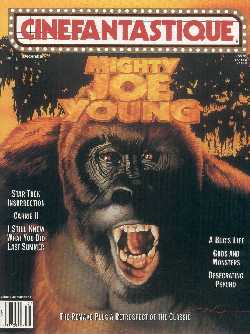
By Michael Beeler, Cinefantastique, Vol 30 No 11, December 1998
"Bill [Condon] and I were working hard on Ian [McKellen], to persuade him to do it because
it was a small picture and he wasn't going to be paid this huge amount
of money. Here we were trying to get one of the greatest actors in the
world to make a very modestly scaled picture with us... Gods And Monsters
isn't a special effects movie. It isn't even a horror movie in
 the strict sense, though it partakes of the genre. It's a character
piece. So, when we went to Ian, it was with an extraordinary role -
one which, I think, it would be hard for any actor to resist. You get
to play a character in many stages of his life. You get to play the
highs and the lows. You get to play the agony and the ecstasy, as it
were. Brendon's role is equally exciting, I think, for an actor,
because you watch the spiritual growth of someone through the picture.
I think the emotional payoff of the picture - the last two minutes -
carry an extraordinary emotional weight. And the sense of the three of
them, because we shouldn't forget Lynn [Redgrave] in all of this, is
dynamic, in the way that all of this plays out... Lynn's character
brings a quirky humor to the thing, which gives a certain balance to
the picture. The picture plays very well to just regular audiences,
who just want a story and perhaps don't feel a heck of a lot about
James Whale. One of the reasons it plays so well is because you have
these dark tragic passages which are relieved every now and then by a
break of humor provided by Lynn."
the strict sense, though it partakes of the genre. It's a character
piece. So, when we went to Ian, it was with an extraordinary role -
one which, I think, it would be hard for any actor to resist. You get
to play a character in many stages of his life. You get to play the
highs and the lows. You get to play the agony and the ecstasy, as it
were. Brendon's role is equally exciting, I think, for an actor,
because you watch the spiritual growth of someone through the picture.
I think the emotional payoff of the picture - the last two minutes -
carry an extraordinary emotional weight. And the sense of the three of
them, because we shouldn't forget Lynn [Redgrave] in all of this, is
dynamic, in the way that all of this plays out... Lynn's character
brings a quirky humor to the thing, which gives a certain balance to
the picture. The picture plays very well to just regular audiences,
who just want a story and perhaps don't feel a heck of a lot about
James Whale. One of the reasons it plays so well is because you have
these dark tragic passages which are relieved every now and then by a
break of humor provided by Lynn."
Uncharted Waters
By David Hughes,
DreamWatch, Vol 5 No 4, December 1998
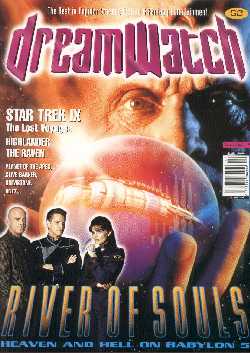 "One of the things I love about large books in terms of their
narrative ambition is that they can do something movies and paintings
can't do: they can give you a sense of being like a bird, so that one
minute you're high above the narrative, and the next you plunge back
into it again. I think and I hope that one of the things that happens
in Galilee is that one moment you're deeply connected with the
intimate moment of a scene, and the next moment, Maddox will pull you
out of this intimate moment and tell you 'Marietta just came in and
stole one of my books', or something to do with the Civil War. That's
because Maddox is this narrator who is connected with the intimate
moments, but also has a sense of the larger structure."
"One of the things I love about large books in terms of their
narrative ambition is that they can do something movies and paintings
can't do: they can give you a sense of being like a bird, so that one
minute you're high above the narrative, and the next you plunge back
into it again. I think and I hope that one of the things that happens
in Galilee is that one moment you're deeply connected with the
intimate moment of a scene, and the next moment, Maddox will pull you
out of this intimate moment and tell you 'Marietta just came in and
stole one of my books', or something to do with the Civil War. That's
because Maddox is this narrator who is connected with the intimate
moments, but also has a sense of the larger structure."
Horror Stories With A Walk-On Part For Jesus
By Frances Welch, Sunday Telegraph, 13 December 1998
[re. God's disapproval] "Good God! Why would He have put imagination there in the first place if He was going to disapprove of what it produces? I believe that the imagination is inexorably linked to the religious impulse. Wherever imagination is involved, there's something spiritual, something outside ourselves, coming into being... Who would put my sexuality into me and then disapprove? I was born that way. David and I have exchanged rings but we didn't go through with an actual marriage ceremony. I find these ceremonies a little kitsch. The marriage has not been formally blessed except by the two of us, and God."
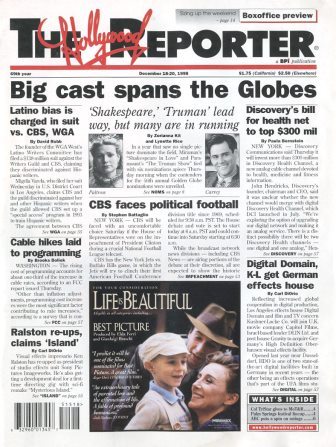
The Hollywood Reporter, 18-20 December 1998
Wake Up: A Dream Comes True
By Zorianna Kit and Lynette Rice, The Hollywood Reporter, 18-20 December 1998
"James Whale is a man who has been largely ignored by the cinema, yet he's created one of the most impressionable images in history with Frankenstein. Getting recognised for this movie is like welcoming him back to the fold and giving thanks to an incredible man. I'd like to think the ghost of James Whale is very happy today."
Click here for Interviews 1999...


