Interviews 1999 (Part Two)
Forward The Imagination
By Frank Barron, www.horroronline.com, October 1999
"We all get painted with the most garish and noticeable of our creations. There isn't much we can do about it except get on with the work and know that the labels others place on us will fall away with time."
The BookEnds Interview
By Jason Wallace, www.thebookplace.com, October 1999 (note : full text online at thebookplace.com)
"What [The Essential Clive Barker] made me realise was: I've changed. I'm not who I was when I wrote The Books of Blood. I'm not who I was when I wrote Weaveworld. My father passed away back in August, and that was a life-changer; it was one of those things that makes you say, 'The changes go on.' My books are filled with thoughts about sons and fathers, many of which are derived from a very complex and elaborate relationship between my father and myself, based firstly on blood on both sides but also based sometimes on mutual incomprehension. All those things find their way into the books. What I'm saying is that those things go on all the way through your life. You change and hopefully mature. You lose people, you gain people. You fall in love, you fall out of love... whatever it is. I want my books to be a truthful reflection of who I am. I could not conceive of writing some of those earlier books; I couldn't make Hellraiser now if my life depended on it. They aren't who I am now."
Clive Barker's Books Of Blood
Seraphim Films press release, October 1999
"I see this film as being the first in a franchise of Books of Blood films. Movies that will re-define horror cinema the way the original books re-defined horror literature. Ground breaking in their intensity, revolutionary in their marriage of frank sexuality and horror."
Clive Barker
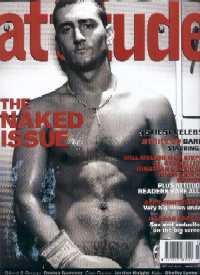
By Tim Teeman, Attitude, No 66, October 1999
"I have a Blakeian take, which is that all life is a holy business, yet how do we stay awake to that fact? Sacrament's central question is precisely that: how do we get by? Practically everything that I have written has been motivated by my own experience. I can still smell the air of Liverpool where I grew up. Places touch me - that's why there is a sense of yearning in my fiction."
Just Call Him Mr Hell Raiser
By Sue Potter, What's On, 1 October, 1999
"In a way I'm a victim of my own success. People like those early books and those movies, and I like them too, but I don't do them any more and it's almost as though everyone is just catching up five years on. The fact is, I don't have anything interesting to say about scaring the pants off people. I've said it all and moved on."
Clive Barker
By Paul Oremland, Pulp, Channel 4, 14 October 1999
"I'm a populist. I believe in trying to communicate my ideas to the
largest number of people that I can. If that means that I have to make
a movie which is, yes, simpler than the novels but opens on 2,000
screens across America one Friday, I think that's a reasonable trade-off.
Is the movie as important to me as the book? No.
"Now, I get into moods where the notion of going to scare the fuck out
of people for a while in a horror movie is just great, and there I
don't feel as if I'm dumbing myself down - I'm making a ghost train
ride. It's great fun. It's immense fun."
Politically Incorrect
Transcript of appearance on TV show with Bill Maher, 29 October 1999
"I think you have to preach to the unconverted. And part of the purpose of making stories is to preach, is to actually reach people. I had a picture last year called Gods And Monsters which was a small movie which ended up making a modest amount of money, but what I think it did was, it brought lives which were strange to the people who were watching those lives, to those people, and I think that's very important."
Talk Of The Nation
Transcript of appearance on NPR, hosted by Brooke Gladstone, 29 November 1999 (note: full interview online in RealAudio at the Lost Souls site - see links)
"I'm very aware as a storyteller that there's lots of [horror movie] rules that I'm able to break when I'm writing - that is, on the page - that I cannot break in movies; people won't let me break... It seems to me that in my books I'm able to celebrate villainy."
Politically Incorrect
Transcript of appearance on TV show, 7 December 1999
"I think you have to preach to the unconverted. And part of the purpose of making stories is to preach, is to actually reach people. I had a picture last year called Gods and Monsters which was a small movie which ended up making a modest amount of money, but what I think it did was, it brought lives which were strange to the people who were watching those lives, to those people, and I think that's very important."
Forbidden Barker
By Stephen Lemons, New Times, Los Angeles, 9 - 15 December 1999
"We all think about death and violent death more regularly than we will admit, but most people don't personalise it. What this kind of fiction does is take you inside the experience and ask you to empathise, which is much more important than watching the spectacle of it. I believe we've all made little rehearsals in our minds for what the final moments will be like. A writer does that on a Monday morning at nine o'clock... By allowing that everyone has these thoughts it can be comforting. That's an important process that story-telling and image-making offers. It's like everyone's in the same boat - the same leaky vessel - and it's okay to voice that."
Clive Barker
By James Bohling, In Los Angeles, Vol 2, Issue 21, 7 - 20 December 1999
"I'm an optimist. I believe that consciousness is a fluid thing, something which is... poured briefly into the vessel which is your body and mine, and then flows out of it upon death. We are walking vessels for consciousness. And we are mind on the move. And that mind, that consciousness, is connected to every other bit of consciousness around us, including, obviously, other human beings, and most obviously those human beings we feel closest to, those human beings we love most deeply. That's one of the reasons why, even in the darkest places in my books, love and connection with other human beings is so important. And when love is lost, when there is discontinuity, when there is a lack of communication, a lack of empathy, that's when I think hell starts to show itself. I don't think you need demons and pitchforks to evoke an image of hell, you simply need two people who once loved each other turning their backs on each other."
Online Appearance At Barnes & Noble
Transcript of an online appearance at Barnes & Noble's site, 15 December 1999 (note : full text online at the bn.com site)
"I truly believe that any work of art that attempts to honestly talk about what it is to be human - our dreams and our nightmares, the things that give us hope and the things that make us despair - cannot be held responsible for the actions of people who are for some reason nurturing profound hatred towards the world. It's a very slippery slope, this blame business. If you start to accuse books and films of changing people's way of thinking, then it seems that you start to empower those who wish to control artists. I would feel very anxious about any piece of government legislation that attempted to curtail the creative freedoms of artists. Now, let's look at the other side of the equation: The artist has to be responsible for what he or she creates. It's no use saying, 'I'm an artist, and I should be taken seriously' and then denying your personal culpability. Art changes minds. Art moves people. Art disturbs and upsets and arouses complicated feelings. Artists should be happily responsible for those achievements. Let me say one other thing on this (and it's an immense subject): When I make my movies I don't make them for eight-year-olds. I make R-rated pictures to be seen by people who are mature enough to understand that they are seeing a piece of fiction. I do not approve of showing disturbing or sexual material to impressionable minds. But adults should surely be able to see whatever suits them."
Interview: Clive Barker
By Spence D, IGN Movies, 16 December 1999 (note : full text online at the IGN.com site)
"I have extremely mixed feelings about the film business. And yet I stay in it because I like movies. I enjoy movies. I enjoy the making of them, I enjoy watching them. I just don't enjoy many of the, oh, the politics. Much of the politics that comes along with the business of making movies is frankly a pain in the ass. "
Clive Barker (Part One)
By Spence D, IGN For Men, 17 December 1999 (note : full text online at the IGN.com site)
"The most honest things I've ever said about my craft, I suppose, and about my motivation,
about my processes, are in that introduction [to The Essential]. And I do believe that I
have gone through sort of cycles, if you will, about why I do what I do. When there are
very dark times in one's life then I think you go to fiction very often to escape. There's
no question that I have fled into the pages of fictions, which have provided a much
simpler vision of life than the one I'm presently experiencing. Do you see what I mean?
"But then there are also times when I have gone, paradoxically, to those same books for a
way to engage with issues which are represented metaphorically in those fictions. Ray
Bradbury, Peter Pan, all kinds of fantastic worlds have provided me - The Tempest,
Midsummer Night's Dream - me with ways to better understand my own life in certain
circumstances..."
Clive Barker (Part Two)
By Spence D, IGN For Men, 20 December 1999 (note : full text online at the IGN.com site)
"I don't worry about prostitution. Artists have always had to prostitute themselves. The
issue is whether in selling yourself you start to make the issue yourself rather than the
words. I did Politically Incorrect the other night and one of the things you do when you
go on television is you sort of, you have a persona which you present. It's what
television requires. Particularly something like Polically Incorrect where you have to
be pretty fast and it's very combative. I thoroughly enjoy doing the show, but without
fail, without fail when I come back from that show I cannot work. Because I've spent,
it's not an energy issue, I've got lots of energy. In fact, I'm very energized by doing
the show. But I'm too much myself, I'm too... I've been in the business of self
advertisement for the last three hours and so it takes me a little time to forget myself
and just get back to where I need to be. And where I need to be is invisible. And now so
I complain every now and then and say 'You know, I don't really want to do anymore
television.' And they say 'But you should count yourself lucky because you sell the book.'
And it's true. Bill [Maher] kindly enough picks up the book and shows, you know, 'Here's
Clive Barker whose most recent book is...' And then they do a big pack shot of the book...
So that's part of the contract I think you make in the modern world, which... and maybe
there's always been an equivalent of this. Maybe when Dickens' was around doing his
readings - which were apparently brilliant - he was, you know, doing the same thing...
"I think there is something of a Faustian pact here, is I guess what I'm saying. I think
that in order to operate as a successful author and compete as a successful author in the
world that we now find ourselves, part of that is about being a public figure in a way
which perhaps was not true for an earlier generation of authors. And I frankly look
forward very keenly to the point in which my publishers say to me 'Okay, you are now so
fixed in people's heads that you need never step outside your house again. Or do a piece
of television.' Because I think I will get more work done."


