Only Connect...
The Twenty-Fifth Revelatory Interview
By Phil & Sarah Stokes,
19 August 2009
We made a trip over to Los Angeles in August to finalise the selection of the interior sketches for Clive's non-fiction collection The Painter, The Creature
and The Father of Lies, to agree on two new archive-based projects that the three of us will do together over the next couple of years - and to celebrate this, the twenty-fifth interview conducted for Revelations...Over the course of several days we caught a new sense of impetus in the house after a period in which projects have inched forward very, very slowly...
Revelations : "There's a fantastic sense of activity in the house, Clive - it feels as if a number of things are all finally coming together at the same time..."
Clive :
"There was an energy in this house which was very destructive and it's gone. And what's happened is that a lot of projects that for one reason or another didn't flower before, have flowered. What we're seeing is a lot of things that I'd wanted to do but had never had the time, there was an unholy amount of my time being used not on things that I wanted to do. The consequence was that some things, like this talk, just simply didn't get done at all or some things had to be delayed: I mean Abarat 3 is the obvious example.
"There's also something else that has happened which is marvellous - and that is Robb Humphreys. Robb took on 'captain of the ship' in a spiritual taking-on, in a sense that this was his moment, this was his time because I have been so profoundly frustrated over a lot of years and prevented, frankly, from
 just getting on with the thing that I like to do and being forced into a more public role than I wanted to have. I mean the situation, let's say when I was writing Imajica, when I was writing Weaveworld: I didn't do any interviews through those eighteen months, I wasn't partying, I wasn't clubbing, I wasn't doing all those other things, but nor was I doing pitches or all this other stuff - I was working!"
Revelations : "In those earlier periods, the PR people took over at publication time and then you had a flurry of it..."
Clive : "Yeah, but it would be three weeks and you would do the three weeks and then you'd walk away. What's happened is that it's got messier because each of these elements - firstly the PR people at the publishers aren't aware of or interested in the people at Bert Green's gallery and the people at the Bert Green Gallery aren't aware of the film people or don't want to be... it happens over and over again - publicists are territorial animals, and so you have all of them thinking that they are the only ones who really have a claim on my time and they are not interested at all, at all in talking - will not pick up the phone to each other. So Robb and I have been stuck in a place where something like this, which should be pleasurable, has become less pleasurable because, I don't know how many projects I've talked about over this year but if you put together the range of media... and now I do the Twittering thing too which I think serves an interesting function - and people write to me privately there about how much they like what Revelations is providing... "
Revelations : "We get the other face of that correspondence, we have people writing to us saying what a wonderful resource you've allowed to be created by being so open about sharing your creative process: 'there's nowhere else,' they say, 'that we can go to see the creative journey of an idea from conception to birth.' And across such a breadth of media - that you don't change your creative view of something that's a painting hanging in a gallery in New York or becomes a mask or is a sketch on a scrap of paper next door or that hangs on someone's bedroom wall."
Clive : "Right, or is a photo. All of the pictures for Imagining Man are done. All of the pictures for the sequel to Imagining Man are done, so there are two books finished now with 90,000 pictures or so, there's obviously some text to be generated around those, though modest."
Revelations : "You're back to it being a trilogy now? Because at one stage it switched to being one big, fat book?"
Clive : "Well, I think it is... because they don't know what the work is, they've only seen samples..."
Revelations : "Ah - how much have they seen? Because that was one of your earliest tweets about walls and barriers breaking down the afternoon that Rizzoli came in to talk about the books."
Clive :
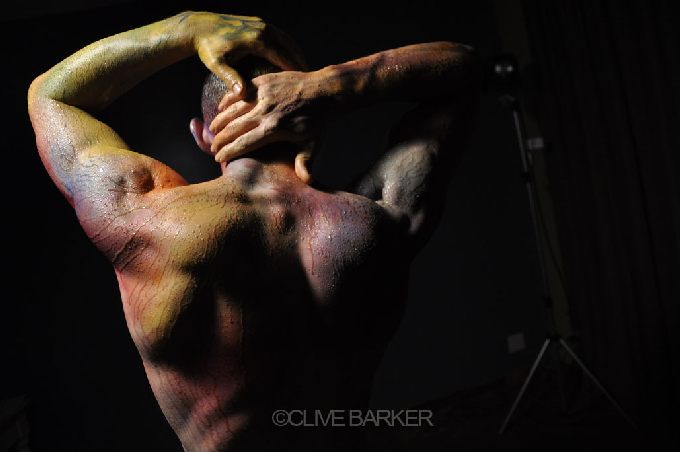
"Absolutely. I wanted Rizzoli to embrace the totality of the vision and I think they probably will end up publishing these three books but will only do it contract by contract although what I was wanting was to say, look, we're going to be in business for the next three years or whatever and then I can be thinking about the next book. The art book was very successful, David's book was successful.
"It's a personally owned company, it's owned by Mr Rizzoli, which is mostly good actually because you're not dealing with a committee, you're not dealing with a lot of people who have shareholders to answer to. They have shown a relaxing of their morals - you saw the four photos that went to the Dirty Show in Detroit, so the orgasm shot, they can now publish, they would not have published that a few years ago when I first went into business with them. They also publish those male nude books that David Leddick does but under Universe, their all-male imprint."
Revelations : "Which are fairly frank in showing erections."
Clive : "They don't show sperm. It's interesting, the stuff of our conception - or at least half of it - I mean it's a fairly innocent substance, is just not welcome... Now I like that, you know, those first books are called the Books of Blood and now I've gone from one bodily fluid to another."
Revelations : "The other thing we've been looking at together are the Halloween mask designs."
Clive : "Yes, now to then pull all those other things in that I've wanted to do for the longest time: Halloween is the second biggest holiday in America - $6 billion a year and growing exponentially."
Revelations : "Being English, we find it hard to appreciate the scale of it as a holiday, although we did stumble into a wild parade one night in San Francisco, totally unprepared and totally under-dressed for the occasion!"
Clive : "The place to be, I think, is Bourbon Street. I prefer it to Mardi Gras just because it's a little smaller, it's a lot weirder and it's even more sexual than Mardi Gras, which is hard to believe but it is. It happens obviously chiefly at night which adds mystery, so I would say if you were going to have a Halloween adventure in time, I would strongly recommend you take it in New Orleans because it really has recovered reasonably fast, certainly where those events are concerned - it is simply the most fucking sexiest place to be, it is unbelievable, and this isn't about gay sex or straight sex, it's just sex, it's physicality. "These are the first paint jobs..."
Revelations : "And you've gone back over this one with Disguise, haven't you, to remould this accessory?"
Clive :
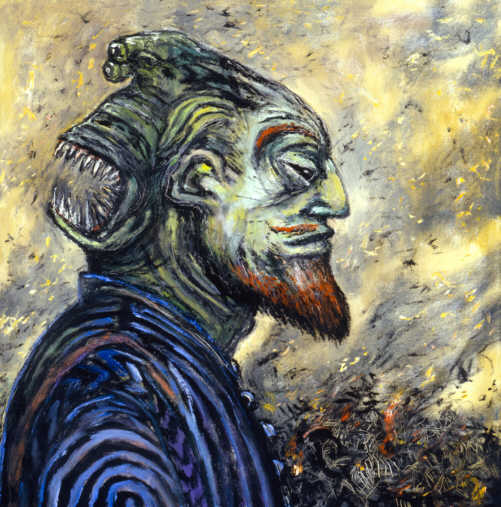
"Yes, to get it closer to the original but it wasn't just the mould... it was two levels: it's the modelling because you can see how soft everything has become, it lost the spikiness and that's what this is all about - you see just how much more sharp and angular the painting was and I tried to say well just go back and give me that, and now see how close it is - this is going to be a fucking beautiful thing..!
"That one... it actually has four faces, you know there's not only a back and a front, there's also a left and a right so every way it turns it sort of presents a different face."
Revelations : "That's something you've added during this process as you've gone three-dimensional - and great for parades because every way you look, when you have people all around you - "
Clive : "Yes, and again I think it's going to be a gorgeous thing. I mean I want these to be imaginative and as a sculpt, it's beautiful. And so a lot of the additional drawings I did on the spot and that's the nice thing about them [Disguise] being in San Diego, I can drive down and this has been a really, really cool experience. We have now about twenty things coming for the first year."
Revelations : "Which for us buying them in shops is a year away for Halloween 2010 - something that's a lot closer is Seduth..."
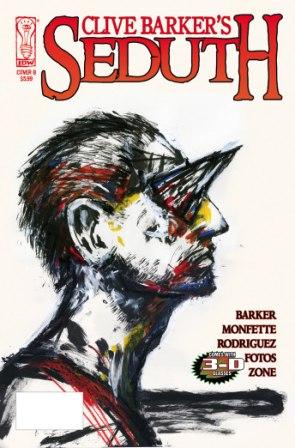
Clive : "I gather you saw it? This is also going to be a gorgeous thing, I think: the storytelling is beautiful, the writing is beautiful and the 3D is mind-blowing."
Revelations : "It is not what we expected; we had no conception of what comic book 3D could do and we were astonished by the number of layers."
Clive : "I was too."
Revelations : "We saw Chris Monfette earlier this week, and he's always said we'd be stunned by the double page spread of The Fourth, which I did go 'wow' on, but it was page 3, as the auction starts and as the frames track in on the diamond that first convinced me Seduth was something very special - I'd seen the 2D version and the diamond is lost, it had been insignificant in the top two frames - "
Clive : "Yeah, inconsequential - "
Revelations : "But in the 3D version it is so obvious that there is something incredible in that first frame, glittering in the darkness."
Clive :
"Most 3D comics are not made for 3D, it's a fake-out essentially. With this they have designed the whole thing for 3D. The whole idea of the Fourth is to say, well, if I'm trying to create the 4th dimension in a comic, which is 2D, it makes sense to make it a 3D comic because the fourth dimension can be represented by the third, so the whole plot centres around a device which is dimensional-friendly, yeah? The whole fucking thing has been a joy; I mean I think Gabriel did an amazing job on The Great And Secret Show, an amazing job. Monfette, because he had freedoms that Chris Ryall didn't have adapting Great And Secret Show, has written a rich, lovely thing and Gabriel's working at the top of his talent. I agree with you about that track-in, but the double-page spread is spectacular and I'm just very excited because comics are still something I adore and they are very cheap. They're cheap to produce, they're quick to produce as well - you don't have this thing about waiting around forever - and, most important, they're cheap to buy. You know, you'll be able to buy this for six bucks.
"Last night I was tweeting, what I didn't get around to saying was I started off by saying, 'I've got to go and paint the Seduth cover' and I came back about two in the morning and said, 'I've trashed two covers...' And, as of this moment, I have a guest at seven and between now and seven I have to produce the Seduth cover...
"The challenge has been shifting this 60% of my brain which was dealing with other things into a more productive, artistic place."
Revelations : "For practical purposes, will the final 20 Abarat 3 pictures will be on paper rather than oils?"
Clive :
"Yeah, I'll have to, though I did that on Book 2 and I don't think anyone noticed - the double page of the sea breaking, for instance. It made a difference, a good difference, to the way that they can be sold because lots of people don't have big houses and space for the large canvases and so making the smaller pictures makes sense.
"But this diversification, you know: Halloween, Seduth cover, I'm awaiting the notes on Abarat 3 from Joanna before I do my final polish and meanwhile I'm doing Grail..."
Revelations : "For the new fiction collection."
Clive : "Right, and Chiliad - I think I've mentioned this in the past but just so you know where this has finally found its place - Chiliad is now no longer in print, which came as a bit of a shock to me - "
Revelations : "Anthologies do drop out, don't they..."
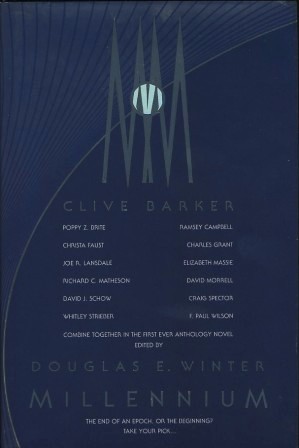
Clive : "Yeah, especially time-related anthologies, this was for the Millennium. So with Chiliad, there will be 3 novellas essentially - I think a novella starts at 17,000 words and Chiliad is not a novella actually, it's a long short story - but Grail is a novella because it will be 35,000 or 40,000 words and that will be the third of three texts to be called Meditations: Chiliad the first, all written in the first person with the style of Chiliad pretty much carrying through. And if Chiliad is essentially about pictorial art references, you know, Ophelia drowning and the stained glass, the third one, Grail, is about the art dealings in historical, particularly Biblical ephemera, you know, fragments of the true cross: I think there are 26 crosses which can be built from the fragments! But this goes back to Chaucer, all the little Saints' relics. Grail is about two men who are fighting over what may or may not be the Grail. It's about Christ, obviously, but it's also about the visual parts that are somehow or other representations of the Christ story or involved in the Christ story, the most obvious one being the Grail itself, the reputation of course being that it is somehow or other a glorious thing. You'll remember Indiana Jones chooses the carpenter's cup? I chose to go with tin because the story is essentially told by Joseph of Aramethea's dog. Joseph of Aramethea takes his dog to the Holy Land on two trips, on the second of which he is on Golgotha at the crucifixion. The dog doesn't see the crucifixion at all - are you Auden fans at all, The Old Masters, the poem? Basically it's a short poem that says the Old Masters had it right, it's essentially about animals not noticing - that the horse is scratching its arse, you know. The dog is very much more interested in Roman flatulence than he is in this huge thing that's going on - because dogs are, you know. He'd smelt a lot of blood in his time, this is literally the beginning of time for us, 33 years after the beginning of time, and he is sort of indifferent to that. What interests him is the smell of the living, and the Roman stink, and dogs will go where there is a stink. I think that is a tad shocking when you actually read the words but it's true. I think if a dog was at the crucifixion, I don't think you'd find him much around the cross - he'll go where the food is... There's obviously my love of dogs but just the animals' indifference to the death of the man of sorrows has been interesting to write."
Revelations : "We were surprised when you started to mention Grail and it being the story of Joseph of Aramathea's dog on Golgotha because wasn't that originally part of The Scarlet Gospels?"
Clive : "Yeah, it was, I mean I found that in Scarlet Gospels simply the presence of the angelic, or the benign, or the reassuring - I think this dog is at least two of those - was overwhelming the darkness; I didn't like that. I thought there's one easy fix which was to snatch away the thing I found the easiest, because I find writing from the dog's perspective incredibly easy and just a joy to do and, you know, I'm just going to take this element away. It has darkened The Scarlet Gospels considerably, because suddenly you don't have the light relief, you know, and it also gave me a much darker context in which to put this story."
Clive strayed into a number of spoilers at this point that are fundamental to the structure of Grail. We've held those observations back for now, including the detail of why and how the action shifts from the Holy Land to Old Brompton Cemetery in London and the closeness of the voice of the dog, speaking in the first person, to his own voice as the author, meditating together on the conundrum of this tale of the cup of Christ...Clive :
"Chiliad was very much a meditation, and I think this has sort of the same flavour; it's a little more narratively driven, simply because two at least of these three stories are two of the best-known stories in the West and I've created what I've called the The Western Mysteries and I think I might return to this idea: The Western Mysteries are a body of stories I'm using to embrace Arthur, which connects to the Grail, through Lancelot and The Crusades, it's amazing how the connections work - I mean talk about six degrees of separation!
"The whole idea of pulling together this body of Western legend - you know Tolkein said he wrote Lord of The Rings in order to provide England with the mythology which it didn't have - "
Revelations : "So he stole it from the Norse."
Clive : "So he stole it from the Norse! Very much so, and a little from Wagner, a little bit here and a little bit there. But what it certainly wasn't was an organically English story."
Revelations : "With the possible exception of the Ents, I'd say."
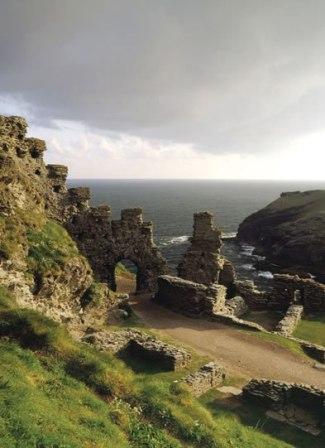
Clive : "Yes, I totally agree with you. Now, Joseph of Aramathea brought Christ to England, is one of the postulations, and he had tin mines in Cornwall and the Grail is made of tin - it's something he had basically and crudely put together by an apprentice, with a rather badly fitting lid... Have you ever been to Tintagel? It's awesome, isn't it?"
Revelations : "Totally windswept the day I went. And the waves crashing - "
Clive :
"Oh I think it's always that way - I've been twice and it's always been windswept! And the location, up in the hills, superb! I can't access all of this in a story so short but Blake, Arthur, Tintagel, Glastonbury, you know, this whole body of ideas and stories is just incredibly powerful, and moving.
"Chiliad is very packed as well; Chiliad is a very dense story and not a lot of people know it and those who do know it fall into two very distinct camps: they love it or hate it. There is nobody in-between, as far I can see, nobody's sort of 'blah' about it! Now I don't think this will be true of Meditations."
Revelations : "You said there's going to be three?"
Clive : "There are three. The middle one is about me, here, now - "
Revelations : "Is the middle one Journeyman itself?"
Clive : "No, I don't have a title - I have a working title: Lore and Anarchy."
Revelations : "Well that answers the next question which was, is Grail the last thing you need to write for the collection?"
Clive : "No, the penultimate. Lore and Anarchy is the last thing and that will be somewhere between the two sizes. Chiliad's 14,000 words, is it? Maybe it's 15,000. So 15 plus 20 plus 45 or 40 is 75-ish? So 75,000 words for this whole three parts and I think it should be viewed as a single unit, so it's a short novel, essentially, in three parts."
Revelations : "And will you still add in the other short stories to the book or would that now be too long?"
Clive : "Oh yes. We decided to treat each of these units as a separate book, so they'll all have separate faces, so they'll almost be like books within books. There'll be a 60 page book of poetry, there will be Meditations and each one will have a different font, each one will be laid differently on the page, so it'll be almost be like you'd picked up a shelf of seven or eight different books. Like all the Nightbreed biographies, which were 5,500 words long but were a really nice, fun thing to have; just gathered together with a short introduction. A lot of, I want to say almost like Burroughs's short fiction - really short, like 500 words, about thirty or forty of those, very misanthropic, Swiftian which have just been numbered. So, being able to put these fifty poems together - though the poems are relatively conservative, formally speaking, the short fiction is absolutely not conservative, it's very radical. I'm thinking, hoping the book will feel like you bought six books."
Revelations : "That's interesting... Going right back to Books of Blood, the only thing which sounds different here is that in Books of Blood you were trying to write with as many voices as possible. It sounds to me like this time you're trying to write in your voice, but showing the multi-faceted nature of that voice after all the journeys you've now taken and travelled."
Clive : "I think that's very smart... I think all that is right with the exception of 'your' - because I no longer know what 'your' is - "
Revelations : "OK, maybe I should say 'Ur'!"
Clive : "I'd love that! That would probably be a tad pretentious! But you're not far wrong. I am looking to remind myself of how much I love words, how much I just adore words and there's the sort of sense of a dog rolling around in mud in the book because, I mean, the title, Lore and Anarchy is a perfect example of something: which is that so much of what is in that title - the pun, you know, the double, the sort of yin and yang, the ideas that are implicit in lore and in anarchy - so much of that is essentially me in a way that I don't think anything has ever been. I'm not going to make any claims the book is great art, you know, all I know is that when I decided Black Is The Devil's Rainbow should be the title, something fitted into place, and slotted into place that seemed absolutely right in terms of describing to myself and to the reader what to expect, which is a mindfuck! And I think it's good to remind oneself, never mind the audience, that the thing that drew me to horror in the first place was its iconoclastic nature, its wilful nature and as C.S. Lewis says, I'm not a tame lion and I don't want to be domesticated, thank you, and this was a reminder. Journeyman was a title that Jane Johnson loved. I never loved it - I liked it, because it was modest - it's the title of a man that says I'm not a master, and I liked that, but I sort of felt it was stale a little bit and Black Is The Devil's Rainbow is absolutely about paradox and - "
Revelations : "Have it if you like, enjoy it if you like, and if you don't - "
Clive : "Go fuck off! Exactly! I'm very, very excited because I think I have got an editor who's going to take a lot of risks with me. You know, this is not about a catch-all, this is not about, 'Oh, well, we've got this one we never published...' No, no no. There'll be stories which haven't been printed which will not be in this book, but there'll be stories like On Amen's Shore which will be because they're good stories. And Lost Souls and obviously Haeckel's Tale and Valerie On The Stairs and things like that. But there'll be other things which I just don't care for and which don't belong in this because I really do care about this book a lot. And having the poetry in there and having Meditations in there, because, frankly the book could be Meditations, you could stop there. But the book's going to be twice the size of Meditations and more because, exactly for the reasons you rightly said, this is really going full-circle. It's doing for metaphysical fantasy, for want of a better phrase, what Books of Blood was doing for horror. It's going and saying, I adore this stuff, and really nobody's doing it - and nobody is doing it. It's like maybe distance lends enchantment, but I'd like to be able to look back at England and, you know, Old Brompton Cemetery - I know the cemetery there very well for a bunch of scandalous reasons! But being able to go back to London in its apocalyptic mode, which is best represented in Damnation Game, and I can't think of anything more end-of-the-world-ish than Black Is The Devil's Rainbow, I mean that seems to sing out..."
Revelations : "We have to tell you, purely as readers, that sounds fantastic - the journey through the narratives is going to be more exciting than a novel."
Clive : "I have to tell you, for me as a writer, it feels that way too. I have been involved in the hardest novel I have ever had to write. The fucking novel itself, it's gigantic..."
Revelations : "We've talked before about the importance of Absolute Midnight being the middle book of the Abarat quintet... "
Clive :
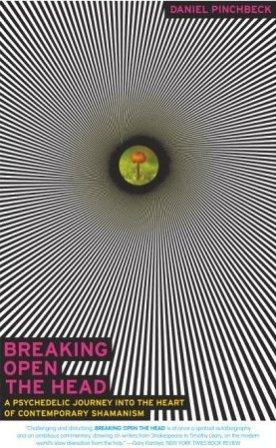
"But it's more... Daniel Pinchbeck, Breaking Your Head Open is the book. I want you to have a look at some pages of this Pinchbeck which I marked up. He's like Terrence McKenna, he's somebody who as a former psychologist takes drugs to investigate himself. In Breaking His Head Open he talks about, I'm going to get this wrong, DPT, which is some chemical that he did a trip on and it's elaborately described, this trip, and I just wrote beside it, 'This is how I feel, this is me, this is my consciousness... '
"I'm not familiar with acid or anything at all. Where is it..? Here we are, I wrote, 'This is every day in my head.' I am actually going to use that for Black Is The Devil's Rainbow. You know, like that thing I'm putting at the end of Abarat 3 which is a single quote? I've sort of collected up 'This is every day in my head' and this again is the nice thing in this book, just as Blake has those lists of the laws of Heaven and Hell, I'm collecting up a whole bunch of phrases; things I've never been able to find a home for. I guess the first one was, 'Only connect... ' E.M. Forster is supposed to be the originator of that, no-one is entirely sure - just as no-one is entirely sure what the fuck it means!"
Revelations : "And it was one of the things that caught your attention as a student when Helen Clarke wrote it in her gift to you of the poems of Yeats."
Clive : "Absolutely - it was the thing, and that edition, with her writing, is somewhere here in my library."
Revelations : "And the reason that we named one of the chapters of Liverpool Lives 'Butterfly Moments' was because of what she said about it and you and that every now and again she saw something she did cause someone to come alive and develop in front of her."
Clive : "Oh yeah! I think that I'm looking for a grail cup of my own in which to collect phrases that are not connected to anything else, just simply, 'This is every day in my head... '"
Black Is The Devil's Rainbow
Seduth
Chiliad
Liverpool Lives


