Clive on Nightbreed
189 - INT. CAB OF EIGERMAN'S TRUCK - DAY
Eigerman cleans his silver-plate Magnum .45, Decker sits beside
him holding his briefcase, across from Ashberry, who's frantically paging through an ancient Bible.
EIGERMAN : Ever done an exorcism, Father?
ASHBERRY : No.
EIGERMAN : Ever seen one?
ASHBERRY : No.
EIGERMAN : Well I'd start rehearsin' if I was you. (hands a gun towards Decker) Why don't you hang on to that, Doc?
DECKER : (a little prim) Oh no, I wouldn't know how to use it...
ASHBERRY : (finds something in the book) Listen! "So Moses spoke to the people, saying 'Arm yourselves for war and let them go and take vengeance for the Lord on Midian...' and so they burned with fire all the cities where they dwelt and killed the kings of Midian, both man and beast!"
EIGERMAN : (with a wink) Hey, how 'bout that, Doc? Sounds like we're on a crusade against the Devil himself.
ASHBERRY : (not terribly convincing) I don't believe in the Devil.
DECKER : Oh... you will.
Ashberry looks at Decker; no trace of irony in his expression. Ashberry sorts through the canteens, finds the one that doesn't have a white cross on it, opens it and knocks back two fingers of bourbon.
Second Draft - December 1988
"The lesson I've learned [making 'Nightbreed'] is that a lot of people
don't want anything different. They don't want you to have a unique vision. But why make movies anybody else could have done?
Well, I've paid the consequences, but I'm unrepentant. Again and again I listened to deprecating comments about low literacy
levels. There was supposedly no point showing 'Nightbreed' to critics because the people who see these movies don't read reviews,
in brackets, even if they can read at all! Immediately it was disqualified from serious criticism. Therefore it had to be sold to
the lowest common denominator. Nobody cares for the product I, and a host of other horror directors, make. One [old] guy at Fox
never saw it through because he felt it was morally reprehensible and disgusting - the two very things it's not. Their imaginations
are limited and they have a very unadventurous sense of what to do. Someone at Morgan Creek said to me, 'You know, Clive, if you're not careful some people are going to like the monsters.' Talk about completely missing the point! Even the company I was making the film for couldn't comprehend what I was trying to achieve!"
How Fox Bungled Nightbreed per Clive Barker
By Alan Jones, Cinefantastique, Vol 21, No 1, July 1990
"The Knights Templar brought back from the Holy
Land a god called Baphomet and they were burned at the stake for worship of him. The Rosicrucians also had Baphomet in their
system, as did the Masons. He's a very ambiguous god - no one really knows where he came from. Some say it was the severed head
of John the Baptist that talked brought back by the Knights, others suggested it was some kind of Islamic god... It's weird, but it
does have a sort of Biblical feel. I always think the whole thing about the 'lost tribe' is Biblical anyway, as is the idea of a
lost tribe being found and led to safety or salvation - or attempting to but failing as in this particular case - but also because,
and this is always true in what I write or do in the movies, there's a kind of religious subtext, an iconographic thing going on.
It's the flipside of the morality which usually informs this type of movie, in that here the monsters are the good guys, the
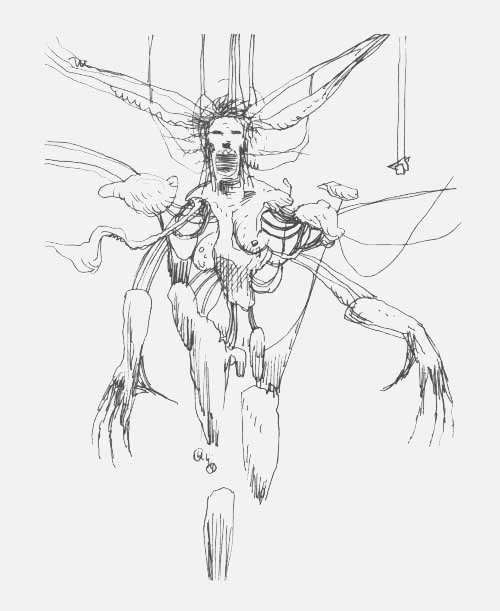 creatures are the sympathetic ones. They are humane. And humanity, represented by priests, cops and analysts - the three forces
of authority - are absolutely, unreservedly bastards. Here we've made a conscious attempt to make positive forces of various
creatures who are usually spat on in life or in the movies. But, particularly, I've tried to get at something which I think is
the subtext of an awful lot of horror and fantasy movies - that the forces of darkness, the things that are supposedly morally
repugnant - are the things we really like. I think there's more of an overlap between the things we are supposed to find repulsive
in the movies, like the vampire - the guy who can pick up girls from across the room with just a glance, who lives forever, who
enjoys the night, who is sensual - there's more of an overlap between those qualities and the things we actually enjoy. Normally
you're supposed to hate those guys, you're supposed to enjoy the fact that they get killed. I've always thought that's a cheat.
I enjoy the monsters and I want them to be as life-affirming as any human beings. What we're asking the audience to do is cheer
the monsters. What I'd like to be able to get at is that, although the world of the Breed is a bit intimidating at first, it's a
world you'd prefer to see survive at the end of the picture - and when it doesn't survive, your hope is that the re-establishment
of that society in the second picture will succeed...[on Cronenberg] For me it couldn't be more perfect casting - it's great genre
casting for one thing. I don't think I'd realised how good he actually looks until I saw him on film. He looks very chilling.
He offers up these wide, sympathetic grins, then they suddenly vanish off his face... He wrote a little speech for himself, which
will be obvious when you see the film - it's absolutely pure, essential Cronenberg!"
creatures are the sympathetic ones. They are humane. And humanity, represented by priests, cops and analysts - the three forces
of authority - are absolutely, unreservedly bastards. Here we've made a conscious attempt to make positive forces of various
creatures who are usually spat on in life or in the movies. But, particularly, I've tried to get at something which I think is
the subtext of an awful lot of horror and fantasy movies - that the forces of darkness, the things that are supposedly morally
repugnant - are the things we really like. I think there's more of an overlap between the things we are supposed to find repulsive
in the movies, like the vampire - the guy who can pick up girls from across the room with just a glance, who lives forever, who
enjoys the night, who is sensual - there's more of an overlap between those qualities and the things we actually enjoy. Normally
you're supposed to hate those guys, you're supposed to enjoy the fact that they get killed. I've always thought that's a cheat.
I enjoy the monsters and I want them to be as life-affirming as any human beings. What we're asking the audience to do is cheer
the monsters. What I'd like to be able to get at is that, although the world of the Breed is a bit intimidating at first, it's a
world you'd prefer to see survive at the end of the picture - and when it doesn't survive, your hope is that the re-establishment
of that society in the second picture will succeed...[on Cronenberg] For me it couldn't be more perfect casting - it's great genre
casting for one thing. I don't think I'd realised how good he actually looks until I saw him on film. He looks very chilling.
He offers up these wide, sympathetic grins, then they suddenly vanish off his face... He wrote a little speech for himself, which
will be obvious when you see the film - it's absolutely pure, essential Cronenberg!"
Nightbreed - Preview
By Stefan Jaworzyn, Horrorfan, Vol 1 No 3, Fall 1989 {note interview took place in week 4 of the Nightbreed shoot}
"After Nightbreed came out [David Cronenberg] said to me, 'Listen, this is going to happen to again. It's happened to me movie after movie - people not getting it, critics hating it and then two years later they say, Ah, you know, it wasn't so bad. It's better than the new movie he's put out.' In fact, we've seen some interesting reassessments of Nightbreed, even in the recent past. Entertainment Weekly just gave an issue over to the "100 Best Movies You Never Heard Of", and one of them was Nightbreed. It's doing very well on video."
Boundless Imajination
By WC Stroby, (i) Fangoria, No 109, January 1992 (ii) Horror Zone, No1, August 1992 {Note : interview took
place in August 1991}
"It's terrible to say it, but I think that a lot of people in these kinds of [Hollywood] systems respect somebody who will yell
and scream and be irrational and throw things, more than they will
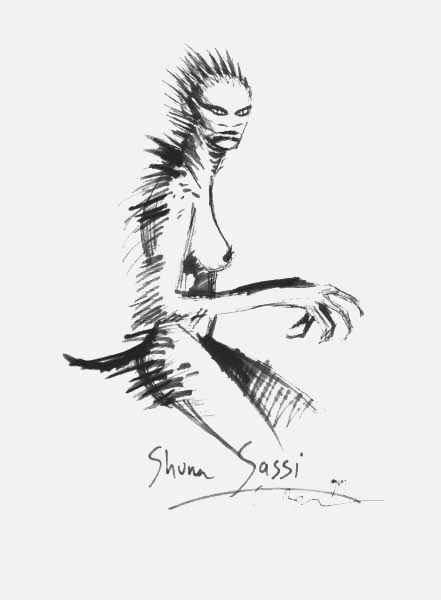 somebody who will come in and talk quietly, intellectually and deal honourably with them. I didn't have a producer who yelled and
screamed and kicked arse. And despite the superfice of sophistication that that community has, it really works at gutter level.
People bully, people connive, this is nothing you haven't heard about Hollywood before, but there it is - and they lie. I want
to make movies, I don't want to make movies with dishonourable people. I think I'm probably going to have to once in a while. I
would prefer to know the systems better. I made 'Hellraiser' here, I made 'Nightbreed' here. I walked over there to finish
post-production on the movie and discovered a whole different system of values, almost anti-values.
somebody who will come in and talk quietly, intellectually and deal honourably with them. I didn't have a producer who yelled and
screamed and kicked arse. And despite the superfice of sophistication that that community has, it really works at gutter level.
People bully, people connive, this is nothing you haven't heard about Hollywood before, but there it is - and they lie. I want
to make movies, I don't want to make movies with dishonourable people. I think I'm probably going to have to once in a while. I
would prefer to know the systems better. I made 'Hellraiser' here, I made 'Nightbreed' here. I walked over there to finish
post-production on the movie and discovered a whole different system of values, almost anti-values.
"The politics got so Byzantine that I didn't know who was stabbing me in the back, who was stabbing me in the eye - but they all
had knives. All those things happen to directors all the time, but because books aren't like that, it came as a real shock to
realise that people would just lie straight to your face and there were times when I thought I really don't know what I'm doing
this for. I don't know why I'm bothering to deal with these people - they are total bastards.
"[after the test screening] I came out of there thinking, 'My God, we've done it. They love it.' Which is one of the mysteries why
20th Century Fox didn't get behind it. If it didn't test well I could understand them dumping it, but the audience had a great
time. When I saw the way they were selling the movie, I freaked out and said, 'What are you doing? This isn't the movie,' and was
given all kinds of excuses... 'Well there isn't time to change it, we have to release now.' And there was a very low awareness of
the movie, and they knew it. The recognition of Cronenberg was smaller than I thought. They knew they hadn't prepared the audiences
for the existence of the movie, nobody knew the movie was coming, when the movie was advertised it wasn't the movie that we'd made.
When the movie was out it was put out with posters that wholly misinterpreted the content, and then of course it was gone.
"[a head of Morgan Creek comments: 'If you're not careful, some people are going to like the monsters'] I was crazy as a loon at
that point. I didn't know what to do, but the thing is it's no use yelling, 'You stupid fucker,' you have to sit down and say,
'Listen, this is the movie we've made, this is why we've made the movie... ' Part of the problem is that people think so
generically, they think 'horror movie': that anything that's ugly or monstrous is bad. Rex Reed said on TV: 'I like my monsters to
be evil. So I don't like this movie because I like my monsters to be evil.' So no room for ambiguity, no room for Quasimodo, no
room, apparently, for Frankenstein's monster, no room for all those wonderful creatures for whom we feel ambiguity, like King Kong.
He liked his monsters evil, so fuck this movie. If you are dealing with a movie that's a little bit quirky, a little bit strange,
then people have to make creative decisions, and the trouble with making creative decisions, if you're a person who wants to keep
their
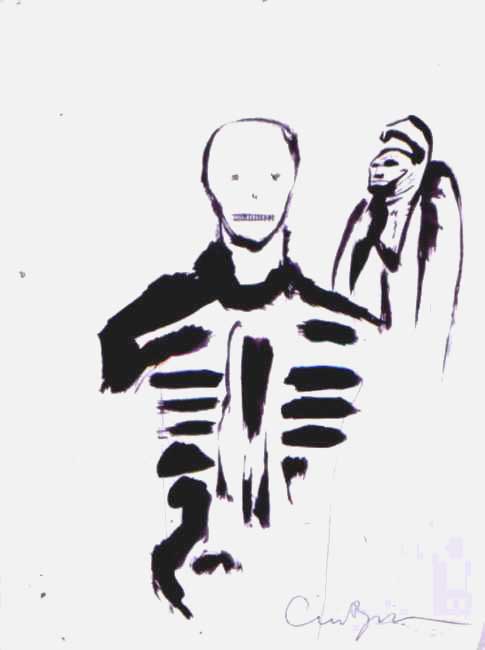 job, is you could be wrong. Our little 'Nightbreed' comes along and it's a one-weekend job, which is going to work, or it isn't,
and if it doesn't, who cares? It's a movie made by someone who made this other quirky S&M horror movie, who isn't one of the
community, who's made this faintly European Hammer-horrorish sort of movie, and it's got Cronenberg in it and they're not that sure
about Cronenberg either for a whole bunch of other reasons. And it's got all these weird creatures, and we're supposed to like
them, and no stars and it's violent and it's weird and it inverts the moralities. The head of marketing at Morgan Creek never even
saw the movie all the way through, and he was the guy publicising the movie! He could never make it through the film; it disgusted
and distressed him. He said to me at one point, 'You're an intelligent man, why do you make these movies? They're disgusting and
horrible.' And this guy was selling the movie! They were just incredibly confused as to how to market the picture. It's a monster
movie and they were slightly ashamed of it being a monster movie. They were uneasy with the whole thing. And there is no way of
articulating to people who just don't get it, what the pleasures of a monster movie are. It's more of a rollercoaster ride than
originally intended. I was surprised at how little time the US audience wanted to spend with dialogue when I tested the movie. The
longer cut frankly didn't work for them. They wanted sensation after sensation after sensation. But it's roundabouts and swings in
a way, because there's an element of excitement now in the movie. What happens now is the movie gets running and just never stops.
I don't think it bores anybody, it moves way too fast to bore. But I've made my second Hammer movie, and it's a very different
kind of movie to 'Hellraiser', but it was nevertheless in an essentially English tradition, indoor sets and the whole thing being
a little strange and quirky, rather than it all being super slick - gothic, if you like. It has a delirious quality; it begins with
a dream and it never stops being a dream all the way through, it has the tone of an opium dream movie and I like that a lot. Its
weirdness quotient is high, which does tend to delight me. [Re. likelihood of sequel to 'Nightbreed'] Yes, partially because the
video company are very interested, but if it does well on video then there'll clearly be an audience for it... [as with
'Hellraiser III] as long as these movies are made for a modest budget there's no reason why they shouldn't continue, so yeah, I
think there's a good chance there'll be a sequel. I'd be involved in it but I've just signed a two-picture deal with Universal so
that'll keep me out of the running for a while. [a sci-fi film & The Mummy re-make] If I wasn't writing books I'd feel very
distressed by all of this. But I'm still learning, this is not my prime profession, and I do need to educate myself."
job, is you could be wrong. Our little 'Nightbreed' comes along and it's a one-weekend job, which is going to work, or it isn't,
and if it doesn't, who cares? It's a movie made by someone who made this other quirky S&M horror movie, who isn't one of the
community, who's made this faintly European Hammer-horrorish sort of movie, and it's got Cronenberg in it and they're not that sure
about Cronenberg either for a whole bunch of other reasons. And it's got all these weird creatures, and we're supposed to like
them, and no stars and it's violent and it's weird and it inverts the moralities. The head of marketing at Morgan Creek never even
saw the movie all the way through, and he was the guy publicising the movie! He could never make it through the film; it disgusted
and distressed him. He said to me at one point, 'You're an intelligent man, why do you make these movies? They're disgusting and
horrible.' And this guy was selling the movie! They were just incredibly confused as to how to market the picture. It's a monster
movie and they were slightly ashamed of it being a monster movie. They were uneasy with the whole thing. And there is no way of
articulating to people who just don't get it, what the pleasures of a monster movie are. It's more of a rollercoaster ride than
originally intended. I was surprised at how little time the US audience wanted to spend with dialogue when I tested the movie. The
longer cut frankly didn't work for them. They wanted sensation after sensation after sensation. But it's roundabouts and swings in
a way, because there's an element of excitement now in the movie. What happens now is the movie gets running and just never stops.
I don't think it bores anybody, it moves way too fast to bore. But I've made my second Hammer movie, and it's a very different
kind of movie to 'Hellraiser', but it was nevertheless in an essentially English tradition, indoor sets and the whole thing being
a little strange and quirky, rather than it all being super slick - gothic, if you like. It has a delirious quality; it begins with
a dream and it never stops being a dream all the way through, it has the tone of an opium dream movie and I like that a lot. Its
weirdness quotient is high, which does tend to delight me. [Re. likelihood of sequel to 'Nightbreed'] Yes, partially because the
video company are very interested, but if it does well on video then there'll clearly be an audience for it... [as with
'Hellraiser III] as long as these movies are made for a modest budget there's no reason why they shouldn't continue, so yeah, I
think there's a good chance there'll be a sequel. I'd be involved in it but I've just signed a two-picture deal with Universal so
that'll keep me out of the running for a while. [a sci-fi film & The Mummy re-make] If I wasn't writing books I'd feel very
distressed by all of this. But I'm still learning, this is not my prime profession, and I do need to educate myself."
Flesh And Fury
By Mark Salisbury, Fear, No 22, October 1990
"I think that Miramax would have dealt better with promoting and selling a movie like 'Nightbreed' than Fox, who are very good with things like 'White Men Can't Jump' but not so good at selling the quirky stuff."
Barker Looks Back
By Anthony C Ferrante, (i) Bloody Best of Fangoria, No 12, September 1993(ii) Fangoria : Masters of the Dark (slightly updated as " Clive Barker's Horror Hat Trick")
"I think the film will be a fair reflection of what's in the book ['Cabal'], though it's not the fantasy world of 'Weaveworld'
and it's not straight horror either. The fantastical elements in the book... are
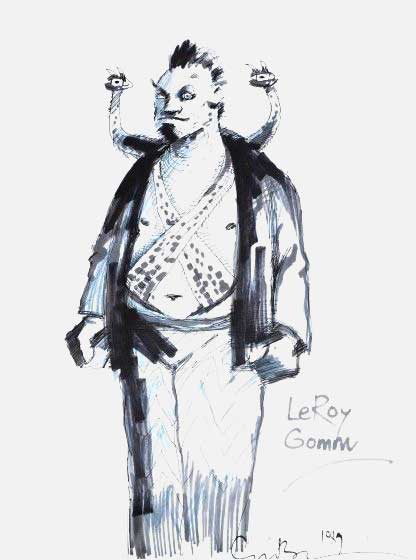 rather impressionistic. But you can't do that in a movie, people need to see what these guys actually look like, what do their
kids look like, and how do they have a bath. I've always liked the idea of thecreature as domestic animals; it's another way of
humanizing the monstrous, which is something I've always tried to do anyway. Whether that takes off its horrific edge is, to some
extent in the eye of the beholder. For me, strictly speaking, these things aren't horrific in the first place. I think the
audience will come out of this movie believing that what they would normally have thought of as the monsters are actually the
good guys. This movie is, like a lot of fantastical art, a hymn to variegation... I think of it as being, however perverse the
moral structure may seem to conventionally thinking people, a fiction of celebration, in which the monstrous is infinitely more
interesting than the banality from which the heroes and heroines of the fiction have stepped. They have dull eyes, and into that
dullness something erupts. And they have to choose to turn their backs on it, or embrace it, and invariably they embrace it. The
climaxes here are emotional rather than sick imagery climaxes; they're climaxes of heroism and romance. Admittedly, the romance is
sometimes very perverse; I mean, what's going on between Boone and Lori is extremely perverse - they fall more and more deeply in
love the deader they get."
rather impressionistic. But you can't do that in a movie, people need to see what these guys actually look like, what do their
kids look like, and how do they have a bath. I've always liked the idea of thecreature as domestic animals; it's another way of
humanizing the monstrous, which is something I've always tried to do anyway. Whether that takes off its horrific edge is, to some
extent in the eye of the beholder. For me, strictly speaking, these things aren't horrific in the first place. I think the
audience will come out of this movie believing that what they would normally have thought of as the monsters are actually the
good guys. This movie is, like a lot of fantastical art, a hymn to variegation... I think of it as being, however perverse the
moral structure may seem to conventionally thinking people, a fiction of celebration, in which the monstrous is infinitely more
interesting than the banality from which the heroes and heroines of the fiction have stepped. They have dull eyes, and into that
dullness something erupts. And they have to choose to turn their backs on it, or embrace it, and invariably they embrace it. The
climaxes here are emotional rather than sick imagery climaxes; they're climaxes of heroism and romance. Admittedly, the romance is
sometimes very perverse; I mean, what's going on between Boone and Lori is extremely perverse - they fall more and more deeply in
love the deader they get."
Frights Of Fancy
By Nigel Floyd, (i) 20/20, No 2, May 1989 (ii) Clive Barker's Shadows in Eden (edited)
"Time does give you a better perspective on things. I saw it again the other day and liked the movie a lot. But its intensity of strangeness makes it a rather more difficult picture for a viewer than I had thought. The movie doesn't give you any relief from its strangeness... the movie has a delirious quality: the kind of sense that it is something you might see (or have made) when you were high - which I hasten to add I wasn't!"
Clive Barker's Letter From America
By Allan Bryce, The Dark Side, No 10, July 1991
"There's an important distinction between Hellraiser and Nightbreed. Hellraiser was an intelligent low-budget horror movie,
but we didn't really have much visual sweep. We had a house in Cricklewood and limited sets. For Nightbreed, we have three
soundstages at Pinewood Studios, Canadian locations, 60 monsters and David Cronenberg in a major role. It's a big canvas. I'm
excited. We have the possibility to make a horror picture with the visual richness of a Hieronymous Bosch painting. The
preplanning has been meticulous. It's going to be fun. We have some extraordinary creatures, many of whom are extremely violent
and require several elaborate effects gags. We're contractually obliged to deliver an R-rated picture, so it won't be as gory as
the Hellraiser movies, but there's lots of visceral material. I think it'll be more exciting since the kind of imagination that
created the Cenobites has been given free reign. Although we had limited money on the Hellraiser films, we created images that
touched people; here those images are times 10, some of the weirdest monsters ever seen. Cabal will be in three parts and
Nightbreed will follow that pattern. On Hellraiser, we didn't know until almost the end of
 shooting that we'd be doing a sequel. With this one I specifically wanted to create a horror mythology from the ground up,
developing characters that will have continuity throughout the series."
shooting that we'd be doing a sequel. With this one I specifically wanted to create a horror mythology from the ground up,
developing characters that will have continuity throughout the series."
Nightbreed
By Philip Nutman, Fangoria, No 83, June 1989
"I'm not interested in just telling a story. I want to explore the theme of monstrousness, to create a mythos that goes beyond anything we've ever seen in this type of movie."
Birth Of The Nightbreed
By Philip Nutman, Fangoria, No 86, September 1989
"The movie has never been in better shape. It is now a bigger and better project than was envisioned. Nightbreed now has an $11 million budget. For me the jump from a $2 million movie [Hellraiser] to an $11 million movie is a big one. What we have here is a big, complicated project. The Star Wars of horror movies is what we promised and that is what we are trying - I emphasise trying - to achieve. We haven't finished shooting yet. All the principalphotography is in the can, but we're currently doing additional work - special effects, makeup, model work. A whole bunch of other material has yet to be included in the picture... There are several ways in which the movie diverges from the book, particularly the way Ashbury deals with Eigerman. A subtle thing in one way, though it's mammoth in another, is that in the book the Breed are represented very impressionalistically. You only get two or three paragraphs about them in a 200 page book. In the movie they have to be realised in great detail. My first job was to go to Bob Keen and his boys and tell them 'My vision of the Breed is this.' They had to translate those notions into concrete forms, make them into prosthetic reality. Then there's the fact that a movie is a two hour experience, whereas a book, even a short one, is a longer experience containing psychological materials that you can't put into a movie because film is essentially visual. That subtext has to be translated into visual terms. [Cronenberg] was tremendously responsive to the movie, both as a director and as an actor. He gave me some advice, not so much on a technical level, but indications of where he felt the particular strengths of a scene lay, little dramatic details. My attitude as a director is that there's only one thing to be served in the process and that's the final movie. When advice is offered I listen. What was especially nice was that David's attitude to directing is similar to mine. He pointed this out within the first couple of weeks and said he was pleased to find the same atmosphere on the set of Nightbreed as there was on Dead Ringers and The Fly. The climax of the film, the battle between Eigerman's troops and the Breed, took place on F Stage, which is a moderately large soundstage at Pinewood. Every shot required fire, smoke, debris, destruction, explosions, guns and all of that, but within the relatively limited confines of a set. Trying to convey a state of open warfare over a two-and-a-half week period was a nightmare. This was a very tough shoot, I can't stress that enough. Some of the crew had worked on the last Indiana Jones movie and they said that Nightbreed was the more demanding of the two."
Bring On The Monsters !
By Philip Nutman, Fangoria, No 87, October 1989 {Note : Interview took place in June 1989}
66 - EXT. NECROPOLIS GATES - DAY
The silhouette of Peloquin, a were-creature, moves between the tombs. He
draws on the cigarette. By its brightening point we glimpse an extraordinary face: more animal than human, but no recognizable
species.
PELOQUIN : He's not Nightbreed. He's Natural.
BOONE : No! I've killed people, I'm like you, that's why I'm here...
PELOQUIN : Shut the fuck up. You're meat.
KINSKI : If we eat him we break the law.
In the shadows Peloquin starts to alter his form, Boone watches, amazed, as the
crouching figure breathes in deeply, his alien appearance becoming smoke, which he sucks into his throbbing body.
BOONE : My God... My God, it's true...
PELOQUIN : Of course it's true. Everything's true...
(he starts to emerge from the shadows) God's an astronaut. Oz is over the rainbow. And Midian's where the monsters live.
And you came to die.
BOONE : I didn't... didn't come to die. I came to be with you, I'm one of you.
Peloquin reaches out and touches Boone's chest.
PELOQUIN : No. Sorry. I can smell innocence at fifty yards.
BOONE : I've killed people. Fifteen people.
PELOQUIN : Who told you that?
BOONE : What do you mean?
PELOQUIN : He lied, asshole. He lied. You're Normal. And that means... you're meat for the beast.
Second Draft - December 1988
"For the first 'Nightbreed' picture, which is the first of the 'Cabal' pictures, we might do a little bit of shooting in Canada,
but
 essentially we want to work with the same team that has done such extraordinary work here [on 'Hellbound']. In the 'Nightbreed'
pictures, I will say I think there'll be more monsters per square inch of screen than probably ever seen before. I mean this is a
major, major number of monsters. It may even be three movies eventually. As long as it's planned, I like the idea of a series. The
only time it doesn't work, it seems to me, is when - as in the Nightmare on Elm Street pictures - there isn't planning.
essentially we want to work with the same team that has done such extraordinary work here [on 'Hellbound']. In the 'Nightbreed'
pictures, I will say I think there'll be more monsters per square inch of screen than probably ever seen before. I mean this is a
major, major number of monsters. It may even be three movies eventually. As long as it's planned, I like the idea of a series. The
only time it doesn't work, it seems to me, is when - as in the Nightmare on Elm Street pictures - there isn't planning.
"I would certainly like to direct the first 'Nightbreed' because I think it is a horror movie with a very new angle. And it has all these creatures in it, and it can be very imaginative and very fun to do. One of the things that Chris [Figg] and I are trying to do is reestablish that tradition in this country. Nobody else is doing it."
Chains of Love
By Mark Salisbury,Fear, No 3, December 1988
"I'm writing and directing it, and there will be 50 monsters in it, more monsters than in any movie for decades. Major monsters."
Top Of The Horror Heap
By Martin Burden, New York Post, 30 December 1988
"I've always loved monsters. I think there's a corner of all of us that envies their powers and would love to live forever, or to fly, or to change shape at will. So, when I came to make a movie about monsters, I wanted to create a world we'd feel strangely at home in. I called it Midian. An underground city peopled with creatures from our darkest fantasies: things that feed on blood; things that avoid the light of day; things repulsive and fascinating; forbidden souls hiding from their cruellest enemy - man... All of us, behind the camera and in front, had the same intention - to make Nightbreed a film like no other, flipping all the conventions of the horror movie, plunging you into a world of insanity and miracles where dead men can be heroes and monsters beautiful, where the only place of refuge is the most forbidden place on earth: Midian - the home of the Nightbreed."
Introduction to Nightbreed
By Clive Barker, Nightbreed US Video, 1991
"They [20th Century Fox] tested the movie and it tested real well. Then they realised that the campaign was a difficult one
because Nightbreed was slightly difficult to classify. It has elements of fantasy, elements of horror fiction, and it was a
mixture of both. I saw that as a strength. [Fox Chairman] Joe Roth saw that as a strength. The marketing people saw it as a
weakness. They saw the fantastical elements as being difficult, rather than one of its strengths. That's one of the things that
I do, both as a writer and as a moviemaker; I write this weird, delirious kind of fiction. It is not necessarily like anyone
else's kind of stuff. I wanted to make a movie that was a celebration of monsters, a movie that was a Bosch canvas come to life.
It wasn't going to be this rational, logical thing. Instead of trusting the movie, they tried to do something which is
reprehensible - they tried to represent the movie as something that it wasn't [a slasher film] which is a small element in the
movie. The monsters were nowhere to be seen in the ads or the one sheet [poster]. The TV teasers were extremely confused and
didn't represent the movie. Added to that, they chose not to preview the movie, which enrages critics - especially those
unsympathetic to the genre in the first place. Nightbreed is a difficult movie of its type because it doesn't fit any neat
categories. The result was confusion and poor box office.
"Hellraiser was also an odd movie with weird elements but New World said, "This is a movie that Barker's made. We don't
necessarily understand it or like it, but we'll get it out there." And they took one of the movie's strongest images - Pinhead
with the box in his hands - and put in on the poster beautifully. Nightbreed was packed with such images! We had 'em crawling out
of our ears and the movie needed to be sold that way. Putting aside reviews, they couldn't even open a movie with 200 monsters in
it.
"No movie is perfect. There are screw-ups in Nightbreed and all kinds of things I'd do differently, but that's true of
Hellraiser and my books as well. Whatever else you can say about Nightbreed, it's not like anybody else's movie, it's not a
tintype. It delivers what I always promised it would - a monster movie that would spill over with weird images and creatures.
There are lots of horror movies out there that don't have very much in their minds. Nightbreed does.
 You don't need to be talking down to people all the time. So yes, the movie has a bleak end. It doesn't cross all the t's and dot
all the i's, but neither does Hellraiser. We don't know where the cenobites come from. I like the sense that there's a mythology
that you only get a glimpse of. You don't get the whole thing, like you don't know how Freddy Kreuger gets into people's
dreams.
You don't need to be talking down to people all the time. So yes, the movie has a bleak end. It doesn't cross all the t's and dot
all the i's, but neither does Hellraiser. We don't know where the cenobites come from. I like the sense that there's a mythology
that you only get a glimpse of. You don't get the whole thing, like you don't know how Freddy Kreuger gets into people's
dreams.
"There's got to be a way to make the kind of movies that I want to, which are never going to be mainstream, ordinary,
middle-of-the-road pictures, and find people in the major studios who will support them. Clearly it's difficult. David Lynch,
Cronenberg and Romero are not working in the main flat of the studio. Argento is barely known in America. Those large
organisations are extremely conservative."
Barker Bites Back
By Anthony Timpone, (i) Fangoria Horror Spectacular, No 1, 1990(ii) Fangoria : Masters of the Dark
"Hellraiser was unapologetically a movie set out to make your palms get clammy and make you shift around in your seat. You
weren't sure you wanted to see what was coming next. That isn't the case with Nightbreed. It is much more benign in its
intentions. This picture is much more upfront about the fact we don't want to see the monsters die. We actually find them
interesting. And sexy. We're not really on the side of the cross-wielding Christians, we're actually on the side of the creatures
of darkness.
"The whole idea of Nightbreed began with my novel Cabal. It's a book I'm very fond of and, as I was finishing
it, I realised that it would lend itself very nicely to movie adaptation: it was economic in terms of narrative structure and I
thought it might be something I'd want to do myself. One of the things I love about making a movie from something I've written is
the pleasure of being able to reinvent your imagination: you've done it once, you know the way it looked when you wrote it, and
then you reinvent it entirely. Nightbreed doesn't look the way I imagined it when I was writing Cabal. It has turned out to be
much larger in scale than I originally anticipated, but it's still manageable for someone like me who is only making his second
picture.
"The book is about Boone and his journey; the movie is about the Nightbreed, this hidden tribe of mythological beings,
shape-changers and strange people who come from the Old Country of the imagination. My sense was that I had to work really hard to
scare audiences, I had to put more solid 'jumps' in it than I did in Hellraiser - it's full of those cheap little tricks. But I
also had to make sure that, when the monsters appear, the audience will warm to them despite their strangeness, despite the fact
that some of them are quite dangerous. If they simply bit and tore and turned to smoke and ripped people up, the audience was
never going to come into their world. There had to be an element of Tod Browning's Freaks in which you saw that there was a wit
and a sly warmth to these characters. The balance to be achieved was not to let the humour undercut the scares.
"In the Thirties you felt sympathy for King Kong and the Frankenstein monster, but there haven't been many movies like King Kong
and Freaks and Bride Of Frankenstein lately. There's no trace of that earlier, much richer tradition and that's what the
inhabitants of Midian represent. What I wanted to do in this movie was to set that Thirties tradition against the Eighties
tradition. You start with a stalk-and-slash character, but this time you're going to understand that this isn't something you want
to applaud. I'm saying to the audience, 'Here's the tradition you've been applauding, but there's another tradition which is rich
and various and witty and warm and poetic. Isn't that what we should be celebrating?'
"Finally, I think that we will perceive
the living from the point of view of the dead, we will perceive the natural from the point of view of the unnatural, we will
perceive ourselves from the point of view of something other than ourselves - whereas conventionally in horror movies, at least
today, you perceive the Other from the place where your head is when you go into the theatre. Nightbreed is a hymn to variegation.
No Breed looks like any other Breed. In the same way the cantina sequence in Star Wars worked the first time you saw it, I want
audiences to have the impression that there is this great gathering of creatures and they are never quite sure they've seen them
all. I think Image Animation has once again created some immensely memorable images - creatures that are monstrous and beautiful
in the same moment, which has always been my favourite condition for any creature.
"I think this movie will be a kind of
ride - not a ghost train ride because that's too grim; not a fairy tale ride because that's too grim as well; but sort of a ride
through the space between my ears, a trip through Clive Barker's skull. There's some very dark stuff in there, some sexy stuff
and some funny stuff as well. I hope it will be the kind of dream you don't want to wake up from, the kind of dream that when
you've opened your eyes you think, 'I wouldn't mind going back there.'"
Nightbreed Presskit
By [ ], 1990
[re. casting Cronenberg out of type] "It's an insight missed by Barry Norman! Most insights are missed by Barry Norman! You're
right. The thing for me was his doing what will probably be the last horror movie I'll do for a while, was the idea of colliding
two traditions, very consciously. I mean, the movie is a series of riffs. My two favourite descriptions of the movie: one was that
it was an Indiana Jones odyssey on acid, which I very much liked; and the other was that it was like a series of trailers, which is
not wrong. It is, it's like a series of trailers for a whole bunch of movies, interweaving and colliding and then going off at
various directions. It's a series of moments from traditions, if you like.
"It's unfair on David, that casting, deeply
unfair on him, because - and I think this is one of the reasons why he did it - the new horror which he represents, 'Long live
the new flesh,' is so much more interesting than the tradition he's representing in the movie. Stalk 'n' slash is a very
uninteresting sub-genre...I think it is a pretty dull genre. So I wanted to kind of collide that with, as you rightly say, a
much older tradition, which is this kind of fantastical tradition of monsters, which is fairy-tale as much as anything. It's
going into the enchanted wood and finding around every corner some kind of strange beast; and you're not absolutely sure whether
they mean you good or harm."
The Edge Interview
By David Alexander, The Edge, 1991
"Cronenberg is a very interesting man. Very urbane and civilised. And he makes these crazy and demented movies!So I thought he'd
fit the role of Decker perfectly especially when he's beneath the mask of the serial killer. I also found it interesting to watch
the contrast between David Cronenberg the moviemaker and David Cronenberg the actor.
"I don't think the budget [for Nightbreed] was huge. Today, even modest films have a budget of fifteen to twenty million dollars,
and Nightbreed was certainly nowhere near that. It was a bigger film than Hellraiser; and certainly had a bigger budget. I enjoyed
having the larger scope for that picture. Hellraiser was a very small film and those limitations helped with the claustrophobic
mood. So to answer that question, I'd have to say that it would depend upon the script and the story you are trying to tell. It
would be very difficult to try and do Nightbreed on Hellraiser's budget. And it's very possible that Hellraiser wouldn't be as
good on Nightbreed's budget.
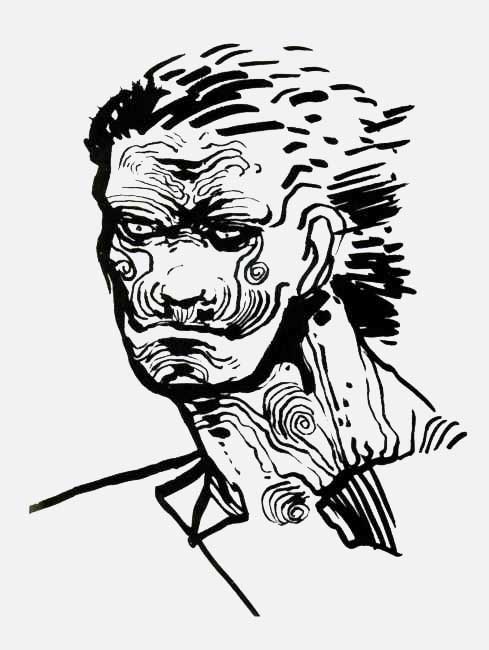
[re. Cabal's facial markings resembling Maori tribal designs] "It was a completely conscious
effort. That's rather obscure, and I'm surprised you picked upon that. The spiral is a classic form, very symbolic. Lost Magic
Kingdoms is a wonderful book, with beautiful photography and very informative. So, I do look everywhere, and I do see a kind of
new tribalism. You don't have to go to New Guinea to see ear, nose, and cheek piercings anymore. In Los Angeles, all you have to
do is step out onto Santa Monica Blvd. to see all kinds of tattooing. Forty years go, you wouldn't see people doing these sorts of
things with their bodies, at least not in Western culture there has been an eruption of new tribal forms in our culture."
L A Gore
By Paul Mungo, GQ, December 1992
...other comments
133 - OUTSIDE BAPHOMET'S CHAMBER
Ohnaka and Lori reach the next to last chamber; a roaring from below, down
a slope in front of them, walls vibrating with the din from Baphomet's chamber. Ohnaka withdraws. Blindingly bright light, out of
which Lori spots a figure climbing towards them.
LORI : Boone? Boone!
She moves down to Boone, scrambling up the slope towards her, drenched in sweat, half-mad with terror.
BOONE : Don't... don't look...
He reaches for her, then collapses. She starts down the slope towards him. Dust falls from the roof, the din makes her reel.
But she reaches him, starts to haul him to his feet. Then, she looks up and we get a glimpse of...
134 - INT. BAPHOMET'S CHAMBER
Out of the blinding light, and seemingly the source of it, a huge black figure turns towards her, twelve feet high, severed
limbs connected by sinews of hot, white energy and extruded spines, the face terrible, wise and beautiful.
Lori's stunned, she averts her eyes. Boone collects himself enough to pull her away and they help each other frantically
scrabble up the slope, out of the chamber.
Second Draft - December 1988
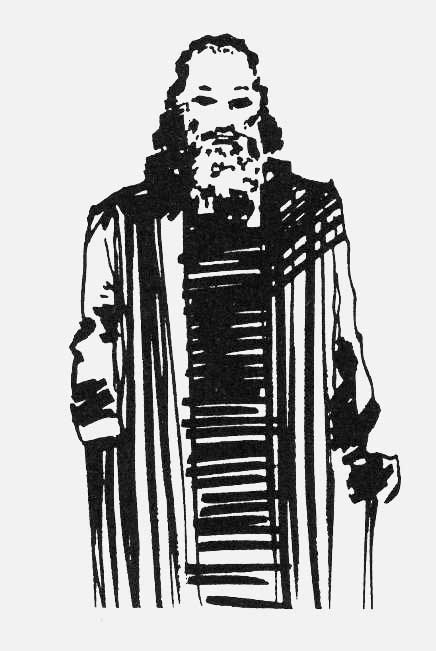
Doug Bradley : "I didn't really enjoy playing Lylesburg very much. There just wasn't very much to get hold of; he was a Moses-type character. He stood for a kind of patriarchal thing; sit down, don't rock the boat and don't frighten the horses, which was fine and I did it to the best of my ability. I'm not sure I was perfect casting for it necessarily, and I found it quite hard work. I felt quite on the fringes of the movie as a whole."/p>
Pin - Points
By Nick Vince, Hellbreed No.3, July 1995
Malcolm Smith : "We're not sure why [Ashberry] puts his hand in the potion to change himself at the film's end. It seems very predestined. Much greater powers have brought him there. He is sent as a messenger from another god, but I don't know whether he's good or bad."
A Hymn To The Monstrous: The Making Of Nightbreed
By Mark Salisbury and John Gilbert, Clive Barker's Nightbreed - The Making Of The Film, 1990
Geoff Portass : "We've got computer-controlled animatronics in Nightbreed, but only where
necessary...Nightbreed has in it every type of monster imaginable, but no monsters that necessarily say 'monster'
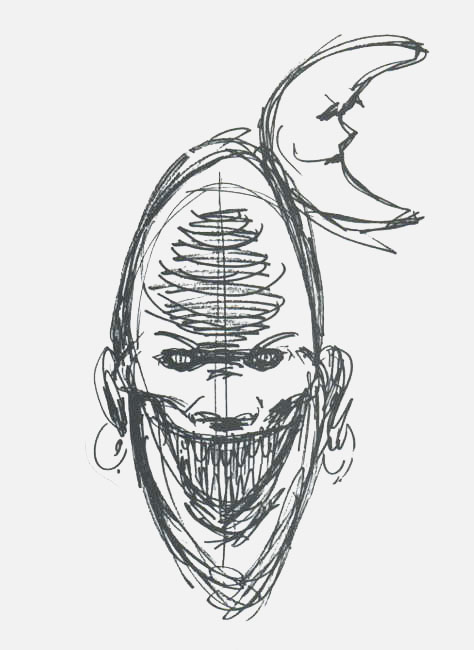 to you. The real monsters in Nightbreed are the humans. That gives us great opportunity: we're on the monsters' side. With that in
mind you don't design anything that's really going to upset that."
to you. The real monsters in Nightbreed are the humans. That gives us great opportunity: we're on the monsters' side. With that in
mind you don't design anything that's really going to upset that."
Games Without Frontiers
By Brian J. Robb, Fear, No.6, May/June 1989
Bob Keen : "The whole idea is that we wanted a certain background and texture. I think Clive will use the characters we see a little of in future movies. It's pretty much like the Star Wars films, in that you lay down the storylines and textures for numerous extra characters, and then you can build on that in later films. In a way, it's heartbreaking to work on something for five months and only have it end up on the screen for three seconds, but it will eventually pay off."
On The Set of Nightbreed
By J.B. Macabre, Slaughterhouse, Vol 1 No 5, 1989
Charles Haid : [on Eigerman] "A very interesting aside to this, which should give you some idea how I've found a way to make Eigerman come to life, is a quote I read recently from Nazi war criminal Klaus Barbie. He said, 'I am a son of the Eiger. I live in its shadow.' That gave me a focus, tied in the fascist elements being used as a background detail."
Birth of the Nightbreed
By Philip Nutman, (i) Fangoria, No 86, September 1989(ii) Fangoria : Masters of the Dark
David Cronenberg : "Clive has got about 60 or 70 characters to deal with in this film and I only have
to deal with one. So, if Clive would say, 'Maybe he'd pick up the cup of coffee,' and I would say, 'Oh no, I don't think he would
do that,' well, Clive would listen. To a certain extent, Clive is going to trust my instincts as an actor, with that character,
because that's the responsibility, to keep that character consistent through and through. On the other hand, you depend very much
on your director to bring you into the movie at the right level.
"The first scene I shot was a scene at the end of the movie,
and that was my introduction to the character of Decker: I don't say a word, but it's a very complex scene. Clive has to tell me
what level we're on for that, because he's the only one who's got the whole picture in his mind. My instincts might say, 'Do this
in a hysterical tone,' and he might say, 'No, no, that's quite wrong, because you've got to build up later to even more hysteria,
so if you go totally to the top, you've got no place to go.' It's really collaboration that way. It never really gets to, 'You're
wrong.'
"A death scene is always a wonderful thing to do. Basically, it's all play, it's like kids and that's what's nice
about it. You get on the set, there's a strange balance between the adult part of yourself which has to be obedient and punctual,
and the part that likes to play. It's really exciting to be on the set as an actor, and primarily be expected to play, make yourself up and put on funny clothes. That's what it is, and that is my pleasure. It has nothing to do with real death or anything like that whatsoever. You're going to do your version of a psychotic. My interests and Clive's overlapped to a certain extent. We could both talk about psychotics of the past, and some of the future, so we really don't need that kind of input [copious character research]. I find that very inhibiting as a director or writer. I tend to invent my research rather than do it.
"There are certain similarities between what I do and what he does, and then there are some extreme differences. For me, it's the differences which are exciting rather than the similarities. We're both interested in transcendence through transformation, considered in a very physical sense rather than a metaphysical sense. Those are themes that we both return to again and again. But he is much more exuberant in his sense of invention and his creation of new mythologies without any rational explanation. That's where we
become different: I would never create the Cenobites, for example, I would never create the Nightbreed. Those are the differences
there, I think."
Faces of Death
By John Gilbert & Mark Salisbury, Fear, No 22, October 1990
Bob Keen : "On Nightbreed we had two months to play around with ideas, before even modelling on
maquettes. Baphomet is a real knockout of an idea and people will say 'Wow, that's never been done before'.
"Clive dreamt up
the answer of how to do Baphomet on screen. He phoned me up one night and said, 'I've dreamt it!' It's difficult putting your own
imagination on the screen, but try putting Clive Barker's imagination on the screen! That's the challenge, making the imagination
real...We're doing the best work we've ever done on this film. We've done two test tapes and everyone is very pleased with
them."
Games Without Frontiers
By Brian J. Robb, Fear, No 6, May/June 1989
Doug Bradley : "I have mixed feelings about Nightbreed on two counts. Firstly, because the movie
that is released is not the movie that was shot at Pinewood, and it's not the movie that Clive wrote. If anybody has read Cabal,
then there's the movie, because the movie that was shot at Pinewood is a very faithful, almost page-by-page faithful, adaptation of
Cabal. And Fox, in my opinion, screwed the movie up.
"It's not my voice doing Lylesberg. in the post production mayhem they
decided to give him a German accent, some guy in L.A came in to do it, which, particularly when you are working in prosthetic
make-up... your vocal performance is terribly important to you. It's one of the things that enables me to possess Pinhead.
"When I saw the film it was like I was watching somebody else do it. But it remains like no other film I've seen... the qualities
of the original managed to struggle through the crap that Fox created, in my opinion, and mark it out as something special, so I
can understand it having that cult following and I think it deserves that."
Pins And Needles
By Chris Fullwood, Firelight Shocks, Issue 4, September 2002
Nicholas Vince : "In a scene that didn’t make it into any version of the film, there’s a moment
during the destruction of
Midian when Lylesburg is urging the Nightbreed to stay below ground while Boone argues they should fight. There were dozens of us
in makeup on the three-story set, standing on the rope bridges listening to them. I stood next to an obviously male actor, as he
was stripped to the waist and it just felt right to put my arm around him protectively, and I thought; 'This is Kinski’s real love.
Surely, there are gay Nightbreed?'
"The truth is, we all want to belong to a Tribe of the Moon; be that tribe family, friends, online, in dungeons, in clubs, or in
the woods. We want and need to belong; to be accepted and celebrated for who we are."
The Tribes Of The Moon Embrace You
By Nicholas Vince, Bigger Bites, Shudder.com, 11 February 2020


