Undying
Released on 20 February 2001 in the US and 8 March in the UK, the game had been undergoing development for some time before Barker's involvement - DreamWorks already had a partially developed game based on a Steven Spielberg project from way back at the beginning of 1999, but needed some help with the storyline. Overhauls from Barker included the main character getting a complete make-over and changing his name accordingly (from Count Magnus Wolfram to Patrick Galloway). The multiplayer mode (and its attendant spells) was a casualty along the way.
Electronic Arts / DreamWorks Interactive promised that the game would deliver "arcane magic, supernatural abominations, and ancient horror" was enhanced by the several layers of reality that Barker generated for them, giving the game what he describes as "the texture of a novel". He also lent his vocal talents as well - recording the voice of Ambrose (suitably the black sheep of the family). Barker has said that Jeremiah's family has "more secrets than the Kennedys and a good deal darker." Galilee 2, anyone..?
Electronic Arts have a massive website dedicated to the game, featuring screenshots, background material and downloadable movies.
Those of you interested in the development process should check out an absolutely fascinating 'developers diary' article at Gamespy.com - who also have the teaser and 6 other movies available to download as well as the back story of several of the characters. Check out IGN.com for a couple of movies too.
Despite having almost as many delays as the PC version, June 2002 did finally see Undying's bow in a Mac version from Westlake/Aspyr Media.
Ultimately though - and despite good critical reaction - poor sales have resulted in Brady Bell confirming that, 'the Undying franchise is dead,' meaning no PS2 version, or follow-up titles...
"They had done some of it and I said, make it more weird. Weird, driven, hard - I'd written hard on the story because my first responsibility, I felt, was to get the story part of it right and be sure that the story made emotional sense. That seemed to be the heart of the problem. Once we'd done that, then we could start to fiddle with design and first up was character, because that's really what an audience is going to respond to. Next up was environment and I did nothing with the monasteries and the walls of the manor as that fell to the designers completely and with Oneiros I just said that I want to make sure that its depths are as vertiginous as possible. It can't just be a pretty piece of Lovecraft. It's got to have a weird kind of logic to it, which it's got."
Clive Barker : Part Two
By Smilin' Jack Ruby, Fandom.com, 13 December 2000 (Note - full text at fandom.com)
"[DreamWorks was] looking for a partner to develop the story, the creatures in the story and bring it to conclusion... This was a great way to see the bones of the thing and then be invited to put the flesh on it."
Barker, DreamWorks Play Games
By Bill Higgins, Variety, 27 April 2000
"My enthusiasm as an artist is not rooted in any particular medium, but in the act of imagination. I am motivated by the images and scenes which arise from my subconscious."
Playing Undead
By David Hancock, The Times, Midland Metro, 2 September 2000
"[Undying]'s a dark fantasy with lots of levels, lots of realities in
it. It's not horror in the sense of Hellraiser. It's horror which is
very bloody, very graphic, with plenty of monsters, no question; but
also a big adventure level in it. There is the sense, as you are
visiting different dimensions and alien cities, that a monster in an
alien city is a different thing than a monster sitting in your kitchen
sink!
"When you put alien forces of one kind or another in your kitchen
sink, your attic or your basement, as I did in the Hellraiser and
Candyman movies and in a bunch of short stories, plainly those
monsters operate as horror figures. If they are simply flora and fauna
in an alien landscape, then, perhaps, they don't scare you so much. In
a way, it's like 'When in Rome...' you know?"
Clive Barker : A Renaissance Man Of Gothic Proportions
By Gil Kaan, Genre, Issue No 86, October 2000
"The Undying, the game I am doing with DreamWorks. Comes out on February 14th, Clive Barker's Valentine. They are making a trailer. It runs about a minute to a minute and a half. It's pretty cool and they are just doing a cut of it now. I will try to get you a copy of it for the site. It really looks great. That comes out in February."
Confessions
By [Craig Fohr], Lost Souls Newsletter, September / December 2000 (note - interview took place 25 August 2000)
"I still believe that [A great quest will have, maybe, a circular
structure]. I certainly believe that quests are clearly nonlinear
narratives. There's also very plainly... the idea about the
pursuit of knowledge, which begins as outward knowledge but ends as
inward knowledge. It's certainly something we talked about as far as
this game is concerned. When you deal with issues of family, as this
game does rather grimly, you can't help but look inward. I hope we'll
be talking, even today, about me coming back and doing another game
with DreamWorks Interactive. I think we have all kinds of things that
we can yet do. I think that the investigation, the journey has only
just begun. The DreamWorks Interactive team educated me on what we
could or couldn't do. I asked why we couldn't do certain things,
didn't get an answer, so we simply did it. Technology is moving along
at such a speed that we will have engines that will create novels in
the form of games... and I want to be there when it happens.
"We'd change things a bit, but I'd love to see this as a movie. The
basic laws of telling these kinds of dark stories are universal laws
about good vs. evil, about tainted families. This is a big family saga.
The corruption of families is a large part of horror fiction. You look
at Lovecraft fiction. He deals with family members that should not be
family members at all. Poe does the same thing. American horror fiction
has very regularly dealt with the horrors of inbreeding and so on. I
think in this curious kind of way, what is being honored in Undying is
American Gothic fiction. That's the feel of this."
Crossing Over
By Eric Twelker, Amazon.com, January 2001 (N.B. full text available at amazon.com)
"We had this fellow called Magnus. Count Magnus Wolfram. Who was bald,
tattoed, looked like a comic book hero. And I got them all in a room,
and I said, 'Look, does anyone in this room know a count? No. Does
anybody in this room know anybody called Magnus? No. Does anybody
really want to be in this guy's skin? Since this is a first
person play, why would you want to be in this man's skin? Why would
you want to play [as him]?' And so we threw him out, and I said,
'Look. You've got a gay man in charge here. Bring me somebody I want
to sleep with. Bring me somebody fabulously sexy.'...
"Brian Horton about ten days later sent me the character that now
appears on the screen. Who was wonderful, he's everything I wanted. He
was just the right kind of character. He seemed like somebody you
would want to be, somebody you would want to play, whose skin you
would want to occupy for a period of time. Even if you are going
against the hordes of hell, at least he was going to do it with a
smile on his face."
Clive Barker's Undying Interview
By Jason Bergman, www.sharkygames.com, 21 February 2001
"In a way, [Undying] does go back a bit to the Books Of Blood, the feelings
I had when I wrote those books, which was that there were no rules.
There are some things in this game that are just outrageous. Ambrose,
particularly in his transformed state, is really just disgusting. I
also think, if you look at this game, it's designed like a movie, it
feels like a movie. It's not brightly colored like a Pokemon game, it
has sepias and grays and occasionally eruptions of red.
"I think, in a way, you can tie Undying to Edgar Allan Poe or H.P.
Lovecraft. Some of the landscapes definitely bring to mind some of the
weird, inter-dimensional spaces that Lovecraft evoked, while once you
get inside the house, and you see all the twisted, messed-up family,
you're in Poe territory, the same territory that informs The House Of
Usher. So I think we paid our dues to our literary forebears, and then
moved on into something wilder."
Clive Barker
By Paul Semel,
Gamespy.com, [13] December 2000

"...Looking back, I grasp for answers as I grasp for air. The story, it seems, changes as I recount it, the dreadful details shifting as if alive. I envision a familiar corridor. Poised before each doorway, listening and waiting, I shudder to uncover the mystery and put the familiar souls to rest. Yet, through every door lies some inexplicable terror. I need to open these doors... I am compelled to tell it all."

Incite.com : "EA is said to be internally
developing a PC horror title using the Unreal Tournament engine. The
first person-shooter, called Clive Barker's Undying, is based on the
horror novel of the same name. According to recent reports, EA will
unveil the title at E3 in May, but the game is due for completion in
fall 2000.
"Clive Barker, whose writing and filmography includes Candyman,
Hellraiser and other titles that would frighten Stephen King, ought to
make for a pretty scary game. However, the fact that Undying is based
on the UT engine alone means this title is one to keep a sharp eye on."
EA Horror With Unreal Engine
By [ ], Incite.com, 11 April 2000
Glen Entis - DreamWorks Interactive : "We were working on a title that had a lot in common with things Clive was interested in, and we asked him to take a look. Clive was immediately generous with ideas. He really clicked our team."
Barker Darkens DreamWorks' Door For Game
By Eddie Borges, Hollywood Reporter, 27 April 2000
Dell Siefert :
"Clive Barker was the first to point out to us that we were crossing
genres of Horror. We start with very gothic sensibility (haunted house,
family in decline) and transformed it into a more cosmic (Lovecraftian)
tale. This has given us a lot of breadth in both Art Direction and
Character design. While the Art Director will discuss this more in
depth later I wanted to point out that this diversity allowed us to
instill our characters with vastly different characteristics, both in
their strengths and weakness, as well as their objectives.
"Since our game will be story driven it will not be about clearing
levels. Similar to 'Resident Evil' (or 'Alone in the Dark') much of
the adventure takes place in a haunted Manor House. The house will
reveal itself over time as the player discovers new skills or advances
the story. Creature's appearances and attacks will be driven by the
context of the story. A player may walk through the kitchen a number
of times until they have angered the ghost of the house, Aaron. Now
the kitchen becomes hazardous as Aaron decides to fling knives and
whatever else he can find at the player.
"It will not always be in the interest of the player to combat the
creatures they encounter. Aaron himself will be invulnerable to most
attacks and can only be defeated by solving the puzzle of his
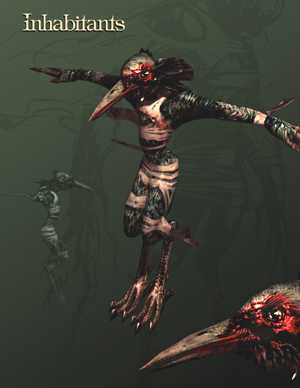
existence. Others creatures like the Inhabitants of Sil Lith may be
passive until provoked. While one Trsanti might look like an easy
target, when he calls his buddies to his aid the player will find they
bit off more than they can chew."
Undying - Development Journal 2
By Dell Siefert, Gamespy.com, August 2000
Electronic Arts : "Set in Ireland of the 1920's,
players take on the role of Magnus, who has been summoned to an ancestral
estate by its lone descendent, Jeremiah. Death has claimed Jeremiah's four
siblings, all of whom have been reanimated and now intend to slay their living
brother, the last of the family. To save his friend and unravel the horror
that has befallen Jeremiah and his family, players must embark on five
perilous quests. The quests will take players to 10 areas of the game
including the ancestral estate, a destroyed monastery, the Eternal Autumn and
the cursed city of Oneiros. Players will have to defeat each of the evil
siblings in his or her individually corrupted and demonic environments in
order to grasp the greater scope of the horror of Clive Barker's:
Undying.
 "Along the way players will also encounter more than 20 enemy
creatures, but will be able to avail themselves of 16 spells (eight defensive
and eight either miscellaneous or offensive), including the destructive Skull
Storm and reality-bending Mindshatter. In addition, there will be eight
weapons for players to use in the game including dynamite, a shotgun, Tibetan
War Cannon and The Scythe of Brennus. The game will also feature a special
spell called Scrye that will allow players to see or hear clues and back story
that are not apparent to the naked eye."
"Along the way players will also encounter more than 20 enemy
creatures, but will be able to avail themselves of 16 spells (eight defensive
and eight either miscellaneous or offensive), including the destructive Skull
Storm and reality-bending Mindshatter. In addition, there will be eight
weapons for players to use in the game including dynamite, a shotgun, Tibetan
War Cannon and The Scythe of Brennus. The game will also feature a special
spell called Scrye that will allow players to see or hear clues and back story
that are not apparent to the naked eye."
Electronic Arts Announces Clive Barker's: Undying for the PC
By [ ], Electronic Arts Press Release, 11 May 2000
Incite.com : "A deep and spooky story to
compare with Half-Life. Clive Barker, best known for his involvement
in horror stories such as Candyman and Hellraiser, is joining EA
[Electronic Arts] to
give Clive Barker's Undying his own imaginative, horrific, touch. From
what we've witnessed so far, Undying looks very promising.
"In addition to a trusty old shotgun, Malitov cocktails, and dynamite,
players can look forward to some not-so-conventional weapons: a Scythe,
a spear gun that can turn enemy creatures into a pin cushion, and a
Tibetan War Cannon.
"With regards to the spells in Undying, the developers at Dreamworks
say they "wanted more than just magical bullets." One interesting
gameplay element will be the ability to amplify spells through
ectoplasm. The basic "Firefly" spell illuminates an enemy in the dark.
However, amplified to level five it also lures magic weapons such as
heat-seeking missiles to the enemy.
"With a few technical tweaks to the Unreal engine, Dreamworks will
introduce some interesting gameplay elements to the first-person
shooter genre. A custom wind system blows out candles and makes
curtains billow in the wind, and a custom lighting system creates long,
eerie shadows for a terrifying atmosphere. Some areas will call for
Thief-like gameplay, in which you - and your enemies - can hide in the
shadows.
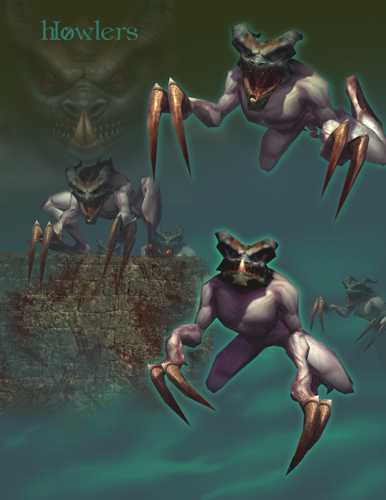
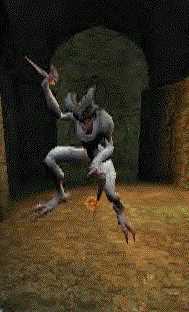
 "Unique and well-developed enemy creatures will also be present. The
werewolf-like Howler is blind, but he'll know exactly where you are if
you make any noise - and if he gets you, he'll knock your head off and
eat it.
"Unique and well-developed enemy creatures will also be present. The
werewolf-like Howler is blind, but he'll know exactly where you are if
you make any noise - and if he gets you, he'll knock your head off and
eat it.
"The game is still in its early stages, but from what we've seen we're
very enthusiastic about Undying - particularly the multiplayer mode.
EA has scheduled Undying for winter 2000."
Previews - Clive Barker's Undying
By Kevin Da Luz, Incite.com, 11 May 2000
Zdnet.com : "Undying is a first-person
shooter with a marked mystical look and feel. Players assume the role
of Magnus, who's described as a spiritual version of Indiana Jones.
The game is set in Ireland during the 1920s. Magnus is called upon by
one of his friends who's recently been haunted by the spirits of his
dead siblings. In order to save his friend, Magnus must unravel the
secret of the siblings' death and embark on five quests that span two
different planes of existence.
"The
game's levels are simply gorgeous, even this early on in development.
Undying is brought to life using a heavily modified version of Epic's
Unreal Tournament engine, and only the most discriminating eye will be
able to note any similarities between it and other Unreal-powered games
of past. Undying will be available in the fall."
Clive Barker's Undying (First Impression)
By Staff at Games spot, Zdnet.com, 24 May 2000
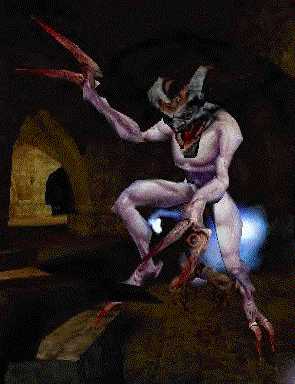
3dshots.com : "As Magnus, a master of the
occult, you are drawn into the drama of a dying family whose degeneration
threatens the fabric of reality. A desperate struggle ensues as
Magnus utilizes a deadly combination of forgotten magic and devastating
weapons to counter the forces of chaos. Powered by the Unreal game
engine, The Undying delivers a highly unique, thoroughly chilling PC
game experience."
Clive Barker's Undying
By [ ], 3dshots.com, 23 May 2000
Gameboyz.com : "Clive Barker's Undying
from DreamWorks Interactive brings players into a world of arcane
magic, supernatural abominations and ancient horror.
"Set in Ireland of the 1920's, players take on the role of Magnus, who
has been summoned to an ancestral estate by its lone descendent
Jeremiah. Death has claimed his four siblings, each who have
reanimated intent on slaying their living brother, the last of the
family, so as to free the Curse of the Undying King.
"In order to save his friend and unravel the curse that has befallen
Jeremiah's family, Magnus must embark on five perilous quests before
he can unearth the final horror of the estate.
"Each quest brings Magnus face-to-face with one of Jeremiah's undead
siblings and the strange and wicked creatures the curse has attracted.
In addition, Magnus must triumph over his reviled competitor Kiesinger.
If there is power to be had by unearthing the mystery of the estate
then Kiesinger will try and steal it - and there is much power to be
had. It's up to Magnus to defeat each of Jeremiah's siblings and
vanquish Kiesinger in order to quell the Undying King.
"Clive Barker's Undying marks the first interactive project from the
famed British author, illustrator, director and playwright. Considered
by many to be one of the best storytellers of our times, ideas sprung
from Barker's imagination often embrace horrific themes...Clive
Barker's Undying is promised to have a similar horrific
ambiance consistently found in all his works. The situations and
creatures encountered in Undying will be creatively deadly and demand
players use their wits and caution, as well as imaginative weapons and
spells.
"Key Features :
i. Ten areas that the gamer will visit throughout the game. They
include the estate, a destroyed monastery, ring of standing stones,
cursed city of Oneiros, the Pirate's Cove, the Eternal Autumn and
Neolithic caves.
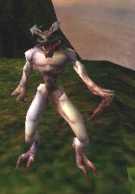 ii. Five horrifying boss characters, including four based on Jeremiah's
dead siblings. Players will have to defeat each of the evil siblings in
their individually cursed and demonic environments in order to confront
the Curse of the Undying King.
ii. Five horrifying boss characters, including four based on Jeremiah's
dead siblings. Players will have to defeat each of the evil siblings in
their individually cursed and demonic environments in order to confront
the Curse of the Undying King.
iii. Sixteen spells (eight defensive and eight either miscellaneous or
offensive) including the destructive Skull Storm, and reality bending
Mindshatter.
iv. Eight weapons including shotgun, dynamite, Molotov Cocktails,
Tibetan War Cannon and Scythe of Brennus.
v. Over 20 enemy creatures including Di'nen, Howlers, Celestial
Chanters, Hounds of Ghelziabahr, Sleads and Monto'-Shonoi.
vi. Special modes will include the ability to fly in the spirit worlds
and a spell called Scrye that allows players see or hear events that
are not apparent to the naked eye to provide back story and clues.
vii. Affecting sound that is actually a vital tool to staying alive,
since it may be the only attestation a creature may be near you.
viii. Game will use the Unreal Tournament engine that DWI has highly
modified.
ix. Soundtrack of Celtic-inspired spiritual tracks.
 x. Robust multiplayer capability similar to the Rocket Arena."
Clive Barker's Undying
By [ ], Gameboyz.com, [ ] 2000
Producer - Undying :
"At the beginning of this year, Brian Horton (our Lead Artist) came by
my office and said, 'Sorry I'm late man... do you want to show the
game to Clive Barker?' About the time I ceased stuttering, we were
dragging a PC into his house for a demo. Clive immediately dug what
we showed, sketched a few character concepts, and offered an 'off the
top of his head' list of story suggestions. About this time the rest
of the guys joined in my stuttering.
"Since that day, Clive and the development team have collaborated
weekly to create new characters, enrich the story, and overall learn
everything we can from each other. Fans of his work who have been
fortunate enough to meet Clive would undoubtedly agree that he is the
most generous man you'll come across... with a real bitchin' house."
Undying - Development Journal 1
By The Undying Staff, Gamespy.com, August 2000
Incite.com : "When you think of Electronic
Arts, the words 'first person shooter' usually don't pop into your head.
Sure, there was Trespasser on the PC (let us never speak of it again),
Medal of Honor on the PlayStation, and a handful of other third person
action shooters, but typically when we think of EA, at least on the PC,
images of sports titles and racing games dance in our heads. Well,
Clive Barker's Undying is hoping to change that image. Like the name
implies, famed British horror writer Clive Barker has his hands all
over this FPS. He's been acting as story consultant on Undying, making
sure that you can expect a lot of atmosphere from this game that is
best described as a mix between Resident Evil, Half-Life, and Thief.
"The game is set in the early 1920s. You play as Magnus Wolfram, a
veteran of World War I who has just recently returned home from his
tour of duty. You have been called to Ireland by your old war buddy
Jeremiah. It seems Jeremiah is having family problems. Unfortunately,
these problems go a bit further than your typical sibling rivalries or
drunken uncles. You see, all of Jeremiah's family is dead, but they
continue to haunt him at the family's ancestral estate. Ain't it a
bitch when your entire lineage up and dies but they still won't let
you be?
"'So why call on Magnus?,' you may be asking yourself. Well, Magnus
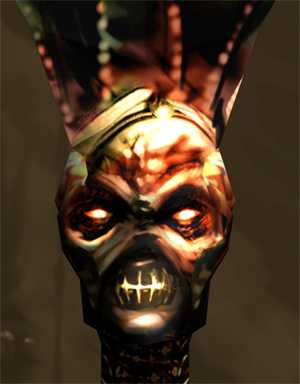 was just starting to realize his arcane side while he was in the war
with Jeremiah, so Jeremiah figures that Magnus may very well be the
only person in existence who can help him with his undead family woes.
was just starting to realize his arcane side while he was in the war
with Jeremiah, so Jeremiah figures that Magnus may very well be the
only person in existence who can help him with his undead family woes.
"Undying is built off a modified version of the Unreal engine that
includes a whole slew of new graphical features, like a new particle
effects system that is affected by wind. But one of the most impressive
new features of the graphical engine is the new cloth modeling system.
This new feature really helps create atmosphere for a horror game as
you can actually see curtains, delicate cobwebs, flowing capes, and
the like waver in the air depending on the speed of the virtual wind.
This is particularly spooky when it's used to represent an unseen
force in the room. Just imagine being in an empty hallway when all of
a sudden the doors slam shut, the lights go dim, and the tapestries
lining the walls at the end of the hall begin to sway back and forth,
getting closer and closer to you with each heartbeat. I think I just
soiled myself.
"The game will be split into ten areas spread around the grounds of
the island estate, as well as a few locales in other planes of
existence. There's the estate itself, the grounds, an ancient monastery
that you can explore in both the present and the past, caves, catacombs,
a pirate's cove, and the mystical city of Oneiros. Your ultimate goal
in Undying will be to vanquish Jeremiah's siblings back to the land of
the dead where they belong. Of course, this is a rather lofty task as
they've been granted supernatural powers to go along with their
grotesque ghoulish forms.
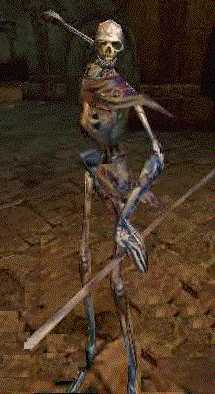 "While your military training will certainly come in handy in this
endeavor, your newly acquired mystical abilities will prove mighty
useful in dealing with the undead as well. Some of the weapons we saw
today include a shotgun, dynamite, a revolver, a Tibetan war cannon, a
scythe, and a spear gun which you can use to pin enemy monstrosities to
the wall, making for easy target practice. You will have 16 different
spells at your disposal -- eight offensive and eight defensive. While
16 spells may seem kind of limiting at first, you'll find augmentations
throughout the game that will increase the effectiveness of your spells,
morphing some into incantations hardly recognizable at the fifth level.
In terms of gameplay mechanics, weapons are delegated to your left hand
and spells to your right, using the respective mouse button for each
action, and the control system for using multiple forms of attack seems
to work quite easily at this point in the game's development.
"While your military training will certainly come in handy in this
endeavor, your newly acquired mystical abilities will prove mighty
useful in dealing with the undead as well. Some of the weapons we saw
today include a shotgun, dynamite, a revolver, a Tibetan war cannon, a
scythe, and a spear gun which you can use to pin enemy monstrosities to
the wall, making for easy target practice. You will have 16 different
spells at your disposal -- eight offensive and eight defensive. While
16 spells may seem kind of limiting at first, you'll find augmentations
throughout the game that will increase the effectiveness of your spells,
morphing some into incantations hardly recognizable at the fifth level.
In terms of gameplay mechanics, weapons are delegated to your left hand
and spells to your right, using the respective mouse button for each
action, and the control system for using multiple forms of attack seems
to work quite easily at this point in the game's development.
"Even though the game is a first person shooter, the DreamWorks team
is stressing a mix of action and stealth throughout the game. Since
creatures will react to sounds in the game environment, You can't just
go in blasting if you hope to defeat Jeremiah's family and their
minions. Instead you'll want to creep around some of the areas and
avoid direct confrontations with an army of the undead.
"Although the team hasn't fully decided what to do when it comes to
multiplayer options, they at least gave us the heads-up on what they're
looking at for deathmatch. Expect to start with all of the weapons and
spells in deathmatch, but you'll have to search for amplifiers and
ammunition in the game to use your arsenal at its utmost effectiveness.
"Undying is looking pretty good from what we've seen so far. The team still
has a ways to go as far as content goes, but the new engine effects and the
heavy story-based spin on the classic FPS model is a step in the right
direction for making a horror-based action game. Definitely look for
more on Clive Barker's Undying after E3 and before its release this
fall on IGNPC."
Clive Barker's Undying : I See Dead People
By Tal Blevins, Ign.com, 16 May 2000
Erik Kraber - Sound Designer :
"The spells were very difficult to design. Undying has more than 16
spells, each with multiple levels of functionality. What does a spell
sound like? Our goal was to make each spell distinct and organic.
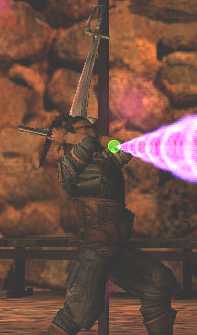
Mindshatter is a fast-traveling spell that disorients the opponent
when they get hit. We wanted a sound of the spell cutting air as it
flies toward the opponent and then a sonic blast as it breaks the sound
barrier. For the first part of the sound we took recordings of bullet
ricochets, reversed them, pitched them down, and mixed them together.
The sound was intense, somewhere between a jet pass-by and laser shot.
For the sonic boom, we took decays of explosion sounds, pitched them up,
and phased them. It sounded like rolling thunder in a strange dimension.
Then the two parts were combined together to match the timing of the
visual. When this powerful spell hits you, you'll know it!
"[One] way we make sure that the player never gets comfortable with the
background tones is to make sure that the player never hears the same
ambient exactly the same way twice. Each area has a wide variety of
sounds - we combined up to four long tracks of ambience for each area.
And our brilliant engineers devised a way for us to randomly alter
these sounds over time, both in pitch and volume. The result is an
ambient soundtrack that is dynamic and unpredictable. You never feel
that an area is either familiar or at rest."
Undying - Development Journal 5
By Erik Kraber, Gamespy.com, October 2000
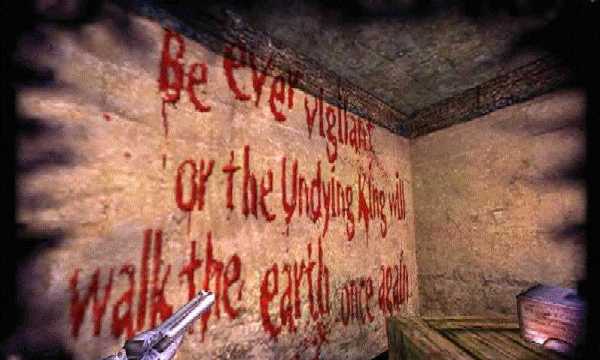
"...Be ever vigilant or the Undying King will walk the earth again."
Brian Horton [lead artist - Undying] :
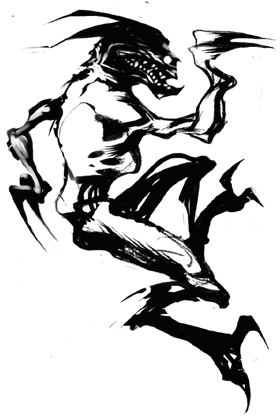
"My right hand man on the character design team was Jonathan Gregerson,
he produced designs for some of the best monsters in the game, and he
too comes from and illustration background. Danny Keller, a fantastic
animator and draughtsman, helped design all of Ambrose's minions, the
Trsanti. Rion Vernon came in towards the end of the process to design
the final boss of the game, watch out sucka! Last but not least Jeff
Haynie, the leader of the art team and my spiritual compass. With a
strong background in illustration and teaching, he helped me design
and focus the process from beginning to end.
"With this team, we attacked the characters and in one month we
addressed every one of them with pencil or pen drawings. We put all of
the characters up on the board of the team room and had a critique. In
this meeting Brady (Producer), Jon Galvan (Asst Producer), Dell Siefert
(Lead Designer), Jeff Haynie, Jon Gregerson and myself went through
each design and made notes for what worked, needed tweaking, or plain
out redesign. We were bull's-eye with 70% of them because of the clear
communication we had with Dell while in progress, and the remaining
30% took another week to address.
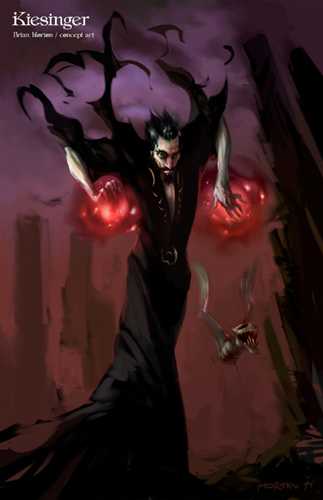
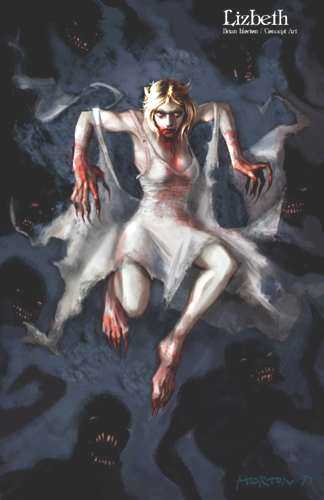 "We would have taken all of the characters to paint, but we were
restricted by time so the 7 major players in the story got the full
treatment. They included the player character, Keisinger, the
rival wizard, Lizbeth, the youngest sibling, Ambrose the black
sheep, Aaron the artist, Bethany the earth witch, and Jeremiah the
eldest. These were all painted in Photoshop and the addition of color
helped describe the mood of the character as well as the environment
they would occupy.
"We would have taken all of the characters to paint, but we were
restricted by time so the 7 major players in the story got the full
treatment. They included the player character, Keisinger, the
rival wizard, Lizbeth, the youngest sibling, Ambrose the black
sheep, Aaron the artist, Bethany the earth witch, and Jeremiah the
eldest. These were all painted in Photoshop and the addition of color
helped describe the mood of the character as well as the environment
they would occupy.
"The most pleasant surprise of the character design process was working
with Clive. Mr. Barker was introduced to the project with a handmade
book designed by Jeff Haynie that included many of the concept
paintings and renders of the finished models. With that and a brief
description of the game and story, Clive was right in the pocket with
what we were trying to do. He insisted we have sketching sessions at
his house where we'd discuss the project and work through any holes in
the story and character design. Clive would sit at the foot of the
table and would listen to Dell weave the story of Undying.
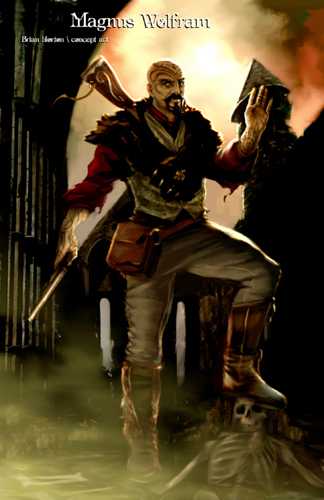 "After a few well-placed questions he identified areas that would
strengthen the project on a whole. From these meetings we would
isolate what needed rework or tweaking, and we started with our main
character. Originally our hero's name was Magnus Wolfram, a
stocky barrel chested man with eccentric clothes and a baldhead and
tattoos all over his body. We all thought he was cool, but Clive saw
that Magnus as unapproachable and seemingly super human.
"After a few well-placed questions he identified areas that would
strengthen the project on a whole. From these meetings we would
isolate what needed rework or tweaking, and we started with our main
character. Originally our hero's name was Magnus Wolfram, a
stocky barrel chested man with eccentric clothes and a baldhead and
tattoos all over his body. We all thought he was cool, but Clive saw
that Magnus as unapproachable and seemingly super human.
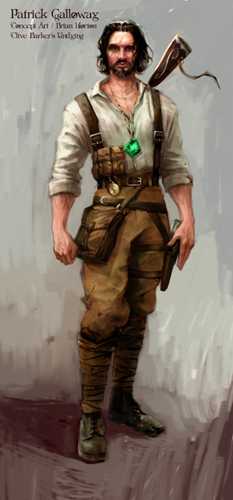
"The story centered on the fallacies of mankind and how evil manifests
and corrupts the human spirit. We needed our hero to have human
qualities to empathize with him... So from
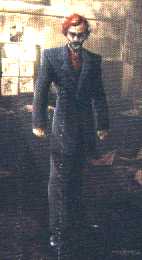
the ashes of Magnus Wolfram, Patrick Galloway is formed, a
human character that is by no means a superhero, but by fate, the only
person that can save the world. Patrick will have to fight against all
odds, with a singular goal, to help his best friend Jeremiah Covenant
defeat the evil that plagues him, his family and ultimately the world.
Once again, a simple but powerful statement, but it strikes to the
core of our motivation. That is highest level of character design.
Thanks again Clive. "
Undying - Development Journal 3
By Brian Horton, Gamespy.com, September 2000
Electronic Arts :
"Lizbeth Covenant was the last of the five Covenant children born, and
she was the first to die, perhaps accounting for her tragic legacy.
Known as the family socialite, Lizbeth briefly thrived in the high
society circles of London. But a mysterious wasting disease cut short
her social career and she returned to the family home in Ireland where
she was often seen roaming the grounds desolately, spending many hours
in the family mausoleum, reading the headstones of her ancestors...
"From the outset of the story in Clive Barker's Undying - when Galloway
first arrives at the Covenant estate -he begins his investigation of
Lizbeth at the family mausoleum, which is located on the manor grounds.
When he opens her coffin, he finds it empty. Galloway realizes she has
dug her way out of her coffin and can be found leaping around the upper
battlements of the Monastery, lurking in the vast catacombs beneath the
cathedral and is at home in the vast system of tunnels that connect
beneath the estate. It soon becomes all too clear that these same
settings are at the core of Lizbeth's realm. Although she may have
been seen lurking in the shadows of the manor, the truth is that
Lizbeth will not leave her dark and shadowy realm, even if it means
allowing Galloway to escape."
Clive Barker's Undying: Lizbeth: The Tormented Socialite
By [ ], Gamespy.com, 11 January 2001
Dellacamp Siefert [designer - Undying] : "[Patrick
Galloway is a] sort of mystic traveller, kind of like Indiana Jones
with magic.
"We wanted things that allowed us to add more horror elements to the
game. For instance, we can have an entire hallway with curtains down
each side, and if a ghost moves down the middle of the hallway the
curtains flutter even though you can't actually see the ghost."
You Are Not Alone...Clive Barker's Undying
By [ ], PC Gaming World, Issue 45, September 2000
3dAction Planet.com : "Personally, I never
found Clive Barker all that frightening. Maybe if I were to find him
dead in my closet, but that goes for pretty much any best selling
author. Clive Barker's Undying, on the other hand, is a little more
creepy and substantially more likely to keep my interest. I got to
check out Undying at the 2000 E3, and found it to be very interesting
and very different from a lot of the other games on the showroom floor.
"Utilizing the Unreal Tournament engine, Undying is the next entry in
the hit parade of horror games to hit the market, but unlike most of
the other horror titles (e.g., Nocturne, the Blair Witch games, Alone
in the Dark 4) Undying seems to be much more fast paced and focussed
on action. The game is played from the first person point of view and
features a huge variety of weapons, magical attacks, and enemies.
Undying is set in the 1920's and places the player in the role of
Magnus, a practitioner of the arcane arts and distant friend to the
lord of an Irish estate, Jeremiah Weedhaven. Jeremiah has requested
his friend Magnus's help to discover why his brothers and sisters have
come back from the dead. The player will uncover clues to the curse of
the Undying King and eventually discover the evil that is behind the
madness. I'm not sure exactly what that means, but it sounds very
unpleasant and Magnus is determined not to let it happen.
 "Magnus has both spells and more traditional firearms at his disposal,
and he can use them together to great effect. There are 16 spells
altogether, but each spell can be upgraded up to five times for
greater potency or extra effects. One spell, Ectoplasm, becomes
cheaper to cast and gains increased range as it is amplified. At its
highest amplitude Ectoplasm gains the ability to pass right through
walls. Some of the spell effects were very interesting, and all of the
ones I saw had very impressive visual effects. The engine's redone
particle effects system makes all of the spells visually pleasing.
"Magnus has both spells and more traditional firearms at his disposal,
and he can use them together to great effect. There are 16 spells
altogether, but each spell can be upgraded up to five times for
greater potency or extra effects. One spell, Ectoplasm, becomes
cheaper to cast and gains increased range as it is amplified. At its
highest amplitude Ectoplasm gains the ability to pass right through
walls. Some of the spell effects were very interesting, and all of the
ones I saw had very impressive visual effects. The engine's redone
particle effects system makes all of the spells visually pleasing.
"In addition to offensive spells, Undying features a lot of passive
and defensive spells. There are several points in the game where using
spells like haste, shield, or silence would be much more effective
than trying to take enemies head on. One particularly cool spell I
saw demonstrated was a Firefly spell that outlined so that you could
see them hiding in any of the game's many shadows. This was ideal,
explained DreamWork's Dellekamp Siefert, for exposing campers during
multiplayer. In addition, at higher amplitude levels Firefly would
attract magical projectiles, in effect creating homing missiles out
of these attacks for a brief period of time.
"While spells are cast by his right hand, Magnus wields conventional
(as well as some unconventional) weapons in his left. His trusty
revolver is the weakest of the weapons to start, but it can be
upgraded with different kinds of ammunition to add extra punch,
particularly against certain enemies. In the revolver, if you load it
with silver bullets it will do magical damage vesus the conventional
physical damage of normal shells. The other weapons I saw at the demo
were the shotgun, sticks of dynamite, a scythe, and a bizarre cannon
shaped like a dragon's head. The interesting thing about this
two-fisted approach to spells and firearms is that it can lead to some
interesting combinations, particularly with the defensive and
information spells.
 "One of the cooler gameplay elements I saw was what was called the
'scrying mode'. This is where Magnus's mystical side takes over and he
is able to see into the spirit world. When activating this mode the
view gets a little warped, and you are able to see things that were
not there before (I'll forgo the nearly obligatory Sixth Sense
reference here). This mode of play enables the designers at DreamWorks
to do a number of interesting things, such as give players clues about
traps, move the storyline along through ghostly apparitions (System
Shock 2, anyone?), or give subtle hints about the best way to progress
through a level. One great example of this use of scrying during the
E3 demo came when Magnus was trying to walk across a floor of rotted
and dusty wooden planks above a room where a large group of skeletons
waited to chop him to bits. The boards would randomly give way and
send the player tumbling to the grasp of the enemies below, but if you
went into scrying mode you could see a ghostly set of footprints across
the safe and stable boards that would let you bypass fighting the
skeletons below.
"One of the cooler gameplay elements I saw was what was called the
'scrying mode'. This is where Magnus's mystical side takes over and he
is able to see into the spirit world. When activating this mode the
view gets a little warped, and you are able to see things that were
not there before (I'll forgo the nearly obligatory Sixth Sense
reference here). This mode of play enables the designers at DreamWorks
to do a number of interesting things, such as give players clues about
traps, move the storyline along through ghostly apparitions (System
Shock 2, anyone?), or give subtle hints about the best way to progress
through a level. One great example of this use of scrying during the
E3 demo came when Magnus was trying to walk across a floor of rotted
and dusty wooden planks above a room where a large group of skeletons
waited to chop him to bits. The boards would randomly give way and
send the player tumbling to the grasp of the enemies below, but if you
went into scrying mode you could see a ghostly set of footprints across
the safe and stable boards that would let you bypass fighting the
skeletons below.
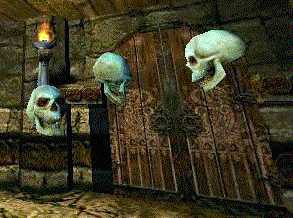 "Speaking of enemies, Undying promises more than 20 of them, including
Di'nen, Howlers, Celestial Chanters, Hounds of Ghelziabahr, Sleads and
Monto'-Shonoi. I have no idea what any of those things are, but I'm
willing to bet that none of them are cute and willing to let you give
them a big hug. Two of the enemies I saw in the demo were small
ghoul-like creatures and skeletal warriors that would keep getting
back up after being knocked down.
"Speaking of enemies, Undying promises more than 20 of them, including
Di'nen, Howlers, Celestial Chanters, Hounds of Ghelziabahr, Sleads and
Monto'-Shonoi. I have no idea what any of those things are, but I'm
willing to bet that none of them are cute and willing to let you give
them a big hug. Two of the enemies I saw in the demo were small
ghoul-like creatures and skeletal warriors that would keep getting
back up after being knocked down.
"One of the cool things to point out about the enemies is that all of
the animations I saw were very well done and looked realistic (or as
realistic as one might expect a giant skeleton to look). DreamWorks
has added a rendering system that can show cloth, spiderwebs, and
other effects in a very realistic fashion. Cobwebs flutter in the
breeze and drapes move around in the wind, suggesting malicious shapes
to the overimaginative onlooker. This is a small thing, but a very
effective detail that added greatly to the overall effect.
"In terms of gameplay, there will be plenty of action in the game,
but Siefert assured me that there would be some places where you have
to be much more stealthy and fear for your life if anything sees or
hears you. The gameplay, he said, would be reminiscent of Looking
Glass's Thief games. The name of this game is horror and suspense,
 which can't exactly be achieved if you run into every room fully
confident that you can blast anything to Kingdom Come.
which can't exactly be achieved if you run into every room fully
confident that you can blast anything to Kingdom Come.
"Multiplayer will ship with the product, allowing gamers to take part
in a deathmatch experience that follows some of the same rules as the
Rocket Arena mod for Quake. Players will begin with the full assortment
of spells and weapons. Combat will revolve around the intelligent and
appropriate use of spells and weapons versus simply picking on the
defenseless newbie. Of course spells can still be amplified during
the game, allowing for tactics and game play styles to develop over
the course of the match. Siefert says that an editor for making custom
levels should ship with the game, allowing players to create their own
single player missions and deathmatch arenas. This is nice to hear,
since these editors usually go a long way towards extending the shelf
life and value of a game. While the game will come with ten huge
levels, players may want to download additional maps from the internet
to play.
"All in all, Clive Barker's Undying looks to be very different from
most of the action games coming out in the next few months. Horror and
action mixed together in an attractive package should keep a lot of
people interested and on the edge of their seats. The game is slated
for a Q4, 2000 release."
First Person Frightening
By Thrrrp ptt, 3d Action Planet.com : First Looks, 22 May 2000
Brady Bell [producer - Undying] : "In my opinion, solid
balancing & pacing of story is what makes good games, great. DreamWorks
Interactive was created to push story and interesting characters into
new directions, so while our storyline is very involved, at no point
can it become a hindrance. Our lead designer (Dell Siefert) and I don't
think there's anything fun about reading twenty pages of back-story to
help solve a puzzle. At the same time, however, it is there for players
who want to immerse themselves further into the game. It's a delicate
balance
 ... one we're very conscious of.
"We approached Clive with a first pass at our story and environments
already in place. He took the story, punched holes in it, taught us
how to improve it, and went to work on additional character design
with our artists. It's been an ongoing process where the team has
benefited far past our expectations. Without question, what attracted
us most was Clive's diverse talent. On our team we have a guy who
studied literature, one who graduated from film school, and a troop of
artists & animators from various professional backgrounds. Clive Barker
is the only person we could all honestly say we've been professionally
inspired by. That's more rare than people think."
The Well Rounded Interview - Brady Bell
By Matthew Braynard & Chris Morris, well-rounded.com, 2000
PC Gaming World : "Clive Barker's input
into Undying is limited to providing advice - and his name, of
course. But don't let that put you off - it still looks the business...
He's given updates on the game's progress on a weekly basis. In return
he provides the development team with an understanding of what makes
good horror content and critically analyses the plot development and
momentum of the game, as well as advising on creature look and feel.
"When enemies actually hit you your character will literally reel from
the effect - for instance, a belt from a Howler's claw-infested fist
will send your view-camera spinning 90 degrees. We put it to DreamWorks
that this is a bit excessive, and it agreed. In the final version it's
more likely to be 5-10 degrees, although DreamWorks is committed to the
 idea that hits will cost you more than just a little bit of life,
they'll also cost you valuable time as you try to re-orientate yourself.
idea that hits will cost you more than just a little bit of life,
they'll also cost you valuable time as you try to re-orientate yourself.
"Of the offensive spells we saw in the game demo, our favourite
is Skull Storm, a kind of magical grenade attack. When you select it,
a ghostly skull starts dancing in front of your fingertips - cast the
spell and your skull will fling itself at an enemy with explosive
results. When you amplify this spell you get several skulls - but
you've got to use them quickly once you select them, otherwise they'll
start arguing among themselves, chattering and clamouring for action.
Quite hilarious.
"Most of all it looks like fun. Scary, but fun."
You Are Not Alone...Clive Barker's Undying
By [ ], PC Gaming World, Issue 45, September 2000
Dellacamp Siefert [designer - Undying] :
"[Clive] came up with things that really grossed him out. There is a
supernatural bloodhound that flies after you and looks like a cross
between an eel and a piranha; and a character called Bethany, who has
a sack of blood on her back that she dips into with her hands and uses
to cast spells - which is really grotesque because you know it's her
own blood she's using.
"[Clive] wants to take everything he is involved with and grow it into
something bigger. He has been talking about a graphic novel or even a
film. Technology is new to him and he is a little taken aback at some
of the things we can do. But he comes from a direction where anything
is possible."
Playing Undead
By David Hancock, The Times, Midland Metro, 2 September 2000
Brady Bell [producer - Undying] : "[On considering Stephen King as consultant] "We looked at our story and realised we are much more about the fantastic, which is Clive Barker. Stephen King's horror is more real."
Playing Undead
By David Hancock, The Times, Midland Metro, 2 September 2000
Robert Berger - lead designer :
"The first six months of a project aren't very sexy. It takes a
programmer months to hammer out an animation system. Then a couple of
artists kill themselves modeling and animating and texturing just one
creature. Then another programmer has to set up a physics system, and
another one maps the input devices, and a hundred other things only a
programmer could understand. All this just so one lousy beast can walk
around on a chunk of ground. It's not very impressive, even to a
seasoned professional, which I'm certainly not. But like I said, we're
getting to the gravy now. The stuff that makes every meatball in the
company drop by on his smoke break to ooh and ahh over your shoulder.
Which is a pain when you have to ALT-TAB away from the Abe Vigoda fan
chat every five minutes.
"I guess I should put something relevant in here so the marketing
folks don't get too bunched up (don't worry, they'll edit that out).
The particle system is in, so there's glowing floaty stuff all over
the place. Smoldering lakes of magma, blood fountains, flaming corpses,
roiling toxic clouds, collapsing buildings, and glimmering mounds of
entrails. You should see it. It's like Detroit or something!
"I must say it's not very often any more that a game really impresses
me. This one does. And I'm not just saying that because my bonus
depends on it. It does, but that's not why I'm saying it. "
Undying - Development Journal 4
By Robert Berger, Gamespy.com, October 2000