Interviews 1988 (Part Two)
Rawhead Rex
By [ ], Fangoria Poster Magazine, No 2, [Summer] 1988
![Fangoria Poster Magazine, No 2, [Summer] 1988](fangopost2.jpg) "I think that I write very visually. I started my career as an illustrator and most of my stories have an incarnation as drawings before they even appear on a page. I have a very clear idea of what my monsters look like and how they will react in certain physical situations. My original concept of Rawhead Rex was somewhat leaner than the movie, but he's got the teeth! It's very interesting to see the interpretations that other people's imagination gives to your ideas. It's given a different reality and that can be very pleasurable. It's like seeing an actor play one of your lines and giving it a different nuance; perhaps it's something that you hadn't thought about...
"I think that I write very visually. I started my career as an illustrator and most of my stories have an incarnation as drawings before they even appear on a page. I have a very clear idea of what my monsters look like and how they will react in certain physical situations. My original concept of Rawhead Rex was somewhat leaner than the movie, but he's got the teeth! It's very interesting to see the interpretations that other people's imagination gives to your ideas. It's given a different reality and that can be very pleasurable. It's like seeing an actor play one of your lines and giving it a different nuance; perhaps it's something that you hadn't thought about...
"The inspiration for Rawhead Rex came from a tale from English folklore about Rawhead and Bloody Bones. I didn't know any more about them but their names, but they evoked quite a lot of ideas. Rawhead is the mindless thing unleashed. I wanted to create a monster who had no niceties; he's relentless, hungry, there's no appeal for mercy, all you can do when you're with him is run. The image I had was a figure with the body of a human being and the mind of a hungry animal."
Hellbound : Hellraiser II
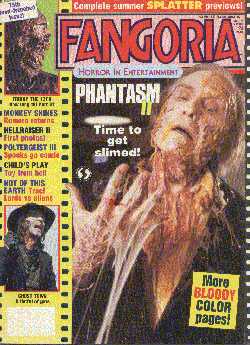
By Philip Nutman, Fangoria, No 75, July 1988
"Tony brings a freshness to the material as well as a passion for science fiction that will tinge the material in a very interesting way. Hellraiser was a medium budget movie with an emphasis on the bizarre, the outlandish, the surreal. Tony has taken the sequel in a slightly different direction. We are opening up the story. We are showing Leviathan, plus the great Lament Configuration. We travel to the hell from which the cenobites were raised and we've even got a how-to-make-a-cenobite sequence! It's going to be a lot of fun. We have a massive body count this time. It's a much more spectacular film."
Hellbound : Breaking The Last Taboo
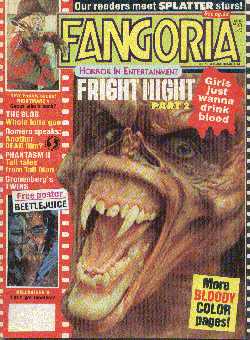
By Philip Nutman, Fangoria, No 76, August 1988
"I think Tony Randel has been getting a little carried away, don't you?"
Clive Barker In The Flesh
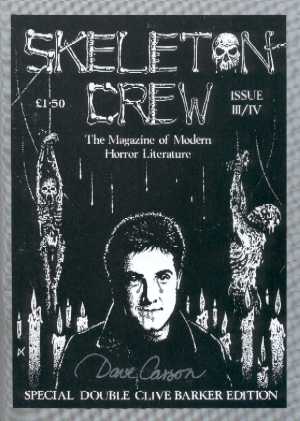
By Dave Hughes, Skeleton Crew, III/IV, 1988
"I think it's safe to say you won't see a slugs novel
from me!...
"We in Britain can begin to be a force in
this kind of area, which we were before in the days of
Hammer, and which I don't doubt that we have the
technical and imaginative expertise to be again. We've
rolled over for the Americans too long, it's about time
we took them up the ass."
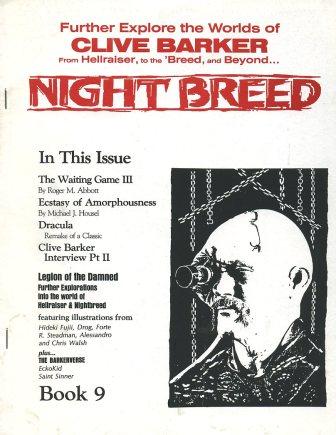
Nightbreed, No 9, April 1993
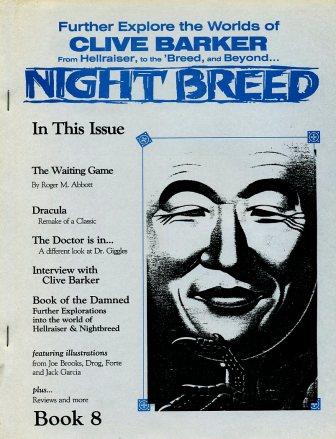
Nightbreed, No 8, January 1993
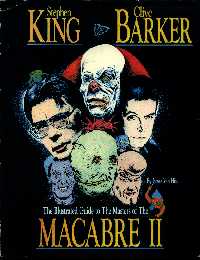
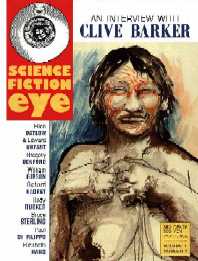
An Interview With Clive Barker
Transcript of an interview on KPFA, San Francisco by Richard Lupoff, Richard Wolinsky and Lawrence Davidson, (i) Science Fiction Eye, No 4, August 1988, (ii) Masters of the Macabre II (as "A Talk with the King"), (iii) in two parts in Nightbreed, No 8, January 1993 and Nightbreed, No 9, April 1993
"I was born off Penny Lane, literally the road off Penny Lane. I do remember, very forcibly, hordes of teenagers coming and taking photographs of all the houses when the song came out. The Beatles thing has gone with me since Linda McCartney took the photo on Weaveworld. Three out of four articles begin: 'Paul McCartney look-alike, Clive Barker...' It was very interesting because Linda was asked to do this photograph and nobody mentioned to her that this had been said. Which was cool by me. So, I went to the site of the photo session, a long photo session. There were a lot of photos to be taken. About two hours into it she said, 'You know, I just realised who you remind me of.' And I just thought, here it comes. And she says, 'You remind me of my ten year old son...' "
Kulture! : Clive Barker
By Jon Hotten, Kerrang! No. 202, 27 August 1988
"Back in the old days of Hammer pictures, what made them good - and they produced some very good movies - was the fact that they had a group of creators, and a house style emerged. Now, I have my producer Chris Figg, director Pete Atkins, Bob Keen and the special effects guys. We're spurs to each other's invention and brakes on each other's excesses."
Shock Horror
By Angela Thomas, Showreel, August 1988
"One of the objections from the critics when Hellraiser came out was, 'it isn't realistic, no-one would do that' and the answer is, 'yes, that's right, it's not meant to be real; what's wrong with that?' Elephants can't fly, but that doesn't mean Dumbo isn't a helluva movie."
Little House Of Horrors: Master Of Gore Lives It Up On Blood Money
By Juliet Warman,
(i) Today, 3 September 1988
(ii) Clive Barker's Shadows in Eden
"I wanted things in my house which were a reflection of what I do - the film and theatre posters and the framed book illustrations. I've only been in print three years so it's still all very exciting."
Every Fear Is A Desire
In London, September 1988 by Lisa Tuttle,
Clive Barker's Shadows in Eden
 "There will be a scene in the movie 'Nightbreed' which I
don't have in the book where, to articulate some things
which can't be articulated in any other way, Babette
takes Lori through a dream-landscape in which a history
of persecution is going on, witches being drowned, and
werewolves burnt at the stake - everything that is
different being destroyed by piously praying
Christians. I want it to be very unpleasant. I want the audience
to understand who are the villains of the piece, to show
them a classic image - the dragon beneath the heels of
St. George - and then say, 'Wait a minute, what's wrong
with this picture?'"
"There will be a scene in the movie 'Nightbreed' which I
don't have in the book where, to articulate some things
which can't be articulated in any other way, Babette
takes Lori through a dream-landscape in which a history
of persecution is going on, witches being drowned, and
werewolves burnt at the stake - everything that is
different being destroyed by piously praying
Christians. I want it to be very unpleasant. I want the audience
to understand who are the villains of the piece, to show
them a classic image - the dragon beneath the heels of
St. George - and then say, 'Wait a minute, what's wrong
with this picture?'"
Blood Money...
By Alasdair Marshall, Evening Times, Glasgow, 7 September 1988
"I wanted to paint, I wanted to write, I wanted to work in the theatre... The writing thing was a bit of an accident. I was basically writing for fun. My theatrical agent put them out. Gollancz was disgusted, but Sphere said they were great. The sales were amazing. It worked out better than even my wildest dreams."
Young, Gifted - And Very Rich
By Colin Kerr, Evening Herald, Ireland, 8 September 1988
"After I left university, my father and mother expected that I would go about my business in my own way... I didn't think about what was going to happen to me when I was unemployed. I just got on with doing it. People are now paying me for the stuff I was doing before they paid me for it.
"A book of short stories is usually anathema as a first publishing gambit. It's a form of literary suicide. You're usually advised to start off with a novel... Being compared with the world's most successful horror author is genuinely very flattering though it's a tough thing to live up to."
Clive Likes It, Stephen Doesn't
By Peter Howick, Evening Herald, Ireland, 9 September 1988
"Yes, people are surprised when they meet me, but I go to bed early, I don't do drugs. Maybe being normal is what's so weird. If people ask me what drug I'm on I quote Salvador Dali's line: 'I'm a drug. Take me...'
"I write two and a half thousand words a day. I don't leave the desk until I've reached my quota."
Babel's Child
By Mark Salisbury, Fear, No 2, Sept/Oct 1988
"If an author has got sufficient profile, sufficient identity, then the chances are that the reader will follow him. I don't know whether my readers would follow me into cowboy novels. I suspect maybe they'd have more problem with that; I wouldn't follow myself into cowboy novels. But into other areas of imaginative fiction, I think, yes, they will follow, and I think the reason people were reading the material in the first place was not simply because it was visceral but because there were imaginative elements which have carried over into the fantasy fiction and will carry over into any other area that I write; whether it be erotic fiction, or science fiction or whatever else, it will be the imaginative thrust; the imaginative enthusiasm is a constant."
Weird Tales Talks With Clive Barker
By Robert Morris, Weird Tales, No 292, Fall 1988
"I think... that the six volumes of the Books of Blood
 were, in a sense, an entire statement - me doing as much as I possibly
could in the genre. The books were my version of a one-man circus - I
juggle, I walk the wire. I tried to be as comprehensive as possible,
as eclectic as possible. To do something that had erotic overtones, to
do something with a comic touch, to do some very graphic things, and to
be able to put it under the six covers, seemed like a lot of fun. Some
of them are going to work better than others. Some people are going to
like certain stories a lot better than others, but that's part of the
pleasure.
were, in a sense, an entire statement - me doing as much as I possibly
could in the genre. The books were my version of a one-man circus - I
juggle, I walk the wire. I tried to be as comprehensive as possible,
as eclectic as possible. To do something that had erotic overtones, to
do something with a comic touch, to do some very graphic things, and to
be able to put it under the six covers, seemed like a lot of fun. Some
of them are going to work better than others. Some people are going to
like certain stories a lot better than others, but that's part of the
pleasure.
"The thing which I think finally excites me most and which is very
difficult to express totally... is the thing about making all of this
work a continuum of some kind or other. So that however it's described
- horror fiction, fantasy fiction, science fiction - and however it's
expressed - in paintings, movies, novels - it's part of a cohesive
whole. And that's a difficult thing to address."
Weaving Words With Clive Barker
By Leigh Blackmore, Terror Australis, Vol1, No1, Autumn 1988
"Who wants to do three of anything, you know? I could be down at Pinewood, but I really don't want to be directing Hellraiser II. What's important, I think, is to
be fresh, and also, I think, to feel as though you're breaking personal ground, because I do very strongly believe that the best sort of fiction is written from
personal concern. Those concerns have to be fresh in your head, and if they're not fresh in your head, then they're dead.
"I write out of anxiety and obsession, I write out of hope and passion. I don't write out of stale marketing ideas because someone paid me a million bucks."
Hellbound : Hellraiser II
By [Philip Nutman], Fangoria Poster Magazine, No 3, Fall 1988
"One of the great things about Hellbound is that it starts off at a run. When I'm writing short stories, I can actually begin in the
middle of things and then track back. It's much more difficult to do that in movies. We tried to do a little bit of that in Hellraiser
with all that flashback material of Frank and the box.
"I like that approach. The first film was a teaser; there were so many things in there that we never got around to explaining.
So I see Hellbound as being both an advance on the first picture and a filling in of that detail."
If You Knew Clive Like We Know Clive
By Philip Nutman, (i) Fangoria, No 78, October 1988 (ii) The Bloody Best of Fangoria, No 8, 1989
"I write imaginative fiction to the limits of my imagination and will continue to do so. My fiction will continue to be down and dirty, will continue to be visceral, erotic and graphic. What people want to call it is academic."
Book Report - Sign Here
By David Streitfeld,
(i) Washington Post Book World, 9 October 1988
(ii) much expanded version as part two of Who's Afraid Of Clive Barker?: The Titan Of Terror And His Studies In Dread Reckoning in
Clive Barker's Shadows in Eden
[Re: signings] "Generally I feel that I'm involving myself in a personal relationship with someone whom the 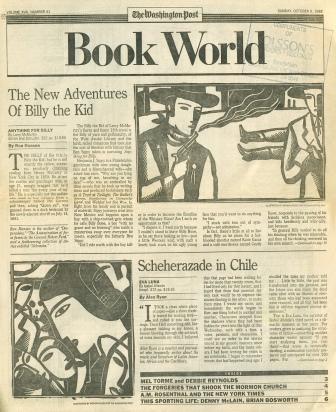
Washington Post Book World, 9 October 1988
overwhelming likelihood is I'll never
meet again. But we've had for a brief time an exchange which has certainly meant something to me and probably something to
them, too. I can't go out to dinner with every single one of them, can't go drinking with every single one of them, and if they were
all to line up in front of me, I'd have great difficulty remembering their names, so this is what we do instead...
"You see the photograph from the flap, maybe you see them on telly once in a while. They're not exactly on public display most
of the time. So I think there's a kind of pleasurable intimacy that comes from the fact that you once talked to this person."
Censorship: National Film Theatre
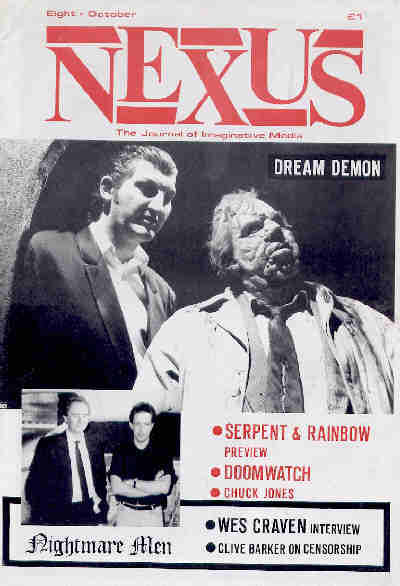
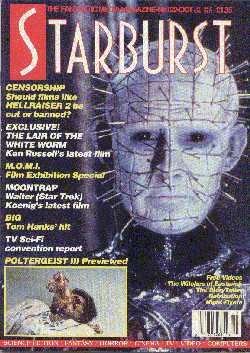
Report and extracts from a talk at the National Film Theatre, London on 28 June 1988, (i) as An Evening With The Censor by Alan Jones, Starburst, No 122, October 1988 (ii) as Depraved And Corrupt by Brigid Cherry, Nexus, No 8, October 1988
"Are acts of violence more likely to be propagated by material as unattractive as Last House on the Left or the immaculately back-lit Sylvester Stallone with a phallic gun in his hand? If we are talking about role models, surely Sly is more likely to be a focus of tension and self-aggrandisement than the shabby no-accounts in Wes's movie?"
Larry King Show
Larry King Show, 11 October 1988 (Note : full interview online in RealAudio at the Lost Souls site - see links)
"My room is complete chaos - it looks like a bomb dropped in there: there are research papers and notes and things literally piled high on every side. It's an absolute nightmare. It's the way I always wanted my bedroom to be when I lived at home, but my mother would never allow it to be."
In Clive Barker's World, Monsters Are People Too
By Mary Ann Grossmann, St Paul Pioneer-Press Dispatch, 16 October 1988
"I come out of the European tradition that celebrates the perverse, the bizarre. The bizarre is not to be thrown out. It's part of you... Frankenstein's monster speaks of pain and his philosophy. Dracula speaks about the romance of his condition. These monsters had a point of view."
'Spirit' Moves Him
By [ ] Newsday, 17 October 1988
"It's about an escapologist who dies because one of his tricks goes seriously wrong. Then he performs the greatest escape trick of his life: he escapes from death and comes back. Unfortunately, in escaping, he liberates about 250 spirits, and turns Los Angeles into 'Spirit City, USA'."
Ripping Yarns: Clive And Dangerous
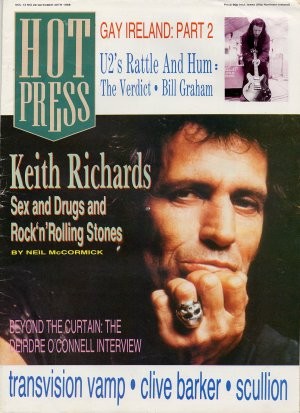
By Graham Linehan, Hot Press, Vol 12 No 20, 20 October 1988
"I hate it when characters are reduced to a sort of low animal cunning because they can't find any other way to deal with the dangers that they're confronted with. I'm saying that the human imagination works lots of ways, and when confronted with evil it doesn't have to take a sawn-off shotgun and blow its head off. Equally, we all have a fascination with violence. We all have a fascination with violent death. We all have a fascination for forbidden material, whether it be the forbidden material of sexuality, or transcendance, or physical transformation as in the images of a Cronenberg movie, and it doesn't hurt us to confront those images vicariously through fiction. In fact I think that it's actually very theraputic."
The King Of Fantastical Fiction
By Bob Lundegaard, Star-Tribune Newspaper of the Twin Cities Mpls.-St. Paul, 24 October 1988
"I'd directed for the theater before, so I had a sense of dealing with actors, and I love special effects, so I felt reasonably comfortable
about that. So all I was really ignorant about was cameras and lenses, and that's not that difficult to pick up...
"When you're shooting two closeups, obviously one person looks camera left and the other camera right so that their glances seem to meet. Now if you move the camera while they're talking, the glances are going to move, and if you shoot them the wrong way and intercut it, they no longer seem to be looking at each other.
"I had this fabulous assistant [on Hellraiser] who every now and then would mutter, 'You're crossing the line, Clive.' So far on Hellraiser 2 we still rate an `X' after four tries, and we have to get an 'R.' We keep making adjustments based on what they say, but we aren't making enough. They keep saying, 'You're crossing the line, Clive. Oh, boy, have you crossed the line!' I guess in all kinds of ways I've spent most of my career crossing the line."
The Knight Of Fright
By Meredith Hladik, The Quadrangle, Riverdale, New York, Vol 65 No 7, 27 October 1988
"I enjoy scaring myself, being grossed out. The taboo subject of every kind has an appeal to me. The moment someone says, 'Don't look,' my eyes are on springs...
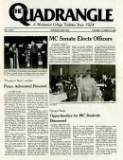 "I write a fiction of the imagination that blows reality to smithereens. It's a dark fiction, but it's a fiction as much concerned with angels as demons...
"Sex and horror are closely linked. Horror fiction is very often a fiction of bodily transformations, whether it be from life to death, from man to werewolf, from living man to zombie. Sex is one of those processes which wins from us very contradictory responses. We are both drawn to it and repulsed by it. We are attracted to people we may not consciously like. All kinds of wonderful things happen under those circumstances, which I believe are analogous to the horrific experience."
Monsters Lurk In Barker's Mind
By Ann Trebbe, USA Today, 28 October 1988
[Re: his imagination] "I'm not suggesting it's sent down by Venusians. My imagination is with me on a day-to-day basis. It's there. It's me. It's who I am... I forbid my thoughts nothing."
Barker At The Moon
By Jason Cohen, Daily Northwestern, 28 October 1988
"The audience response has been so good to Weaveworld, not just in terms of numbers sold but in terms of reviews and letters, so I'm tempted to feel that I can move across the fields, maybe do some science fiction or something like that, maybe do some erotic fiction at some point, with my audience coming with me. I think that's an exciting prospect...
"There's a story... The Last Illusion, which is very much film noir, very much detective fiction crossed with monster fiction. I think to some extent the definitions are artificial, anyway, and I just write it like it comes. Sometimes it comes out erotic, sometimes it comes out funny, sometimes it comes out film noir... whatever else, I like that. I love genre fiction; the only genre I can't get on with is the Western. I'm pretty happy to keep making those mixes."
Horror-Story Writer Clive Barker Scares Up Admiring Fans In Denver
By Maureen Harrington, The Denver Post, 30 October 1988
"I was that fat, short little boy who was never chosen for anything, but I could scare the kids around the campfire.
"You can use your talent to take revenge for your youth - to defeat and shake people. I didn't want to as a child, nor do I now want to seek revenge with my writing.
"Rather than frightening people so badly that they feel bereft of hope, I seek to celebrate the monster - to show that the non-socialised creature may just surprise you with a humanity greater than ours.
"I love to shake up the status quo. Whenever I feel constraints, I'm compelled to blow them away. What better way than to make the unthinkable admirable, the unappealing heroic?"
Clive Barker Digs Deep For Horrors In Cabal
By Cathie Lou Porrelli, San Gabriel Valley Tribune, 31 October 1988
"I've always loved Highgate. It's really a necropolis like Midian. It's one of those places which started out small and got bigger and bigger through the Victorian period with massive mausoleums built to the great and wealthy. There are some that are actually the size of houses. It decayed because the families didn't have the money to keep up these vast mausoleums."
Clive Barker, Horror Heir Apparent
By Karen Liberatore, San Francisco Chronicle, 31 October 1988
"Happy endings have to do with revelation, if we've learned something or come to a self-understanding. We can pretend we don't believe in this [fantastic] stuff. We can say, 'Don't show me, or I'll have to face it.' But we do believe in it as metaphor. We are all vulnerable to our human condition."
Wogan
Appearance (with James Herbert) on the Terry Wogan show, 31 October 1988
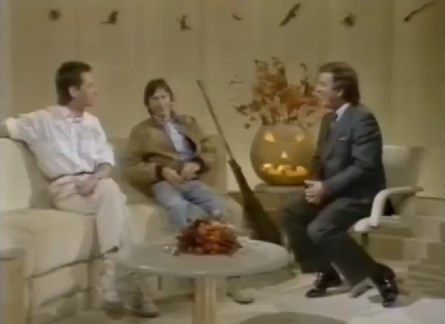
Wogan, 31 October 1988
"My imagination is working overtime all the time and all I'm doing when I'm sitting in front of the desk writing is I'm
putting that stuff on the page, but it's working all the time...
"I did a photo session this afternoon with an American photographer and she came round and she said, 'What have you got?
What about the props?' and I said, 'Props? Have I got props...' Out came the skulls, out came the bones, of course, I
love that stuff - it's part of of the tools of the trade - it's like being a chemist, you're going to have some some
chemicals around, right...?
"I don't [believe in ghosts] no. I think when we're dead we've got better things to be doing with our time than
hanging around the living. I think we're off. I think a new adventure begins, you know in Peter Pan it says 'death
will be an awfully big adventure' - I think we're off on something new."
Clive Barker Speaks Against Censorship
By Nick Kontos, The Observer, Tufts, November 1988
"Beauty is immensely important to horror. What I consider to be beautiful... is not always what others consider to be beautiful. For instance, I think that crocodiles are beautiful animals. I also have large collections of dead insects."
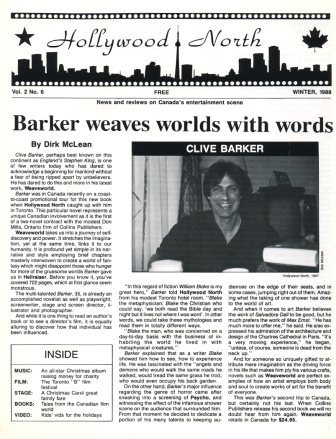
Hollywood North, Winter 1988
Barker Weaves Worlds With Words
By Dirk McLean, Hollywood North, Vol 2 No 6, Winter 1988
"William Blake is my great hero. Blake the metaphysician. Blake the Christian who could say, 'We both read the Bible day and night but [he reads black where I read white].' In other words, we could take these mythologies and read them in totally different ways. Blake the man, who was concerned with the business of inhabiting the world he lived in with metaphysical creatures... angels and demons who would walk the same roads he walked, would tread the same grass he trod, who would occupy his back garden."
Fear And Loathing In Hell
By Mark A. Altman, Galactic Journal, No 23, Winter 1988
"Sartre said hell is other people. I think hell is bad producers. Hell is something different for everyone. Making love to someone for an afternoon and finding out they're out of your life forever, that's hell."
The Future Of Horror Is Here : His Name Is Clive Barker
By Curt Schleir, Inside Books, No 1, November 1988
"It would be wonderful if I could produce something
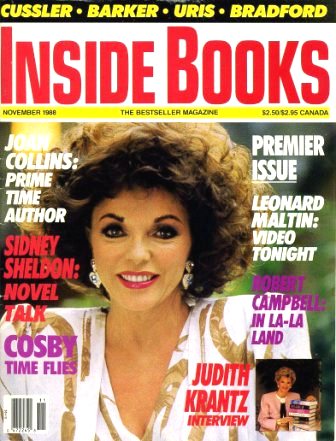
Inside Books, No 1, November 1988gross from my past. But my pets lived to ripe old ages.
None of my relatives died in particularly odd
circumstances. The most dramatic thing was the sheer
banality of growing up in a town that was not of great
interest to me. Right through my childhood I was
supplied with all of the things I needed in the way of
imaginative materials. My mother was keen that I should
be reading, and allowed me to range through the library.
I suppose for imaginative kids, deprivation comes not
in the home, but in school. That's certainly where I
felt it most keenly, because that's where the world is
divided up into the real and the unreal. That's where
you learn the gross national product of Chile. That's
where live things are dissected - and I speak both
literally and metaphorically. That's where people bully
you and shame you into pretending that you don't
actually like the things you actually like. That was the
time I saw the world divided up into pragmatists, literalists and reductionists on the one hand and imaginative individuals on the other.
"I was a fairly solitary child. I spent an awful lot of time by myself making those experiences happen. I had puppets. I wrote. I drew. I did that stuff as a way to make a little colourful ring around myself when I could see the world around as monochrome."
Aktueel, 5 November 1988
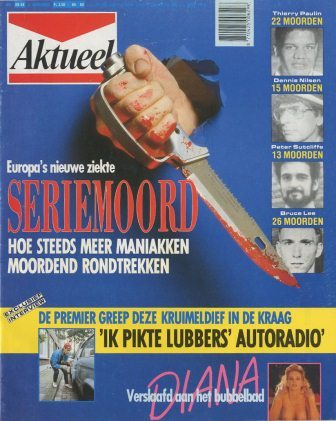
Horror Writer Makes His Film Directing Debut
By Gerhard Hormann, Aktueel, 5 November 1988 (note: translated from Dutch)
"Stephen King once said, 'You read Clive Barker with a book in one hand and a sickbag in the other' and of course I hope that that is true. But what I write is not only meant to people to feel lousy. There must be something more. What horror does very well, is to raise things never talked about elsewhere, those being sex and death. We don't talk about those two in our society. These are the Last Taboos. And that I try to break through that..."
![Totally Wired, No 7, [Spring] 1989](totallywired7.jpg)
![Grim Humour, No 14, [Autumn] 1989](grimhumour14.jpg)
Clive Barker : Tearing Your Soul Apart
By Gerald Houghton, (i) (edited version) Your Worst Fears Confirmed, November 1988 (ii) (slightly edited) as Running With The Monsters in Totally Wired, No 7, [Spring] 1989 (ii) (slightly edited, but differently) as Running With The Monsters in Grim Humour, No 14, [Autumn] 1989
"I don't like trick-ending stories. I've never liked them. They have the structure of jokes and I don't like joke-tellers. I never like stand-up
comedians, I always like situational stuff. Or people who are a little off the wall. I think my trouble with the punchline story is that you
spend half the time wondering what the punchline's going to be. You start the story in the full and certain knowledge that the last two
lines or the last paragraph will contain a twist, and it becomes a guessing game. And I'm not very interested in that. I much prefer to
give away everything at the beginning and then start to go to some new place. And then get strange..!
"I think I'm a little more pro the body than David
[Cronenberg] is. David tends to be quite down on
physicality and finally there is an argument that he's
being repulsed by the flesh he's writing about, whereas
I tend to be having a good time with it. 'Long Live the
New Flesh' would be a cry that would come from both our
lips."
Hellbound
By [Stephen Jones], Hellbound US Press Kit, 1988, reprinted in The Illustrated Clive Barker by James van Hise, 1989
"Christopher Figg and I often spoke about making a sequel if Hellraiser
worked, but we weren't prepared for it to work to the extent it has,
both critically and commercially. I was certainly aware that the first
story left open ends, some of which were quite deliberate. Others were
there because we didn't have the resources to follow some of the ideas
through to their logical conclusion. Hellraiser II: Hellbound will
 answer some of those questions, but it also opens up a new level of
possibilities... "
answer some of those questions, but it also opens up a new level of
possibilities... "
Hellbound
By [Stephen Jones], Hellbound UK Press Kit, 1988
"The first picture came out of my own passion for modestly budgeted horror films. I also wanted an emphasis on the bizarre, the outlandish and the surreal, plus a conscious desire to take the imagery just a little bit further - pushing those limits. I didn't direct this time because I had responsibilities to my publishers to deliver a new novel. However, I had a very strong creative involvement and there is a great sense of continuity - and that continuity would have been there, whether I directed or not. It's based on my story and I feel that it is very much in the tradition of Hellraiser."
Hellbound
By [Stephen Jones], Hellbound Electronic Press Kit, 1988
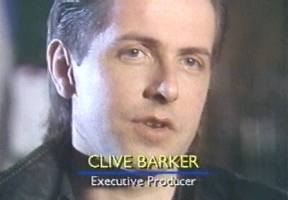
"We follow Kirsty into Hell, into the secret of the box, to discover something of what the cenobites are,
what the box is for, what indeed Hell as it was interpreted in the first picture actually is... That's exciting, to see the doors open,
and open, and open again - and see new panoramas...
"There was certainly a good deal of blood in the first picture: I think there will be a fair amount in the second one too. You know,
you can't make omelettes without breaking eggs and you can't make horror movies without breaking heads!"
Welcome To The Magic Show
By Cate Terwilliger, Colorado Springs Gazette Telegraph, 4 November 1988
"So many magic worlds are about the liberation to the foulest kinds of wish fulfillment. Men go into enchanted worlds and manage
finally to be able to slaughter, like barbarians... Women go into enchanted worlds and become queens and princesses and are
worshiped like goddesses, but in actual fact become wholly passive in the same process.
"What I wanted to do was create a pacifist paradise. Could I create a moment for Cal in the book [Weaveworld] that was magical to
the reader and yet didn't require him to, you know, like kick major alien ass?"
The Secrets Of Our Success
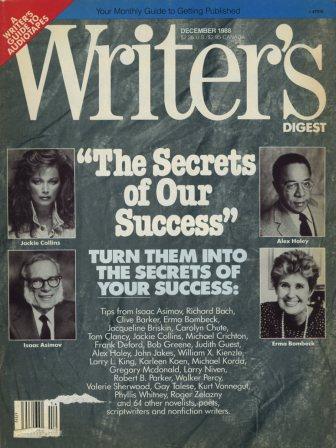
By Bill Strickland, Writer's Digest, Vol 68 No 12, December 1988
"The day I'm sure I've succeeded will probably be the day I stop writing and take up cattle rustling...
"I forbid my imagination - and hence my pen - nothing."
Chains Of Love
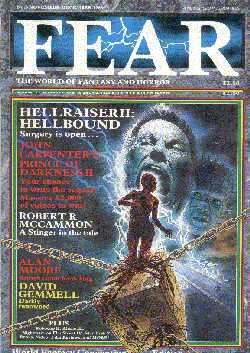
By Mark Salisbury, Fear, No 3, December 1988
"It ['The Great And Secret Show'] will have the same mixture of the fantastical and the strange and the sexual and the weird and the magical and the visceral as 'Weaveworld'. The kind of fiction which is in a lot of categories and so probably is in no category except imaginative fiction. I want people to buy a Clive Barker book and say, 'Well, what's Barker cooked up for us this time?' And that becomes a more interesting challenge in a way than trying to write it for a particular slot."

Clive Barker : The Horror, The Horror
By John Leland, Spin, Vol 4, No 9, December 1988
"Out of just scaring people in the simple sense of making them jump or feel grossed out, I don't get much satisfaction. That's only like the garnish. The steak is getting to talk about death, madness, obscure forms of sexual activity, and selling it to people who thought that they never wanted to hear these kind of things talked about."
After The $30 Million Success Of Hellraiser, Clive Barker Puts Out 'Tougher' Sequel
By John Wooley, Tulsa World, 18 December 1988
"The things I learned from the first picture were that special effects take longer than you think they're going to, and that has to
be scheduled in. You can't expect every special effect gag to go right the first time. In fact, you can't expect it to go right the
third time, sometimes.
"Also, you can't predict audience response to moments or, indeed, audience response to characters. Whoever would've thought
that Pinhead would become the little icon he's become, a jigsaw in Japan or all the other things he is? I created that character in
innocence. And what I tried to say to Tony [Randel] was, you can try and manipulate the audience's response to all kinds of
things, but they'll surprise you. There are moments in the second movie, which I've seen with audiences on several occasions
now, that I never would've thought the audience would've enjoyed as much as they do. And then other moments that
you think are going to be a major 'wow' moments turn out not to be.
"Now, I like that. I think one of the nice things about that is it proves that audiences are not putty, that Pavlovian planning
will not work. You can construct movies every which way hoping that it will all fall exactly into place, and audiences will still
surprise you with their response."
Clive Barker: Hellbent On Shocking Our Shirts Off
By Phantom of the Movies, New York Daily News, 21 December 1988
"Having done Hellraiser, which got a reputation as a tough piece of work, we got very anxious [about the MPAA's reaction to Hellbound]... Obviously the imagination would stay intact, but a lot of the imagination is predicated upon these FX."
Gore Master
By Wilder Penfield III, The Toronto Sun, 22 December 1988
"[Nightbreed]'s not going to be a splatter movie the way the Hellraiser pictures are, but we have about 60 monsters in it - it has thrills and spills...
"I will shoot more than I expect to get into the picture. It's got to be a very erotic movie. I'm auditioning stars all afternoon, and I said don't come along unless you're willing to do two things - get covered in prosthetics and slime, and do major sex scenes...
"I don't write stalk-and-slash fiction. I don't make stalk-and-slash movies... Disapprove sounds slightly matronly, but I think there are better things to be doing with celluloid than watching young girls be hacked to pieces in showers."
Barker Kept Head, Appeased Censors
By Steve Dollar, Atlanta Journal and Constitution, 23 December 1988
[Re David Cronenberg] "He'll be playing the mass-murdering psychoanalyst. I said to him, I'd seen him on the BBC doing an interview about himself, and he was so massively calm, so massively in control of himself. I thought if this guy was dangerous, I'd be scared..! I'm just glad he's a good guy."
Clive Barker Wishes You A Hellish Little Holiday
By Peter Keough, Chicago Sun Times, 25 December 1988
"Part of the problem with the holiday scheduling of movies is you get all
the Disney remakes, you get Scrooge, what have you, maybe a
comedy or two. But a movie like this, which is a perfect antidote to an
excess of goodwill, such pictures are conspicuous by their absence. So if I
was an audience member, I would be pleased because this will be a fast, fun
ghost train ride for Christmas. It's also going to be the toughest horror
movie of the year. I spoke to someone in the MPAA, and he said he was
surprised by what they let us get away with.
"So, if there are a few critics out there who are outraged, I say there are
still Care Bear movies out there for you this Christmas. No one is dragging
people to the screenings. People are not going to a film called Hellbound:
Hellraiser II with a picture of Pinhead, expecting to see
The Turning Point!"
Hellbound's Horror Fiction Lion
By Patrick Goldstein, Los Angeles Times, 28 December 1988
"I was given a book to autograph by this perfectly normal looking guy, who sounded quite articulate and self-possessed. And before I knew what was happening, he took out a razor, and slashed his arm open, ripping the razor along his veins. I put my hand into the blood on his arm and asked him, 'Do you want this in your book too?' He nodded his head. So I signed the book, planted my bloody palm print next to my signature and told him to have a bloody nice day."
Top Of The Horror Heap
By Martin Burden, New York Post, 30 December 1988
"[The MPAA] said, 'We feel the movie [Hellbound] is too strong, too intense, too distasteful, too horrific.' But if you're making a horror film you want intensity, so in a way you have to be flattered by their response.
"We made some trims, and it went back and forth six times before we got the R...
"What bothered you? The maggots feeding on the man's arm? The fellow juggling eyeballs, with blood running from the sockets? Oh, that's so mild. The MPAA are not bothered by that at all. It's cutting and slicing they object to - that scene of a razor cutting into a man's chest, for example.
"It's interesting - in films you can kill people with bullets, over and over again, and they seem not to care. Rambo for example. Generally speaking they're much more bothered by knives."
Cabal UK Presskit
By Peter Atkins, Cabal UK Presskit for Fontana Books, Winter 1988
"My work is fuelled by a refusal to acknowledge any distinction between the Fantastic and the Realistic. I know my stuff falls between two stools: it's too loyal to the art of storytelling to be avant-garde and too weird to be mainsteam fiction. Fortunately for me, the gap between those stools happens to be full of audience!"
Click here for Interviews 1989...


