Interviews 1989 (Part Two)
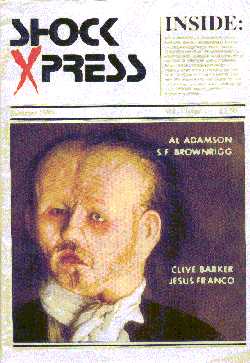
Nightbreed
By Stefan Jaworzyn, Shock Express, Vol 3 No 1, Summer 1989
"What I've got to avoid is making the books and films self-referential. I've got to keep them separate. I'll write the second Cabal book after I finish this picture, and as a sequel to the first book, not a sequel to the movie (of the book!). I don't want to keep the characters separate, but what you can't predict of course is how theatre audiences will react to different characters. Narcisse is a big hit in rushes, and maybe that will influence the way we view him in the movie. Maybe we'll bring him back in the movies if he goes down well. But I won't bring him back in the book, absolutely not. That's where there might be divergences."
Clive Barker Talks About Guts
By Gary J. Svehla, Bits N Pieces, No 3, Summer 1989 (NB originally intended for publication in Midnight Marquee)
"I feel an awful lot of this stuff [other directors' work] is stuff that you simply take on board as far as the influences are concerned. You take them on board without noticing that you've taken them on board. I've never gone out of my way either with my written stuff, the paintings I make, or in the movie [Hellraiser], to say that I'm going to make a scene that is like scene X. In fact, if I did that, I feel that artistically it would be death. It's just not what I do. My literature, which is successful, is successful because it does not do that. Because of its refusal to do that. I just do the best I can and hope the people want to spend the money to go see it."
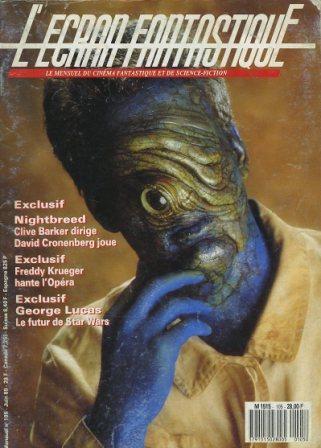
Nightbreed
By Indra Bhose, L'Ecran Fantastique, No 105, June 1989 (note: translated from French)
"There are creatures which you'll only see out of the corner of your eye, but look interesting. I wanted it so that you have the impression of a multitude, so that you can think that you didn't see everything, that there was lots in the background."
An Interview With Clive Barker
By George Beahm and Howard Wornom, (i) Grimoire, edited by George Beahm, 1990 (ii) The Stephen King Companion (revised edition), 1995 (Note : Interview took place July 1989)
"I regret the fact that there's a reluctance to reading widely through
the fantastique; to looking at books and paintings and films
and theatre work that may touch on these subjects but not be typical
horror fiction. I'm presently doing a piece* for The Daily Telegraph
talking about my favourite horror pieces. They get somebody in from
each genre to write about what they find influential and important.
I'm using Grimm, I'm using Marlowe's Dr. Faustus, I'll probably use a
John Webster play like The White Devil. It's important to celebrate
the fact that these subjects are approached and analysed and explored
in many forms, and have been for many years."
* 'Keeping Company With The Cannibal Witches' - see Essays
No Rest For The Wicked
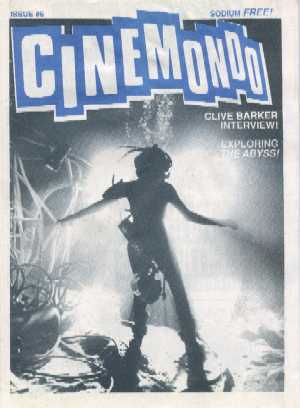
By Burk Sauls, Cinemondo, No 6, July 1989
"I was always an imaginative kid, and imagination will get out. You need some place
where your imagination is actually going to get liberated. Originally mine was on the
page as a painter, and it still is to some extent; still is, obviously, as a writer, and
then movies came along to add to that list.
"I'm basically just finding ways to tell stories, but the basic instinct is to actually
take people and move them in various ways. You know, make them laugh, make them cry,
make them jump. That's the instinct, and the instinct remains the same as when
I was a kid. I guess some people are born to be swimmers. I was born to tell stories."
Nightbreed
By Marjorie Billow, Film Monthly, Vol 1 No 4, July 1989
"We're not making a horror movie. It's a different kind of genre. We're dealing with the 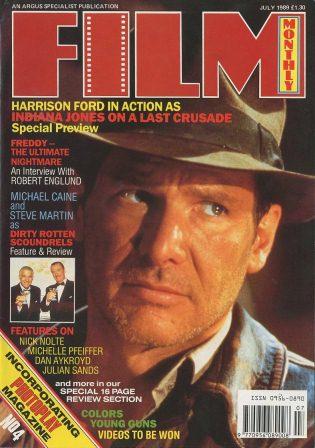
Film Monthly, Vol 1 No 4, July 1989
fantastique and although it ranges into horror it also ranges into high fantasy.
"If the story is to work it must be because the actors are believable, because they are sympathetic, because their performances are complex, not because they run and scream well.
"Anne, who plays Boone's girlfriend Lori, is very physically brave and does all the acrobatics extraordinarily well, but that's not all she does. She plays her scenes with great reality even though she's often in very fantastical circumstances.
"Craig, who plays Boone, has a great brooding presence and a very real feeling for what we are up to and gives it great emotional solidity. Neither of them views it as a tongue-in-cheek project, which I think is very important. You've got to have a complete commitment to making a project like this work as a realistic piece."
Phantasmagoria
By Mark Salisbury, Fear, No 7, July 1989
"Midian is bigger than in the book. It's more elaborate,
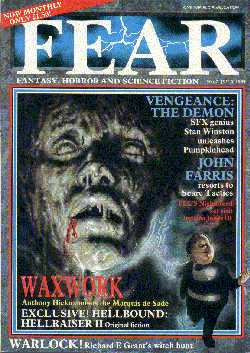 more detailed in it's imaginings and in the way it's
been realised. The whole challenge is taking material
which, on the page, was rendered impressionistically
and have it realised in great detail when you actually
build it."
more detailed in it's imaginings and in the way it's
been realised. The whole challenge is taking material
which, on the page, was rendered impressionistically
and have it realised in great detail when you actually
build it."
It's Alive
By John Hind, Blitz, No 80, August 1989
"Although I'm not a member of any church, I am religious. I believe that the afterlife is a whole other journey. But I think humans are innately religious as a species, so you don't need a specific excuse for examining the perversely unholy."
The Fantasy Man Has No Illusions
By John Gibson, Evening News, Edinburgh, 26 August 1989
"I don't drive. I don't indulge in drugs. I don't have a third eye in the middle of my forehead. I don't have a hunch back. I'm a big disappointment to a lot of people...
"The Great and Secret Show is my tenth book and it's getting to the stage with my novels that as long as I don't produce them in Serbo-Croation I know they will sell. Yes, I'm comfortable. The royalties I'm making now should see me through my early forties...
"It's a huge book - 720 pages - set in America. Hollywood, sex and Armageddon. It's not a horror book, more a dark fantasy book, and it has gone into the best-seller lists tomorrow, a week after publication.
"The sexual stuff has always been very strong in my books and this is no exception. There are scenes of profound weirdness that shouldn't be talked about over a civilised dinner table.
"I found this little town in Ventura County just outside Los Angeles and re-named it for the book. The residents' obsessions and dreams erupt into the real world."
Nightbreed - Preview
By Stefan Jaworzyn, Horrorfan, Vol 1 No 3, Fall 1989 (note : a large portion identical to the interview in Shock Xpress, Vol 3 No 1, Summer 1989)
"I take my Breed very seriously, maybe more seriously
than I took the Cenobites. The challenge we face is
getting the viewer to take on not one or two monsters
but a whole society of creatures. Obviously there are
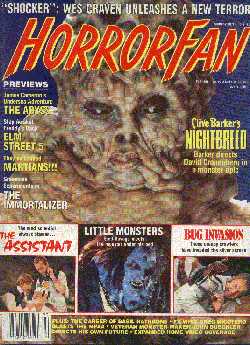 feature creatures who appear for longer, have dialogue
and so on, but we thought the best way to give a
feeling of depth was to have a wealth of monsters in
the background, producing a feeling that this is just
the tip of the iceberg. It's weird, but it does have a
sort of Biblical feel. I always think the whole thing
about the 'lost tribe' is Biblical anyway, as is the
idea of a lost tribe being found and led to safety or
salvation - or attempting to but failing as in this
particular case - but also because, and this is always
true in what I write or do in the movies, there's a
kind of religious subtext, an iconographic thing going
on. It's the flipside of the morality which usually
informs this type of movie, in that here the monsters
are the good guys, the creatures are the sympathetic
ones. They are humane. And humanity, represented by
priests, cops and analysts - the three forces of
authority - are absolutely, unreservedly bastards."
feature creatures who appear for longer, have dialogue
and so on, but we thought the best way to give a
feeling of depth was to have a wealth of monsters in
the background, producing a feeling that this is just
the tip of the iceberg. It's weird, but it does have a
sort of Biblical feel. I always think the whole thing
about the 'lost tribe' is Biblical anyway, as is the
idea of a lost tribe being found and led to safety or
salvation - or attempting to but failing as in this
particular case - but also because, and this is always
true in what I write or do in the movies, there's a
kind of religious subtext, an iconographic thing going
on. It's the flipside of the morality which usually
informs this type of movie, in that here the monsters
are the good guys, the creatures are the sympathetic
ones. They are humane. And humanity, represented by
priests, cops and analysts - the three forces of
authority - are absolutely, unreservedly bastards."
To Hell And Back
By Dick Hansom, Speakeasy, No 102, September 1989
"The EC [comics] tale tends to have a very straightforward morality underpinning it and
tends to have the structure of a joke - they are for the most part punchline stories -
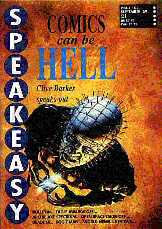 and I find those very unattractive and unappealing as narrative structures. EC has
never been a model for me in terms of their moral underpinning, because my stories tend
to fly in the face of conventional morality rather than supporting it. So the only thing
I enjoyed about EC when I looked back at them... was the unrelenting violence of them,
which was startling, I think, for its time. I just got in my hands half an hour ago the
first issue of the Tapping The Vein from Eclipse - gorgeous stuff. I wanted Craig
[Russell] for Human Remains because I'm a great fan, and I was just so delighted. In
colour it's sensational. What's interesting about the stories is they absolutely don't
relate at all to any of the horror traditions that we've seen in comics, and I'm pleased
about that.
and I find those very unattractive and unappealing as narrative structures. EC has
never been a model for me in terms of their moral underpinning, because my stories tend
to fly in the face of conventional morality rather than supporting it. So the only thing
I enjoyed about EC when I looked back at them... was the unrelenting violence of them,
which was startling, I think, for its time. I just got in my hands half an hour ago the
first issue of the Tapping The Vein from Eclipse - gorgeous stuff. I wanted Craig
[Russell] for Human Remains because I'm a great fan, and I was just so delighted. In
colour it's sensational. What's interesting about the stories is they absolutely don't
relate at all to any of the horror traditions that we've seen in comics, and I'm pleased
about that.
"You can never stop somebody coming out and complaining
about you. If you're working on material that contains
taboo imagery or taboo subject matter of some kind or
other, there's inevitably going to be some
self-righteous person who's going to decide that you
should be taken out and shot."
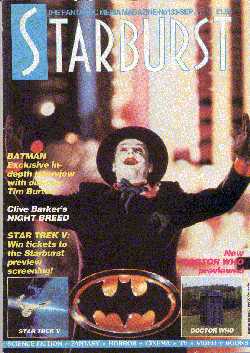
In The Heat Of Nightbreed
Set visit by Alan Jones, Starburst, No 133, September 1989
"It will take you from solid normality into the weirdest place imaginable. The hero dies wonderfully a third of the way through, but he has an even better resurrection... It's a subconscious journey into a forbidden zone where taboo subjects and forbidden confrontations await. This adventure may well change your life. And don't we all enter the fantasy arena to speculate and hope that something like this will happen to us? What happens to Boone could be just around the corner for us all - a night voyage offering the possibility of ever more exciting nights."
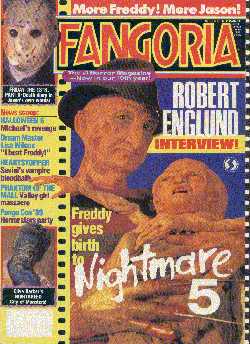
Birth Of The Nightbreed
By Philip Nutman,
(i) Fangoria, No 86, September 1989
(ii) Fangoria : Masters of the Dark
"I'm not interested in just telling a story. I want to explore the theme of monstrousness, to create a mythos that goes beyond anything we've ever seen in this type of movie."
Bring On The Monsters !
By Philip Nutman, Fangoria, No 87, October 1989 (Note : Interview took place in June 1989)
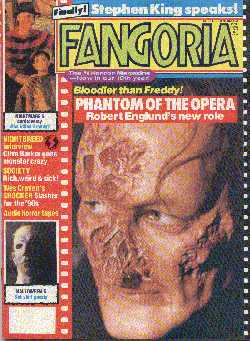 "With Hellraiser we had four monsters. Here we had an
opportunity to let rip imaginatively and put some
extraordinary monsters on screen in large numbers, but
to present them with a more sympathetic vision than
would usually be the case in a conventional horror movie.
"With Hellraiser we had four monsters. Here we had an
opportunity to let rip imaginatively and put some
extraordinary monsters on screen in large numbers, but
to present them with a more sympathetic vision than
would usually be the case in a conventional horror movie.
"I've always been of the opinion that we seek out this
kind of material because we seek out a confrontation
with the bizarre, the mysterious, the transformational.
I therefore find it paradoxical that stories of this
nature usually present the bizarre and the mutated as
repugnant. I don't think we live in fear of the monster.
We anticipate it, salivate at the thought."
The Breed : Source Of The Soul
By John Gilbert, Fear, No 10, October 1989
"Ralph [McQuarrie] has designed the history of the Breed in symbolic
form, painted on an enormous mural. So he's not just the artist, he's
actually now the chronicler of the Breed's history, springing as they
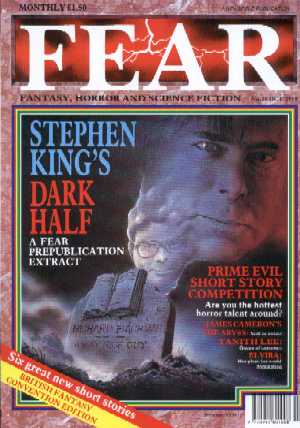 do from the same seed as we naturals - the naturals being the people
who like the Sun and the Breed being the people who rather prefer the
Moon. Ralph is now laying out the whole history; the back story, the
wars...
do from the same seed as we naturals - the naturals being the people
who like the Sun and the Breed being the people who rather prefer the
Moon. Ralph is now laying out the whole history; the back story, the
wars...
"Fox saw the picture at the weekend and what they talked about was
the mythology. They see it as a very, very dark Star Wars, and what
Joe Roth, who's heading up Fox, said was that they wanted to put out
a trailer which was basically The Myth trailer. Put out a long trailer,
introduce the mural chamber, use stuff from the picture to present the
fact that this movie was going to take the audience - if you think of
Star Wars as being a trip into space - this is a trip into the earth
to meet the dead stuff and the almost dead stuff, and the stuff which
wishes it could be dead but can't quite be dead; the Breed, in other
words. I think what Ralph has been able to lend to the project is a
sense of that mythology."
Clive Barker's Nightbreed
By Alan Jones, Cinefantastique, Vol 20 Nos 1 & 2 (double-issue), November 1989
"I like the film characters a lot; they are very close to the book but
I've no idea how a viewing audience will respond to any given one. Hugh
Ross is a big hit in rushes because he plays Narcisse as high comedy
and that may influence the way I view him in sequels, although he's
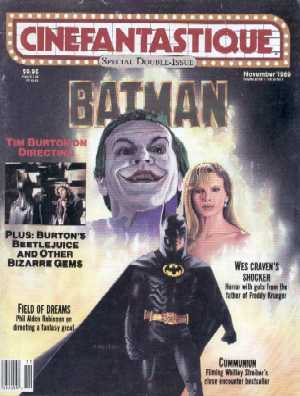 dead as far as the book is concerned. That's one major diversion. The
other change is the Breed themselves. They are rendered very
impressionistically in the book, and their descriptions wouldn't fill
more than a page. Specifics for the screen meant their form had to be
completely realised. Sixty Breed are actually named in the book out of
the 132 realised on film. But where they are from and why they are
what they are doesn't appear in the book at all."
dead as far as the book is concerned. That's one major diversion. The
other change is the Breed themselves. They are rendered very
impressionistically in the book, and their descriptions wouldn't fill
more than a page. Specifics for the screen meant their form had to be
completely realised. Sixty Breed are actually named in the book out of
the 132 realised on film. But where they are from and why they are
what they are doesn't appear in the book at all."
Genre Auteur David Cronenberg
By Alan Jones, Cinefantastique, Vol 20 Nos 1 & 2 (double-issue), November 1989
"David is a hero of mine. I never thought he would say yes when I called him up out of the blue after I put my thoughts to the Morgan Creek People. But he seems to be having a good time and at least his face isn't covered by a gynecological mask this time! He looks great on film and he has the ability to offer up a wide sympathetic grin one moment and the next it vanishes off his face to chilling effect."
No More Horror!
By Anand Banerjee, NB News, Vol 1 Issue 1, Winter 1989
"One of my responses to the idea of writing horror fiction is that one should always attempt to go to the limits. But in taking people to the
 limits, you should be very careful and calculating about the way you present information which is distressing. My response is to make the
language more subtle, evocative, and exciting when what you just characterized as the 'gross-outs' occur. In other words, there should be
a kind of relationship between the strength of the imagery and the way that it's represented. Language should never be more elastic,
never more responsive, never more poetic than when something barbaric is happening. Because otherwise it's simply a gross-out.
limits, you should be very careful and calculating about the way you present information which is distressing. My response is to make the
language more subtle, evocative, and exciting when what you just characterized as the 'gross-outs' occur. In other words, there should be
a kind of relationship between the strength of the imagery and the way that it's represented. Language should never be more elastic,
never more responsive, never more poetic than when something barbaric is happening. Because otherwise it's simply a gross-out.
"There is an element of the visionary in the best horrific images and in books, an element of the transcendental; something that touches
upon the dark mysteries of non-Christian religions - the cult of Kali or some of the darker Tantric imagery which values the monstrous as a
necessary revelatory force. But you've got to be very careful with that stuff because if you present it simply as gross-out you don't get to
the metaphysic behind it. You never push the audience far enough to see beyond the gross-out. And I think that very often audiences are
unresponsive, or don't quite see where these moments occur. But let me instance a couple of them from movies I'm sure you know.
In Brian DePalma's The Fury - it's a dumb picture ultimately - there's all kinds of errors in the scripting; but there are a couple of moments
of sublime visionary imagery. There's a moment quite late in the picture when Kirk Douglas walks into a smoke-filled room and his son is
hanging suspended in the air above the door, after having murdered a woman, in fact; after having spun her around, do you remember?
Extraordinary image; a sort of perversely sacred moment... Also, the fight between the siblings at the end of Scanners, with the burning
hands and the eyes blowing out. Extraordinary stuff.
"Those sort of moments imply a sort of sublime or perversely sacred symbolism behind the gross-out. Yes, these are images of
blood-letting; but they have the power of Bosch. There is a long and perfectly honorable tradition of painting and representation - physical
representation - of the distressing which is as old as painting and storytelling, and which is perfectly aesthetically legitimate, perfectly
valid. My response, therefore, to the gross out is always push it so far it becomes another thing, becomes another kind of revelation
rather than ending up as being barf-bag stuff."
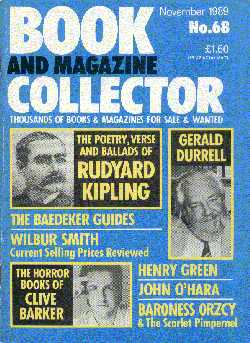
The Horror Books Of Clive Barker
By David Whitehead and Jonathan Cook, Book and Magazine Collector, No 68, November 1989
"Although I'd always made it a point to write a minimum of two thousand words a day, I'd had no fiction published anywhere when The Books of Blood came out in 1984, so it was quite a coup. I didn't plan it that way, but maybe my editors knew that it would be."
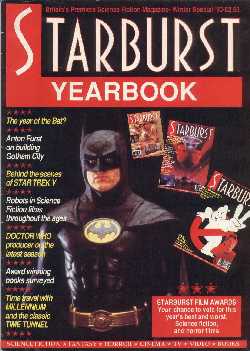
Barker And McQuarrie
By [ ], Starburst Yearbook, Winter Special 1989/90
"What I think Ralph brought to the team is a scale to his imaginings - which are coming through the matte paintings, the murals, through some of the creatures which he helped me develop - which are really making the movie even more epic than it was... What Ralph has been able to lend the project is a sense of mythology... When we first started work on the Necropolis, we had quite a modest idea of what this would be. Then Ralph came in and said, 'Hey, let's make this a city!'... and that's what it is. I think it was quite good that Ralph came on board quite late, because then you were able to see the project and say, 'Hey, you know, there's an opportunity in this - we can have a really great matte...' "
On The Beauty Of The Beast
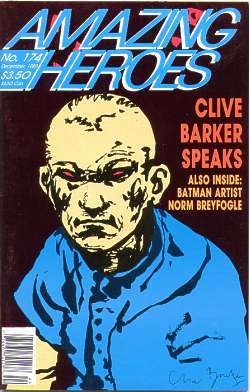
By Mike Maddox, Amazing Heroes, No 174, December 1989 (note : full text online at Lost Souls)
"I'm an inclusionist. I've always divided up (very, very broadly, I
admit) the artistic instincts into the inclusionist and the
exclusionist. The exclusionist is Raccine. The inclusionist is
 Shakespeare. I've always felt like I'd prefer to throw 45 things into
the pot and hope that maybe 36 of them will taste good. You may choke
on 9 of them. I'd rather do that than only have half that number of
elements and each one perfect. That's because I know that people
choke on different things.... I think that when I was a kid, the
experience of things, the experience of just finding words for things,
of finding somebody else's world and being able to leap into it and,
like any world, you pick up the geography instantly. You expected the
thing to unfold, you expected there to be valleys that upon entering
that world you were barely aware of. For me a novel, particularly a
large novel, one you put down at the end and think, 'Hell, that was
interesting. I'm not sure I understood Chapters X, Y and Z, but maybe
next time I
read it or talk to someone about it, I will'... that's a very different
experience to the immaculately formed, beautifully honed, finished
'art' thing."
Shakespeare. I've always felt like I'd prefer to throw 45 things into
the pot and hope that maybe 36 of them will taste good. You may choke
on 9 of them. I'd rather do that than only have half that number of
elements and each one perfect. That's because I know that people
choke on different things.... I think that when I was a kid, the
experience of things, the experience of just finding words for things,
of finding somebody else's world and being able to leap into it and,
like any world, you pick up the geography instantly. You expected the
thing to unfold, you expected there to be valleys that upon entering
that world you were barely aware of. For me a novel, particularly a
large novel, one you put down at the end and think, 'Hell, that was
interesting. I'm not sure I understood Chapters X, Y and Z, but maybe
next time I
read it or talk to someone about it, I will'... that's a very different
experience to the immaculately formed, beautifully honed, finished
'art' thing."
Straight For The Jugular (Part 1)
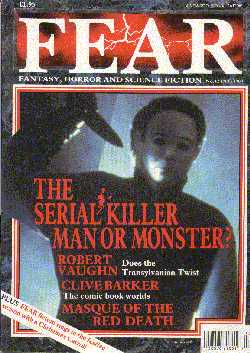
By Brigid Cherry, Fear, No 12, December 1989
"Dan Chichester indicated to me that he'd like to take the underlying mythology and hand it to his writers and artists. He's taken it in a new direction. I'd like to think it'll be similar to what happened to Harry Cornelius for a while in the Sixties and Seventies when Michael Moorcock opened up the mythology to a whole bunch of other people. The Hellraiser comic series even includes a cowboy story and a medieval story using the Hellraiser mythology. The fact that it works shows that these ideas are universal enough to adapt to that, which is exciting."
Clive Barker: Sex, Death and Censorship
By W.C. Stroby, Asbury Park Press, 20 December 1989
"Books like mine - phantastique books of various kinds - are maps, ways to find your way around that adventure, the adventure which takes a third of your life up, and probably a lot more, because even in our conscious lives we're living in fantasies of ambition, we're living in fantasies of desire, we're living in fantasies of what might happen to us if we turn this corner as opposed to that corner.
"Our lives are forever segueing into the fantastical, into the daydream, into the dreamed ambition, the dreamed encounter. And I think if you would actually add up the amount of time that we spent of our lives living a kind of fiction - whether it be through a movie or through a day-dream or through a night-dream, sexual fantasy, whatever else it is - it'd be a lot of time. And I think that fantasy fiction is describing that universal adventure...
"My imagination is always putting a half-twist on things, because my reality is constantly breaking apart in front of me. We are every day of our lives, it seems to me, presented with information somewhere or another which leads us into wild places. Things happen, you meet people, somebody makes a chance remark, somebody tells you a ghost story, somebody does something which suggests that realism - realistic fiction - would actually be a lie. And as a fiction writer, the last thing you want to be is a liar, which seems like a paradox and that's why it's interesting.
"What I suppose I'm saying is, 'Accept one thing, accept one weirdness, and the rest of it will follow realistically.' "


