Clive on the plays
"My interest in theatre was fuelled by annual pantomime visits but then
nearly quenched when I discovered most contemporary theatre to be seen
 in my native city did not much believe in transformations and miracles
. But Faustus, ah Faustus! Poetry, perversity, farce and damnation!
What more could I ask for? I adored its rapid changes of tone, its
sheer theatricality."
in my native city did not much believe in transformations and miracles
. But Faustus, ah Faustus! Poetry, perversity, farce and damnation!
What more could I ask for? I adored its rapid changes of tone, its
sheer theatricality."
Speaking From The Dark/Keeping Company With The Cannibal Witches
Essay by Clive Barker, (i) Daily Telegraph, 6 January 1990 (ii) Deadline, No 23, October 1990 (iii) Pandemonium, 1991
"Plays were interesting because they were a stepping stone from the writing into this other forum. I'm a weird kind of combination; introvert/extrovert. I really do like to be on my own. I really do like to be buried in myself. But another part of me likes to be out there having fun with life. Writing for the theatre, then directing the pieces gave me an opportunity for both."
So Many Monsters, So Little Time...
By Michael Brown, Pandemonium, 1991
"One of the things that I enjoy about writing the novels is that I am
not involved in the debate about every word that I put down on the page
. When you are writing for actors and you're writing for a company that
already existed, there are a lot of things that you have to factor in
 - what people's strengths are, their weaknesses, what people prolifics
are. Some of that is very good because it challenges you to find
creative ways through narratives. Some of it is not so good because it
is destructive to the freedom of the flow of your imagination."
- what people's strengths are, their weaknesses, what people prolifics
are. Some of that is very good because it challenges you to find
creative ways through narratives. Some of it is not so good because it
is destructive to the freedom of the flow of your imagination."
Hell's Events
By [ ], Lost Souls, Issue 2, [September] 1995
"We had the usual dry-as-dust productions of 'Macbeth' or whatever, and I thought it was pretty boring. So I decided to write plays about magicians and dragons and mad Nazis - I've been consistent, you see - and they were pretty popular."
Give me B-Movies or Give Me Death !
By Douglas E. Winter, Faces of Fear, 1985
"An incredible amount of what makes me feel I can do whatever the fuck I want has to do with the Dog Company, with our collective history, and you [Phil Rimmer] just said it. Of course I can do 'Hellraiser'. Of course I can get books published. Of course I can do other movies, musicals, kid's books, whatever - because... we did it once. We made things happen. And that is so much the source of my confidence in doing things now. That continuity is as important as the continuity of imagery, of concerns. The real consistency is that we never made a distinction between what was fantastical and what was realistic. It never even occurred to us that there should be some rigid belief system here. Gaining access to The Imaginative Experience was all."
A Dog's Tale
By Peter Atkins, Clive Barker's Shadows in Eden
"The experience [reviewing and publishing plays] has not only been
pleasurable but positively enlightening. It's aroused memories not
only of the first productions of the plays but of my earliest
encounter with the theatre, which was that most English of
entertainments: the pantomime...Panto offered a glimpse of magic and
spectacle that would fuel my dreams for weeks before and after my visit
. And in truth there is much in the form I admire. Its artlessness, for
one; its riotous indifference to any rules of drama but its own; its
guileless desire to delight. And of course beneath all its tartish ways
there is buried a story of primal simplicity: good against evil, love
triumphing over hate and envy.
This was one of the two formative theatrical experiences of my
childhood. The other - and in some senses more influential experience -
 was that of puppet theatre. Like so many imaginative kids whose lives
would take them into the theatre, my first taste of working behind the
footlights was as a puppeteer. I made a cast of hand, rod and
marionette puppets, and then proceeded to write elaborate vehicles for
them...
was that of puppet theatre. Like so many imaginative kids whose lives
would take them into the theatre, my first taste of working behind the
footlights was as a puppeteer. I made a cast of hand, rod and
marionette puppets, and then proceeded to write elaborate vehicles for
them...
There was a good deal of cruelty in the stories I created. This isn't
so surprising, given that my earliest exposure to the world of puppets
was Punch and Judy shows: short, brutal tales of how the devious and
unrepentant Mister Punch kills his own child, beats his wife to death
and then inexorably murders the rest of the cast with his truncheon. My
puppet tales also contained a measure of supernatural stuff, the
appetite for which I trace to my maternal grandmother, who had a
healthy nineteenth century appetite for the macabre."
The Painter, The Creature and The Father of Lies: an Introduction
Introduction to Incarnations, by Clive Barker, Los Angeles, 1995
"I'm interested, certainly, in getting to do some more theatre work. It 's really a question of factoring it into a schedule that's already crazy. It's been great to see people respond to the plays the way that they have. You know these plays are fifteen years, so it's doubly nice to feel that the work I did then still has some purpose. People are laughing at the jokes and being scared in the right places, that's great. "
Confessions
By [ ], Lost Souls, Issue 6, January 1997 (online at clivebarker.com)
"The Commedia dell'Arte..has always been an interest of mine. I'm very interested in Fools: Fools obsess me and always have, clowns too. And Pulcinella or Punch has always fascinated me because he's so cruel and so funny at the same time."
Transcript of talk at UCLA 25 February 1987
Clive Barker's Shadows in Eden
"We want to combine well-told and often outrageous stories that involve not only the actors' but the audience's imagination, as well as the visual effects and wit - theatre that entertains and asks questions. We 're completely independent and receive no funding except what we earn through fees and the box office - a situation we're eager to change. But in spite of economic problems, we're growing fast."
Linda Talbot at the York and Albany
By Linda Talbot, The Hampstead and Highgate Express, 10 July 1981
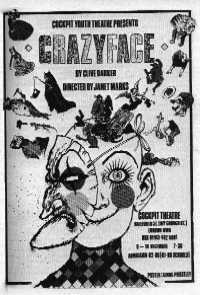
Crazyface
CRAZYFACE: I came to Rome for forgiveness.
ANNIE: You're forgiven.
CRAZYFACE: But you're a cheat. You shouldn't be the Pope.
ANNIE: I'm the best man for the job; really I am.
CRAZYFACE: They'll find you out.
ANNIE: Probably. But in the meanwhile -
CRAZYFACE: Does...does God talk to you?
ANNIE: All the time.
CRAZYFACE: Really?
ANNIE: In my bath; while I'm dressing; at the circus. All the time.
CRAZYFACE: What does He say?
ANNIE: Mostly bad jokes. She laughs a lot. And She -
CRAZYFACE: She? God's a woman too?
ANNIE: She is when She speaks to me.
"[Alasdair Cameron] invited me to write a trio of plays as summer workshop projects at the Cockpit. Crazyface was the first of these, and after the constraints of writing for a small touring ensemble like the Dog Company, which regularly performed in tiny spaces above pubs, it felt wonderful to be unleashed; to be able to create stories that called for a large cast, and to write scenes that employed an ambitious range of lighting and scenic effects. Excited by the sheer scale of what I now had at my disposal - comparatively speaking - I wrote Crazyface as a kind of fool's epic...The result is a play that is part pageant, part circus and part meditation on the glory of clowns. I loved writing it, spiking its high spirits with sudden eruptions of violence and scenes of strange melancholy."
Laughter, Love and Chocolate: An Introduction
by Clive Barker, Los Angeles, 1996
"If Crazyface's journey teaches anything, it is that the rich and the mighty are not any more secure than those they lord over. The laughter and the high spirits of the piece should never quite drown out the sound of the four fatal horsemen, coming to claim both the Kings and the Fools of the world."
Production Notes
by Clive Barker, Los Angeles, 1996
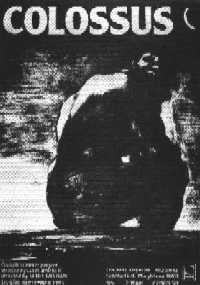
Colossus
GOYA: I think perhaps the dead see more than we do. I envy that.
BARBARA: Envy?
GOYA: If they can see more, yes. Other men have to fill their mouths
all day, I have to cram my eyes. Looking's a vice with me. I have to
devour everything I so much as glance at, what the angels and the
fallen angels made, it's the same to me. And when I've got the sights
in here I want to make them all over again, in paint, and sign them,
yes sign the world and say: 'Goya saw this!'
"In writing the play, my central challenge was how to create a portrait of Goya and his world without falling prey to the cliches of biographical fiction: scenes of famous folks meeting more famous folks at historically significant events. The solution, I decided, was to create a drama in which Goya was effectively invisible much of the time , a situation which would allow me to explore the idea of the painter as a witness to events he could do little or nothing to influence."
The Painter, The Creature and The Father of Lies: an Introduction
Introduction to Incarnations, by Clive Barker, Los Angeles, 1995
"Like a man in extremis, the play constantly glimpses hints of Heaven and Hell. A sub-structure of dream images lurks beneath the surface of the piece, haunting it as surely as any ghost or demon. We live, the play suggests, in more than one world. It's only when events shatter our simple constructs - when the order we have imposed on reality falters - that we sense this multiplicity. The revelation may drive us crazy, or help us better understand ourselves. The choice is ours."
Production Notes
by Clive Barker, Los Angeles, 1995
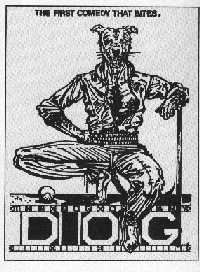
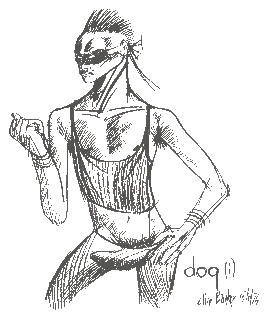
Dog
DOG: I'm not unhappy, Eloise.My life is a constant pleasure to
me. Smell the soup.
ELOISE: What soup?
DOG: The air, Eloise.
ELOISE: I can't smell anything. Oh yes I can. That sour stink,
what is it?
DOG: The sour blue smell with the green pieces floating in
it? That's Costello; and he's in your clothes -
ELOISE: It is! That's Costello's smell.
DOG: And your breath; can you smell that?
ELOISE: No.
DOG: Or my paws?
ELOISE: No.
DOG: Or that smoke in the air?
ELOISE: Not a whiff.
DOG: You see, to you the air is emptiness. To me it's a
gravy, a thick, ripe soup made of the meat off the backs of stevedores,
out of the heads and hams of sweet women, unknowingly nosed as they
go about their business. Without moving a single step I can pluck
buds, sniff children, drink girls, chew tissues, gulp the flukes under
the tails of bitches...
"I escaped to London, and to a self-created world, where I painted and wrote a number of experimental pieces for the theatre. They were mime pieces to begin with (three years of English and Philosophy had silenced me), and then, once my faith in language had returned, plays. The first substantial piece was called Dog, from which our company took its name: a highly stylised tale of sex, transformation and apocalypse which drew on the Commedia dell 'Arte, pantomime, personal psychosis, the Bible and werewolf movies. It was not a success. But its fantastical nature, its philosophical pretensions and its use of effects, violence and low comedy began to define my approach to theatre work."
The Painter, The Creature and The Father of Lies: an Introduction
Introduction to Incarnations, by Clive Barker, Los Angeles, 1995
"[Dog is] a play of Joycean complexity, and length which may in the fullness of time find its way onto the printed page."
Laughter, Love and Chocolate: An Introduction
by Clive Barker, Los Angeles, 1996
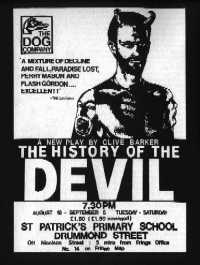
The History of the Devil
(Scenes From a Pretended Life)
ACTOR: In law, there are no certainties. Suppose we tried our loved ones? Made a list of offences against us. How long before we'd amassed enough resentment to hang them by? Now, we put the Enemy on trial. How long before we find enough reasons to love the Prince of the World?
"We had a production of History of the Devil which was banned in England by one of it's venues. This brought it great notoriety and sold the show out wherever it played."
Confessions
By [ ], Lost Souls, Issue 10, June 1998 (online at clivebarker.com)
"The metaphysics of the piece is not particularly original, but the characters are lively, I think, and what the play lacks in profundity it makes up for in audacity. One of the critics, reviewing the first production, described it as: 'a mixture of Decline and Fall, Paradise Lost, Perry Mason and Flash Gordon.' Lord, I loved that description! Why? Because it evokes a stew of high art and low, of intellect and spectacle, pretension and fun."
The Painter, The Creature and The Father of Lies: an Introduction
Introduction to Incarnations, by Clive Barker, Los Angeles, 1995
"It's hardly a Shavian text, because Shaw clearly intended his plays
for publication. He takes complete control of the thing, padding it
with introductory essays, copious notes and stage and character
directions, like he wants to be a kind of paper director as well as
the writer. My stuff was never like that. I didn't intend them for
publication - they were written strictly to be performed. The reader
of 'Devil' should bear two things in mind - it was written to be
performed by a group of people I knew very well, and it was written
for me to direct. This means I could write in a kind of shorthand way,
a gestural way, knowing that between us we were going to get it right.
"Readiness [to accept breaks in reality] is something I expect from my
audience. History of the Devil - indeed, all my plays - are full of
radical changes of tone, pace and style, along with an almost cinematic
cross-cutting between scenes. My plays are like collages; they're
collections of thoughts, eclectic and full of strange narrative thrusts
...I realised, after the first production, who the ideal Devil would
be. The Devil is the still and near-invisible centre of the drama,
present and yet curiously translucent - the thing on which everybody
projects their own guilts, shames and hungers. So the ideal casting
is the most famous invisible person in the world - Andy Warhol."
A Reader's Guide to History of the Devil
By Peter Atkins, Pandemonium, 1991
"The Devil is an actor: a man of masks, never the same tempter twice. It's appropriate then that a play exploring his life and times should be an actor's piece, using word-pictures in place of elaborate sets, in the stream of which a large number of characters are carried, some of them healthy swimmers, many swept away by the protean evil that is the play's true constant...If this story's worth telling it's because it's about being human. The Devil's tale is the tale of our own confusion, ego and inability to live without hope for Heaven. His wings removed, Satan is dropped into the world wounded, and though he conceals his frailty well enough, putting on a fine show of dispassion, he's never far from throwing back his head and raging like an abused child. If the play persuades its audience to look at what this mirage of external evil is - in short, an excuse; a brushing off - then it has done something of what I intended."
Production Notes
by Clive Barker, Los Angeles, 1995
"'Devil' was written with quite a lot of involvement [from The Dog Company]. It got changed a lot and developed in the rehearsal process. If memory serves, I think the material underwent quite a few changes as a consequence of the actors' suggestions and contributions."
Hell's Events
By [ ], Lost Souls, Issue 2, [September] 1995
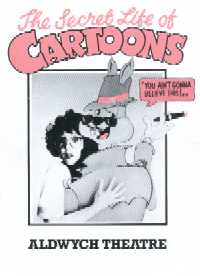
The Secret Life of Cartoons
Enter; surreptitiously, the six-foot Rabbit. He is dressed for a
holiday, a parody of an American tourist. The colours he wears are
shreikingly loud. He wears dark glasses and carries a suitcase covered
with punny stickers. He looks immaculate, as he does in all the
disguises he will adopt in the next hour and a half.
Scarcely a hare out of place.
"It's about an animator who comes home to his New York apartment to find that his magnum opus, Roscoe Rabbit, is in bed with his wife. It moves from that premise to a wild collision between cartoon characters and real life - the undertow being that here is a man whose mental creations have broken out into the real world, and all the rules which pertained to cartoons now pertain to the real world... Horror and comedy are very similar. They both elicit immediate responses, gasps and shivers on the one hand and laughter on the other."
King of the Gory Tellers
By Neil Gaiman, Today, 19 October 1986
"The Secret Life of Cartoons had a great life on the fringe in England and in Europe and in Edinburgh - the festival. And then it had a disastrous life on the West End when it became a legitimate production. In part because I lost control of it. With all these movies and all this stuff, maybe I'm coming across as a control freak but I genuinely do think that sometimes things get lost. Some producers came in, they cast some stars and the thing was lost...The problem when you go into legitimate theatre in the West End is that it costs a lot of money to mount the thing and they have to clean up your act because they are cleaning it up for a tourist audience. Suddenly, you find that you're losing control of the stuff you really loved. And a lot of the nice stuff goes and it gets coarsened in a curious kind of way because it gets simplified. Suddenly it's Vaudeville, and it lost it. The reviews were disastrous. They deserved to be because it was a bad production. Maybe, one time down the line I'll let Roscoe out again but I'm not holding my breath while I wait."
An Interview with Clive Barker
Transcript of an interview on KPFA, San Francisco by Richard Lupoff, Richard Wolinsky and Lawrence Davidson, (i) Science Fiction Eye, No 4, August 1988, (ii) Masters of the Macabre II (as "A Talk with the King")
"We made certain that the characters in no way related to the Warner
Brothers or the MGM or the Disney projects. The characters in the play
are general portraits. All the studios created rabbits and mice...but
we've tried to create characters that are the embodiment of the spirit
of those cartoons rather than specific references to specific
characters. It's about a whole tradition of American animation, that
anarchic, life-affirming, outrageous tradition of the wise-cracking
animal characters. There's only a limited number of animals you can
choose, though, and it was mainly ones you could see about the house,
with behaviour you could relate to. The joke is that one knows them,
they're familiar to us.
 "There's a tie in with two other traditions of American humour:
vaudeville, with the whole cross-talk element such as Bugs Bunny, and
the movie tradition. The Marx brothers influenced Warner Brothers
cartoons hugely. Bugs is derived from Groucho, and he never gets hurt.
He just bounces back and the best of the cartoons are celebrations of
a life-force, they're full of energy and full of positive feelings and
appetites for food, sex, a warm burrow... They're outrageous, always
flinging themselves into drag, doing a song and dance, they fall out of
windows, get blown up and keep bouncing back."
"There's a tie in with two other traditions of American humour:
vaudeville, with the whole cross-talk element such as Bugs Bunny, and
the movie tradition. The Marx brothers influenced Warner Brothers
cartoons hugely. Bugs is derived from Groucho, and he never gets hurt.
He just bounces back and the best of the cartoons are celebrations of
a life-force, they're full of energy and full of positive feelings and
appetites for food, sex, a warm burrow... They're outrageous, always
flinging themselves into drag, doing a song and dance, they fall out of
windows, get blown up and keep bouncing back."
Tap-Dancing Ducks and Hammer Murders
By Michael Darvell, What's On, 30 October 1986
"Might very seldom does it. It's usually wit that does it and imagination. So you get these characters using their abilities to change reality in some way, to snatch an identity from nowhere to overcome the bullies. The best cartoons are about making the world work without kicking the shit out of it. And I like that; it's very life- affirming."
Hell Hound
By Anne Billson, Time Out, 15-22 October 1986
"At the very time that The Secret Life of Cartoons opened in London's
West End, to almost universal condemnation, I was in the midst of
shooting Hellraiser. A study in contrasts. After two abortive
experiences in the cinema, which had ended up resembling scarcely at
all the projects I had first set on paper, here I was again - this
time in the theatre - seeing work I had enjoyed writing, and which had
been successful in another incarnation (as fringe and provincial
shows) appearing in a form I barely recognised...
"So, by day Hellraiser: hammer-murders, lovers raised from the dead,
sado-masochists from another dimension. By night, Cartoons: tap-dancing
ducks, a transvestite pacifist rabbit, Technicolor anarchy. And
travelling between them the conviction growing that I should never,
repeat never, let work I loved, or even liked, out of my control.
It's an oath easier in the making than in the keeping."
Footnote to Cartoons
By Clive Barker, Clive Barker's Shadows in Eden
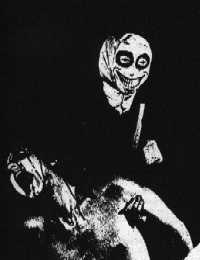
The Day of the Dog
(L'Abattoir d'Amour)
The Day of the Dog takes place outside an abattoir.
The Morning:
It is dawn, and the working day begins; the cleaning of the tiles, the
sharpening of the knives; the preparations for the slaughter. To the
Abattoir wall comes Dog, in search of meat. He is punished for
attempted theft and instigates his revenge. The lovers meet in the
rising heat of the day, part and go their ways. Dog dresses in offal
and seduces the Butcher. All retire for a light lunch.
The Afternoon:
It is getting hotter. The Butcher sleeps and dreams of the evening.
Dog produces the second part of the revenge and goes on to wound the
Lover. As the heat becomes unbearable, the Hunchback seems to see Dog
transformed and the Butcher goes mad.
The Evening:
The heat has soured and thunder threatens as Dog dines. There is no
rain. The whore falls in love with Dog and remembers herself too late.
The Butcher wakes, the unveiling takes place and there is slaughter
outside the Abattoir. Dog plays his third trick; the Lovers are
reunited, the Hunchback exits.
Night and rain.

Frankenstein in Love
(or The Life of Death)
CARDINAL: But Frankenstein, oh dear Joseph, he
always loved humanity.
VERONIQUE: Never.
CARDINAL: Oh yes. He had a passion for its intricacies, its strength,
its elasticity. So he wanted to stretch it, shape it, remake it by his
own rules. To make a law for the flesh, a physical morality he called
it. I just saw a blood-letter, a tormentor. And it pleased me,
watching him silence their complaints, sluice out their minds with
agonies. I'd put my finger, sometimes, into their hot heads, buried in
thought up to the knuckle, and see their lives go out a little further
with each prod. That pleased me too. He worked out of love, I out of
loathing.
"Frankenstein In Love is a play of dark, airless places that have long
been sealed from any hope of sanity. This claustrophobia is, of course,
a common device in horror fiction, allowing the readers or spectators
no escape from the source of their anxiety, and the theatre is
arguably the easiest place to evoke it.
"In its obsessive way, the play creates a kind of alternative world,
where everybody is corrupted or corrupt, dead or dying; monstrous in
form, deed or both. A fantasia, if you will, on taboo themes, which
refuses to offer much in the way of comfort to its audience. In that
singularity of intention lies both its limitation and its potential
for theatrical power."
Production Notes
by Clive Barker, Los Angeles, 1995
"'Frankenstein in Love' is a 'Grand Guignol' play. The 'Grand Guignol' tradition fascinates me. The idea that there was this theatre in Paris where you went just to watch people mutilated and dismembered onstage strikes me as fun. I thought I'd try my hand at a piece of shock theatre. "
Meet Clive Barker
By Philip Nutman & Stefan Jaworzyn, Fangoria, No 51, January 1986
"I came very late to genre writing - three, four years ago. But the plays always had an element of the fantastic. The History of the Devil and Frankenstein in Love have very strong horror elements and closely approximate the tone of my short stories. Vicious, farcical and metaphysical by turns and, at their best moments, all three simultaneously."
Clive Barker
By Kim Newman, Interzone, No 14, Winter 1985/86
"Mary Shelley's original ('Frankenstein') is a tale of what happens
when you reach out too far beyond the scope of your humanity and
violate the sacred trust that humans should have with God. I didn't
think contemporary audiences were interested in metaphysics,
regrettably. The thing I thought could be new, that I thought I could
add new to the story, was about a man who begins to divide himself in
the same way as a country divides itself.
"For a country to work as a fluid healthy machine, it must have all its
parts working together. If all the parts don't work in harmony, you
have a sort of mutiny. I like the idea of mutinous body parts, of a
body coming apart at the seams."
Clive Barker And Rude Guerilla Theater Co. - A Mutual Admiration Society
By Eric Marchese, online at www.calactors.com, July 2001
Subtle Bodies
MRS MOCATTA: The Dream Bureau is overworked,
pressed to the limits. We need reliable agents in the field. If we
lose you, we need to find somebody to replace you.
MR FOSS: But I'm incompetent. That dream that Dexter just
created?
MRS MOCATTA: What about it?
MR FOSS: I couldn't have choreographed a Freudian spectacle
like that.
I haven't got the wit left. I'm reduced to stealing ideas from
juveniles.
>MRS MOCATTA: I'm sympathetic. Really I -
MR FOSS: (Furious now) You are not! You don't give a damn
for me. As
long as you have your agents burrowing in the dream life of the nation,
you're quite content. Bugger me! I'm just a cog! Well I won't do it! I
won't!
MRS MOCATTA: (unmoved) You will, Edward. You signed a
contract.
MR FOSS: I've a good mind to spill the beans.
MRS MOCATTA: Now you're being silly.
MR FOSS: Tell the world about this conspiracy.
MRS MOCATTA: It's not a conspiracy, it's a science. What would your
so-called dream-life of the nation be like without our nurturing it,
shaping it? Once upon a time you thought it would be fine sport to
paddle in the collective unconscious.
MR FOSS: Well, I've got my feet wet and it wasn't as advertised. Most
of the minds I peer into are awash with trivia.
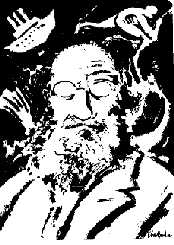
"'Subtle Bodies' is about a hotel in which the ghost of Edward Lear is manipulating a wedding party - giving them dreams and nightmares."
Transcript of talk at UCLA 25 February 1987
Clive Barker's Shadows in Eden
"Subtle Bodies...probably dramatizes the complexities and confusion of
affection (sexual, familial and bestial) most elaborately [of the
Forms of Heaven plays], the entire story is predicated upon a series of
problematical relationships. The way these passions - whether failed, frenzied or simply
 foolish - shape the behaviour of the characters is at the heart of the
play; the fantasy elements are simply entertaining methods of revelation
...[Subtle Bodies] takes some of its formal design from English farce -
the cast of disparate charaters converging on a hotel over one
calamitous day and night; the manic concealing of secrets and the
inevitable humiliations when the plots these people have laid against
one another unravel - but to this familiar mix I added a few wilder
elements of my own. Chief amongst them, the politely anarchic person of
Edward Lear, whose romantic nonsense poem 'The Owl and the Pussycat'
had been a favourite from childhood.
foolish - shape the behaviour of the characters is at the heart of the
play; the fantasy elements are simply entertaining methods of revelation
...[Subtle Bodies] takes some of its formal design from English farce -
the cast of disparate charaters converging on a hotel over one
calamitous day and night; the manic concealing of secrets and the
inevitable humiliations when the plots these people have laid against
one another unravel - but to this familiar mix I added a few wilder
elements of my own. Chief amongst them, the politely anarchic person of
Edward Lear, whose romantic nonsense poem 'The Owl and the Pussycat'
had been a favourite from childhood.
"The notion of a ship setting out on a voyage across a dream-sea may be
familiar to readers of The Great and Secret Show and Everville. In
those novels, this sea is dubbed Quiddity, and in Everville a character
called Joe Flicker takes a leaky vessel called the Fanacapan out
across its wastes, only to have the ship finally founder. Beyond this,
there are few similarities of detail between play and book, but have
no doubt, the first mention of Quiddity is here in Subtle Bodies, and
appropriately enough, that mention comes from the lips of Edward Lear
himself."
Laughter, Love and Chocolate: An Introduction
by Clive Barker, Los Angeles, 1996
"This is a dream play; a comedy of altered stages in which images that have been shaped by the private rages, frustrations and desires of the characters take public, or at least semi-public, form. On occasion, these dream-images seep almost unnoticed into the 'real world' of the play, like the sand that is constantly blowing in under the doors of the Atlantic Hotel, where the story is laid. At other times they supplant that world entirely, the most spectacular example of which occurs in the Third Act, when the hotel becomes a ship and sails off into the night on what is to be its final voyage."
Production Notes
by Clive Barker, Los Angeles, 1996
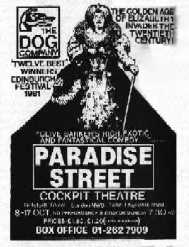
Paradise Street
ELIZABETH: Men make these distinctions, Jude: it's their territorial instincts misplaced. They divide existence as they do land. Life here, death there, and a border between. They guard it with the Church, with science... only poets defy the divide, and even they can be sentimental about it. It's taken us four hundred years to realise that if the Golden World is to be won, and kept, it must be won with ambiguities. There is no certain thing on earth worth knowing. Now, men are not subtle enough to grasp this simple idea. They have a fear of ambiguity. They think it's weakness, they think it's senility, a sign of death. They box it up and bury it; they tell us we should be certain or be slaves.
"Paradise Street was neither a great failure nor a notable success. Amongst the critics in London - and later at the Edinburgh Festival - it had its supporters, if memory serves, but I fear of all the pieces the Dog Company mounted it suffered most from our absence of funds."
Laughter, Love and Chocolate: An Introduction
by Clive Barker, Los Angeles, 1996
"Paradise Street imagines what it would be like if, in the depths of that season [winter], magic were to transform the city, replacing the grey with green blossom, and lending the people trapped in its streets a new perspective and a new purpose...This is a play that deals, despite its metaphysical chat, with things tangible and viable: Bonner's body in a sack, the potency of a grenade, the health of Glorianna's ovaries."
Production Notes
by Clive Barker, Los Angeles, 1996
[re. marginal characters] "These characters, not quite centre-stage, with access to dangerous knowledge [including the tramp in 'Hellraiser '] ...maybe even Mulrooney from 'Paradise Street' - though I consciously split him up into two characters; Gluck and Mooney in 'Weaveworld' are both from Mulrooney - I even give Mooney his poems; the poems he speaks as the Earl of Essex. "
A Dog's Tale
By Peter Atkins,
Clive Barker's Shadows in Eden
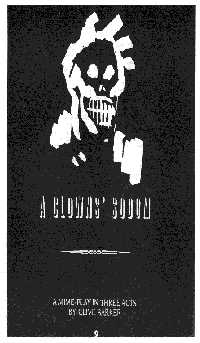
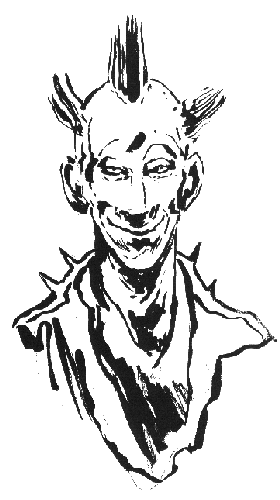
A Clowns' Sodom
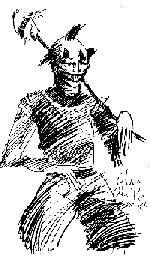
A bull-fight develops, and Herlequin's swiftness seems to make him the
certain victor. He dances around the Patriarch easily, and though he
has one or two narrow escapes when the Patriarch has him against the
wall, he is able to wound the great Bull easily.
Thus, after a few minutes, the Patriarch becomes an even more pathetic
figure, shambling and half blind with pain, but still very terrible.
Then, after a particularly agile manoeuvre, Herlequin turns to bow to
Pierrot, and the Bull takes his opportunity. He charges and Herlequin
turns, just in time to receive the horns in his stomach. The Bull
shakes himself free and Herlequin staggers back, scarcely believing
that he has been hit.
His fingers dig into his stomach, creating the horrible illusion of a
gaping wound.
The great Bull reels back, his face suddenly expressionless again.
Herlequin too reels back, and falls to the floor, where he lies
still.
The Bull wanders round and round in ever decreasing circles, no longer
fearsome.
The spectators are absolutely still for a moment. Then Pierrot steps
down from behind the wall and enters through the door. Columbine tries
to stop him, but he ignores her.
He approaches the Bull slowly, taking from the wall a large knife. He
stops the Bull. It gazes ahead, unblinking. He takes it by the back of
the neck and slits its throat. It jerks. It falls to its knees. It
collapses and dies twitching on the floor.
Pierrot looks at the blood on his hands and is no longer afraid of it.
He wipes it off on his trousers. He embraces Columbine, weeping. She
calms him. They kiss and exit.
The surgeon examines Herlequin and shakes his head. He is dead. The
surgeon exits.
Pulcinella enters, with his lobster. He looks at the bodies and shakes
his head. He picks up the baby and begins to rock it gently. He sits
on the corpse of the Patriarch, and rocks the child.
Herlequin opens his eyes.
Pulcinella looks at the corpse. Did it move?
Herlequin opens his eyes again. He gets up, slowly.
Pulcinella is terrified. Herlequin reassures him. Pulcinella pulls at
the offal that seemed to have burst from Herlequin's stomach. It comes
away, and Herlequin is intact. Another trick. Pulcinella laughs, while
Herlequin claims the baby.
Pulcinella takes off the butcher's apron and spreads it over the
Patriarch's corpse. He takes his lobster, puts on his jacket, picks
up his bucket and exits.
Herlequin kisses his child, and exits to the joyous barking of dogs.
The End
...other comments
Doug Bradley : "[Clive] was a pretty flamboyant character. I had gone to see a play 'what he had wrote' and directed and starred in. He had hand-drawn posters that tantalisingly appeared on the walls of the corridors and down the school. This was called 'Voodoo' or 'Inferno'. He did both of them, and I only saw one of them. I can't remember which one it was. So, I went off to see this and was further intrigued by it all. I got to know him really well and became a friend of his by working on two school plays."
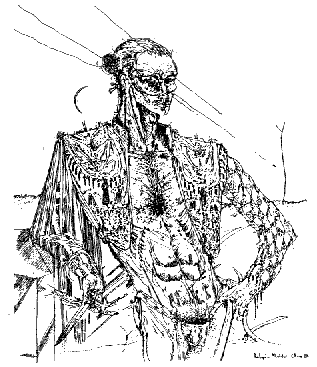
Flaying the Cenobites
By Nick Vince, Pandemonium, 1991
Peter Atkins : "I miss the drive and confidence and ambition that
you can only have at that age. It was a blind faith and complete
commitment to what we were all doing. I miss the sense of a very
fruitful artistic collaboration with a peer group that you loved,
admired, and respected. It's not just the artistic side, it's also the
fun of just doing it. It was like when I formed a rock band after I
left the company. It was the same thing, just a 'six of us against the
world' feeling. We had no money whatsoever. We would stage these
ambitious plays on non-existent budgets. We would all sit up late at
night making the costumes and the props, printing the tickets. It was
hell, but it was great as well. What I miss is the togetherness in the
face of adversity kind of thing.
"Clive was absolutely artistic director without a doubt but it was
very much workshop theatre. Clive would produce a text and then we
would collectively mutate it for the next six months as we rehearsed,
and rehearsed, and rehearsed. Although I don't think that any of us
actually put pen to paper, it was an avant guard and experimental
theatre in which we all contributed and worked and changed things."
From The Dog Days To Bloodlines
By [Stephen Dressler and Cheryl Bentzen], Lost Souls, Issue 3, 1996
Doug Bradley : "Coming to work with Clive on the first film...I suddenly realised we [had] developed this unconscious shorthand. I would know what Clive was driving at before he had spoken to me. As soon as he said certain key things to me I knew exactly what he was driving at. There were similarities between the sense of humour and the language that the Devil has and Pinhead has and I picked that up straight away as soon as I read the screenplay."
Dread Goes to Hell with Doug Bradley
By [Michael Brown], Dread, Issue 4, 1992
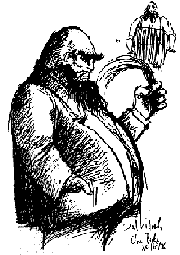
Peter Atkins : "Doug played Jokanaan [in Salome] with a papiermache head... Dougie was already hiding his face from the public - he has a history actually of that sort of stuff, because in our circle one of his most famous interpretations, in a play we did called Dog, was Louis Erasmus Sugarman, who was fatter than Orson Welles, a huge, monstrous patriarchal figure. Dougie, as you know, is very slim, and every night he would put this massive body suit on - it was made I think by Lynne and Julie - and he came out as this hideous Orson Welles-to-the-power-of-'n' thing."
Hellwriter
By John Martin, Samhain, Number 10, August/September 1988
Doug Bradley: "Clive is wonderful at giving you elliptical acting notes. Once when we were working in the theatre [on a musical - Hunters in the Snow] he said, 'Doug, I want this line delivered like the north wind is blowing through your eyes.' Yes, Clive, I can remember the last time that happened to me."
The Pride of Pinhead
By Philip Nutman, Fangoria, No 82, May 1989
Anne Billson : "'Cartoons', although not quite horrific, nevertheless exploits the sense that the world isn't quite the way you thought it was...The principles of breaking concrete reality apart pertain as much to Barker's plays as to his horror writing. That is to say: "Here's the status quo. Let's see what we can do if we put a few cracks in it."
Hell Hound
By Anne Billson, Time Out, 15-22 October 1986
Donald J. McLeod : "A presentation of the words and visions of William Blake is an adventurous undertaking, and one fraught with the danger of excess... Clive Barker's presentation leads through Blake's strong death vision and finally to his death. It is an accomplished dramatic performance, which manages to convey something of the visionary powers of a man rightly called a genius."
Festival Fringe Review: Dangerous World
By Donald J. McLeod, The Scotsman, 31st August 1981
Oliver Parker : "I was 19 when I joined The Dog Company. I guess
you could say it cost me my education. I had just begun attending
Cambridge and was working in the theatre at night. It got to be too
much... That was what was so exciting about those times. We all had
this youthful enthusiasm and earnestness. That and of course Clive's
writing had a lot to do with the success of these plays.
"We played [Frankenstein In Love] for three
weeks at The Cockpit in London. Next we played the Edinburgh Festival,
where we had a successful run of The History of the Devil a year
earlier. After that we performed in Belgium and Holland. I think that
we played it in Edinburgh with Dangerous World.
"El Coco's not the lumbering, grunting Frankenstein monster that the
audience is expecting. He's witty, sophisticated, and romantic. He's a
bit of an Everyman really... That gave me permission to break free of
any restraints my image of the monster may have had on me."
An Interview With El Coco
By Russell Blackwood, Thrill Peddlers, [date].
Clive's further thoughts and work in the Memory, Prophecy and Fantasy series


